
How to Build a Forex Trade Idea: Step-by-Step Guide
Rebate Savings Calculator
Estimate cashback using verified USD/lot or percentage-of-spread rates, and compare trading costs.
Illustrative estimate only. Percentage-of-spread rebates apply to the spread component, not commission. Assumes every entered lot is eligible. Excludes swaps, slippage, conversion costs and other charges unless included in the verified cost figure. Negative net costs are possible mathematically and do not represent guaranteed profit. Actual rebate is subject to broker attribution, eligibility and reconciliation.
Open Rebate Wallet →How to Build a Structured Forex Trade Idea
There is an important difference between believing that gold will rise and building a structured XAUUSD trade idea. The first is a market prediction. The second is a decision-making framework that defines entry conditions, acceptable risk, potential reward and the circumstances under which the original analysis becomes invalid.
Professional trading is not simply about predicting market direction. It is about managing uncertainty through a repeatable process.
In this guide, we explain how to build a structured forex trade idea, examine practical examples and explore how the FXVNPro Trade Idea Builder can help traders transform market analysis into a documented trading setup.
What Is a Structured Forex Trade Idea?
A structured forex trade idea is a documented trading scenario that describes why a potential opportunity exists, how a trader intends to participate and how the associated risk will be managed.
Unlike a simple BUY or SELL signal, a structured trade idea contains enough information to evaluate the proposed decision before any capital is committed.
| Component | Purpose |
|---|---|
| Trading instrument | Identifies the market being analyzed. |
| Trade direction | Defines whether the scenario is bullish or bearish. |
| Entry price or zone | Specifies where the trading opportunity may become actionable. |
| Stop loss | Defines the planned exit if the scenario becomes invalid. |
| Take profit | Identifies the intended reward or exit target. |
| Position size | Determines the financial exposure associated with the trade. |
| Risk/reward ratio | Compares potential reward with planned risk. |
| Market reasoning | Documents the evidence supporting the trading scenario. |
| Invalidation conditions | Identifies when the original trading idea should be abandoned or reassessed. |
These components work together. An attractive entry price is not particularly useful if the stop loss is undefined, while an impressive profit target has little meaning if the required risk is excessive.
Trading Signal vs. Structured Trade Idea
Forex traders frequently encounter trading signals on social media, Telegram channels and online communities. While signals may communicate potential opportunities, they do not always provide enough information to evaluate the underlying decision.
Consider the difference between these two hypothetical examples.
| Basic Trading Signal | Structured Trading Idea |
|---|---|
| BUY XAUUSD | Potential XAUUSD BUY following confirmation of support. |
| Entry: 4,000 | Entry: 4,000, subject to a valid entry trigger. |
| Target: 4,020 | Target: 4,020, based on a hypothetical resistance area. |
| No stop loss provided | Stop loss: 3,990. |
| No position sizing information | Position size calculated according to acceptable account risk. |
| No explanation | Market context, entry conditions and invalidation documented. |
The second example is not necessarily more profitable. However, it is easier to evaluate, execute consistently and review after the outcome is known.
That distinction is particularly important for traders who want to develop a repeatable strategy rather than depend on isolated market predictions.
Step 1: Identify the Market and Trading Context
Every trading idea begins with a specific instrument and an understanding of the conditions affecting that market.
A trader analyzing EURUSD may focus on monetary policy expectations, economic data and differences between European and US interest rates. A trader analyzing XAUUSD may also consider real yields, US dollar strength, geopolitical uncertainty and demand for defensive assets.
Technical analysis can complement this broader context by identifying trends, price ranges, support and resistance levels.
Before defining an entry, consider the following questions:
- Is the market trending, consolidating or experiencing unusual volatility?
- Which timeframe is relevant to the intended trading strategy?
- Are major economic announcements approaching?
- Is the opportunity based on a breakout, pullback, reversal or another identifiable setup?
- What evidence would contradict the original market view?
The objective is not to collect as many indicators as possible. It is to identify the market conditions that make the proposed trade meaningful.
Step 2: Define a Clear Entry Condition
A common trading mistake is confusing a favorable market direction with an immediate entry opportunity.
A trader may correctly identify an upward trend but enter at an unfavorable price, leaving insufficient room for normal market fluctuations.
A structured trading idea should specify both the intended entry price and the conditions under which that entry becomes valid.
Common Forex Entry Methods
| Entry Method | Description |
|---|---|
| Breakout entry | Entry following a move beyond an identified price level. |
| Pullback entry | Entry following a retracement within an existing trend. |
| Support or resistance entry | Entry based on a potential reaction around an identified price zone. |
| Confirmation entry | Entry after a predefined price-action or indicator condition is satisfied. |
For example, a trader might identify a hypothetical XAUUSD support zone between 3,995 and 4,000. Instead of immediately buying gold, the trading idea could require a bullish confirmation before the proposed entry at 4,000 becomes actionable.
If the confirmation never occurs, the trader may decide not to execute the setup.
Not every trading idea needs to become an actual trade.
Step 3: Establish the Stop Loss Before Entering
The stop loss is one of the most important components of a structured forex trade idea because it connects market analysis with financial risk.
A stop-loss level should ideally reflect the point at which the reasoning behind the trade becomes invalid, rather than an arbitrary distance selected only to produce an attractive risk/reward ratio.
For a bullish setup based on support, a sustained move below that support area may indicate that the original scenario no longer applies.
For a bearish setup based on resistance, a move above the relevant invalidation level may have a similar implication.
Example: XAUUSD Stop-Loss Distance
| Trade direction | BUY |
|---|---|
| Entry price | 4,000.00 |
| Stop-loss price | 3,990.00 |
| Planned price risk | $10 per ounce |
For a gold CFD with a contract size of 100 troy ounces per standard lot, a $10 price movement represents approximately $1,000 of gross price exposure per standard lot.
At 0.10 lot, the same movement represents approximately $100 of planned gross loss, excluding commissions, financing, slippage and other applicable costs.
Actual contract specifications vary between brokers. Stop-loss orders also do not guarantee execution at the requested price, particularly during market gaps or periods of limited liquidity.
Step 4: Define Realistic Take-Profit Targets
A take-profit target should reflect a plausible market scenario rather than an arbitrary profit expectation.
Traders may use previous swing highs and lows, support and resistance zones, market structure or volatility measurements to identify potential exit levels.
Some strategies use a single target, while others divide the position into multiple exits.
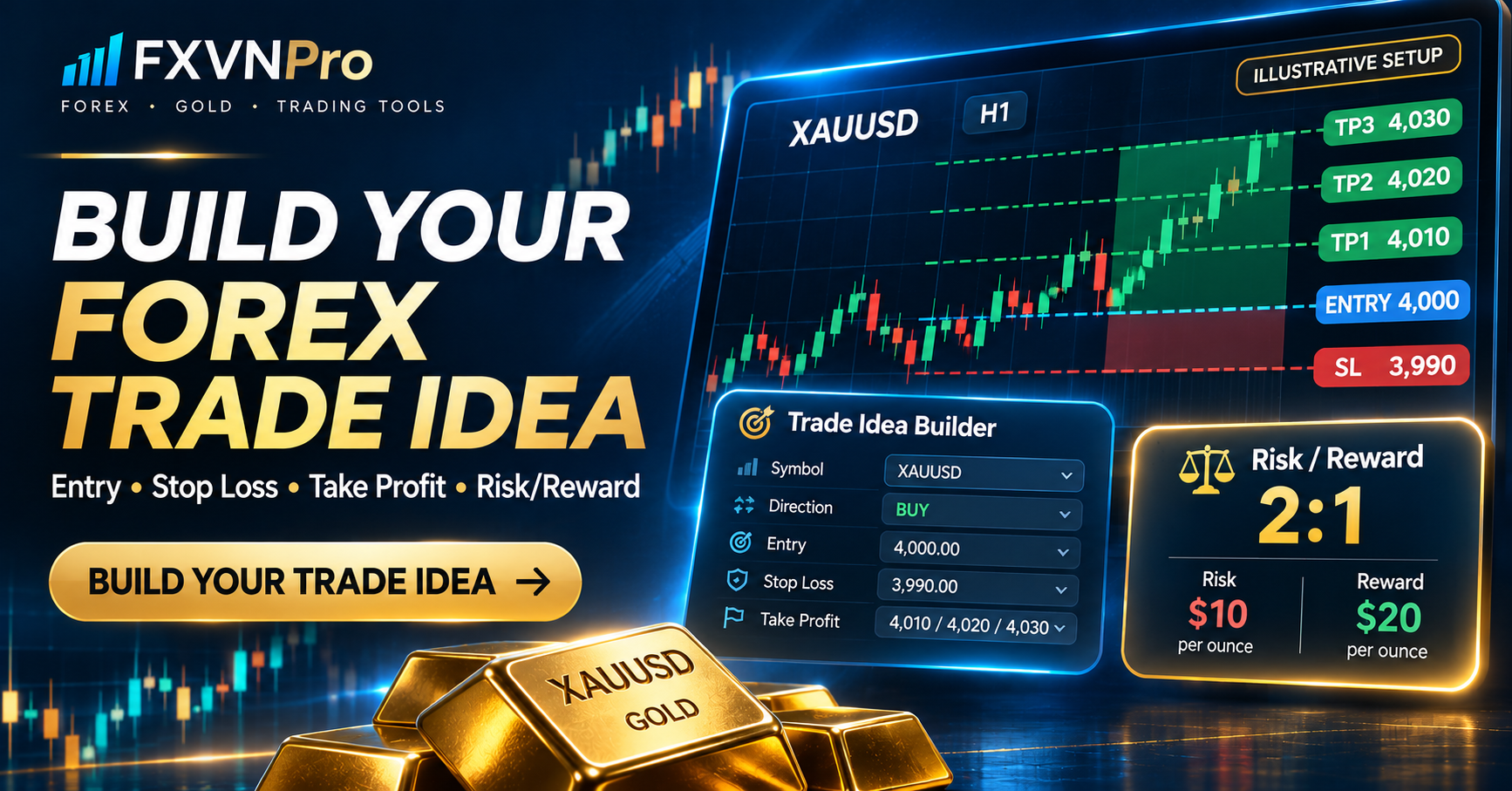
Example of Multiple XAUUSD Targets
| Level | Price | Distance From Entry |
|---|---|---|
| Entry | 4,000 | — |
| Stop Loss | 3,990 | $10 risk |
| Take Profit 1 | 4,010 | $10 potential reward |
| Take Profit 2 | 4,020 | $20 potential reward |
| Take Profit 3 | 4,030 | $30 potential reward |
These prices are hypothetical and are provided solely to demonstrate trade planning.
If multiple targets are used, the trader should also document how much of the position will be closed at each target and whether the stop loss will be adjusted.
Without these details, the final risk and reward of the trading strategy may differ substantially from the initial calculation.
Step 5: Calculate the Risk/Reward Ratio
The reward-to-risk ratio compares the potential profit of a proposed trading setup with its planned loss.
Reward-to-Risk Ratio = Potential Reward ÷ Planned Risk
Using the hypothetical XAUUSD example:
- Entry: 4,000
- Stop loss: 3,990
- Take profit: 4,020
- Planned price risk: $10
- Potential price reward: $20
Reward-to-Risk Ratio = 20 ÷ 10 = 2:1
This means the potential gross reward is twice the planned gross risk if the entire position exits at the specified target or stop-loss level.
However, a higher reward-to-risk ratio does not automatically make a trading idea better. A distant profit target may have a lower probability of being reached.
Reward-to-Risk Ratio and Break-Even Win Rate
| Reward-to-Risk Ratio | Theoretical Break-Even Win Rate |
|---|---|
| 1:1 | 50.00% |
| 1.5:1 | 40.00% |
| 2:1 | 33.33% |
| 3:1 | 25.00% |
| 4:1 | 20.00% |
These theoretical break-even figures assume consistent winning and losing amounts and exclude trading costs.
In live trading, spreads, commissions, slippage, partial exits and inconsistent execution can increase the win rate required to break even.
The purpose of calculating risk and reward is to evaluate the proposed structure of a trade, not to predict its outcome.
Step 6: Calculate Position Size Based on Financial Risk
Two traders can use the same entry, stop loss and take-profit levels while experiencing completely different financial outcomes because of their position sizes.
A structured trading idea should therefore include a position-size calculation based on the amount of capital the trader is prepared to risk.
Hypothetical Gold Position-Sizing Example
| Parameter | Value |
|---|---|
| Account balance | $10,000 |
| Illustrative risk allocation | 1% |
| Planned financial risk | $100 |
| Stop-loss distance | $10 per ounce |
| Assumed contract size | 100 ounces per lot |
| Theoretical position size | 0.10 lot |
The simplified calculation is:
Position Size = $100 ÷ ($10 × 100) = 0.10 lot
This example excludes additional trading costs and assumes a USD-denominated account and the specified gold contract size.
If the trader intends to keep the total planned loss within $100, commissions and other estimated costs should also be considered when determining the position size.
The 1% risk allocation is illustrative, not a universal recommendation. Appropriate exposure depends on the trader’s financial circumstances, strategy, existing positions and ability to absorb losses.
For a more detailed explanation of gold trading expenses, read our guide to XAUUSD trading costs, spreads, commissions and rebates.
Step 7: Document the Trading Thesis and Invalidation Conditions
Numbers alone do not explain why a trading opportunity exists.
A complete trading idea should include a short explanation of the market conditions supporting the setup and the circumstances that would invalidate it.
For example, a hypothetical bullish gold setup might contain the following reasoning:
Gold is being evaluated for a potential bullish continuation following a pullback toward an identified support area. The proposed entry requires evidence of renewed buying interest. A move below the predefined invalidation level would undermine the original setup.
The trader might also document conditions under which the idea should be cancelled before entry:
- Price breaks below the identified support area.
- The entry confirmation does not occur.
- Market volatility increases beyond the strategy’s acceptable range.
- A major economic announcement changes the original market context.
- Price moves too far from the proposed entry, making the original risk/reward calculation unsuitable.
Documenting these conditions before execution can help traders distinguish a planned decision from an emotional reaction to market movements.
Introducing the FXVNPro Trade Idea Builder
Building a complete trading setup manually can involve charts, spreadsheets, calculators, screenshots and separate notes. Sharing that setup with another trader can introduce further inconsistencies if important information is omitted.
The FXVNPro Trade Idea Builder is designed to bring the core elements of a trading idea into a more structured and shareable workflow.
Instead of communicating only a BUY or SELL instruction, traders can organize the proposed entry, stop loss, profit targets and supporting analysis into a defined trading setup.
What Can Traders Do With FXVNPro Trade Idea Builder?
- Build structured BUY and SELL trading scenarios.
- Define entry prices, stop-loss levels and take-profit targets.
- Evaluate the relationship between planned risk and potential reward.
- Organize market analysis around a specific trading setup.
- Generate shareable trading ideas.
- Use supported analysis features to review the structure of a setup.
- Explore existing shared setups and adapt them using the available modification tools.
The objective is not to replace the trader’s analysis. It is to make the reasoning and structure behind that analysis easier to communicate, evaluate and review.
FXVNPRO TRADING TOOLS
Turn Your Market Analysis Into a Structured Trade Idea
Define your entry, stop loss and profit targets. Review your trading setup and create a shareable idea with FXVNPro.
Trading tools support decision-making but do not guarantee profitable results.
How to Build Your First Trade Idea With FXVNPro
The following example demonstrates how a trader might organize a hypothetical gold trading scenario using the FXVNPro workflow.
Example: XAUUSD Bullish Continuation Setup
| Trade Idea Component | Example Input |
|---|---|
| Symbol | XAUUSD |
| Direction | BUY |
| Timeframe | H1 |
| Entry | 4,000.00 |
| Stop Loss | 3,990.00 |
| Take Profit 1 | 4,010.00 |
| Take Profit 2 | 4,020.00 |
| Take Profit 3 | 4,030.00 |
| Reward-to-Risk at TP2 | 2:1 before trading costs |
| Trading thesis | Potential bullish continuation following support confirmation. |
| Invalidation | Breakdown of the predefined support structure. |
All prices and trading conditions in this example are hypothetical. This is not a live trading signal.
After defining the setup, the trader can review the relationship between entry, stop loss and targets before deciding whether the proposed scenario is suitable.
Where available, the Analyze My Idea feature can provide additional feedback on the trading setup. Such feedback should be treated as analytical assistance rather than confirmation that a trade will succeed.
The completed idea can then be shared using the platform’s supported sharing features, allowing other traders to examine the proposed setup instead of receiving an unexplained directional signal.
From Trading Ideas to Verified Trading Records
One of the most valuable aspects of documenting a trading idea is that it creates a reference point before the final outcome becomes known.
Without that reference, it is easy to reinterpret a market prediction after prices have already moved.
FXVNPro extends the trade-planning workflow through its Verified Trades functionality. Supported setups can be associated with execution and result information recorded through the FXVNPro MT5 Bridge.
This creates a connection between what the trader originally planned and what subsequently occurred.
The FXVNPro Trading Workflow
- Analyze: Identify a potential market opportunity.
- Build: Define the proposed trading setup.
- Review: Examine planned risk, targets and invalidation conditions.
- Share: Publish or distribute the structured trading idea.
- Execute: Trade through the relevant broker and supported trading environment, if the setup remains valid.
- Verify: Associate supported trade execution and result records with the original idea.
- Improve: Review the difference between the planned scenario and actual outcome.
Verification does not establish that a trader’s strategy is profitable or that all trading activity has been recorded. Its purpose is to provide additional transparency around supported trade records.
Explore FXVNPro Verified Trades to learn more about the documented trading workflow.
Why Structured Trade Ideas Matter for Signal Providers
For signal providers and trading communities, the quality of communication can be just as important as the original market analysis.
A message containing only an entry and profit target may leave followers uncertain about the intended risk, entry conditions or circumstances under which the signal should be cancelled.
Structured trade ideas can help providers communicate more consistently by presenting the essential elements of each setup in a recognizable format.
They can also support a more transparent review process by allowing followers to compare the original scenario with its eventual outcome.
Within the broader FXVNPro ecosystem, traders can explore additional tools such as Verified Trades and CopyTrade 2.0.
Copy trading introduces separate execution and financial risks. A shared trading idea should not automatically be interpreted as an instruction to copy a position without evaluating individual account exposure.
Seven Common Mistakes When Building Forex Trade Ideas
1. Entering Without a Defined Stop Loss
Without a predefined exit condition, the trader may have difficulty evaluating the potential financial loss before execution.
2. Selecting Targets Based Only on Desired Profit
Profit targets should reflect a plausible market scenario rather than the amount of money the trader hopes to earn.
3. Moving the Stop Loss to Avoid Accepting a Loss
Increasing the stop-loss distance after entry can invalidate the original position-sizing and risk calculations.
4. Ignoring Trading Costs
Spreads, commissions, swaps and slippage can materially affect the results of short-term trading strategies.
5. Using Excessive Position Sizes
A technically reasonable setup can still create unacceptable financial exposure if the position size is too large.
6. Treating Every Market Opinion as a Trade
Some market scenarios are worth monitoring without executing. A trading idea may remain inactive until its entry conditions are satisfied.
7. Reviewing Only Winning Trades
Losses and cancelled setups can provide important information about strategy limitations, execution quality and market conditions.
A Practical Forex Trade Idea Checklist
Before executing or sharing a trading setup, consider whether the following questions have been answered:
- Have I identified the instrument and relevant timeframe?
- Is the market context clearly documented?
- Is the proposed entry based on a defined condition?
- Have I identified where the trading idea becomes invalid?
- Is the stop-loss level clearly specified?
- Are the profit targets consistent with the market scenario?
- Have I calculated the potential financial exposure?
- Have I considered trading costs and upcoming economic events?
- Do I know when to cancel the setup before entry?
- Can I review the original plan after the trade is completed?
A checklist cannot prevent every trading mistake, but it can help identify missing information before a decision is made.
Frequently Asked Questions
What is a forex trade idea?
A forex trade idea is a proposed trading scenario that describes the instrument, direction, entry conditions, stop loss, profit targets and supporting market analysis.
What is a forex trade idea builder?
A forex trade idea builder is a tool that helps traders organize the essential components of a trading setup into a structured format that can be reviewed and shared.
What is a good risk/reward ratio for forex trading?
There is no universally optimal ratio. A suitable relationship between risk and reward depends on the strategy’s probability of success, trading costs, market conditions and actual execution results.
Can I use FXVNPro Trade Idea Builder for XAUUSD?
Yes. Gold trading scenarios can be organized around entry prices, stop-loss levels, profit targets and supporting market analysis using the Trade Idea Builder.
Can I share my trading ideas with other traders?
FXVNPro supports shareable trading setups, allowing traders to communicate their ideas through supported links and sharing features.
Can I modify another trader’s setup?
Where the Modify This Setup feature is available, traders can adapt a shared setup to their own analysis. Changing entry prices, stop losses or targets requires reassessing the original risk and reward.
Does Analyze My Idea guarantee that my trade will be profitable?
No. Analytical feedback can help review a proposed setup, but it cannot predict market outcomes with certainty or eliminate financial risk.
Can a trading idea become a verified trade?
Supported trading setups can be associated with execution and result records through the FXVNPro MT5 Bridge and Verified Trades workflow. Compatibility and connection requirements apply.
Do I need to execute every trading idea I create?
No. A trading idea can be used for planning, research, education or scenario analysis without placing an actual trade.
Final Thoughts: Build the Process Before Taking the Trade
The difference between a market prediction and a structured trading idea is not the ability to forecast prices more accurately. It is the ability to define what will happen if the market behaves differently from expectations.
By documenting entry conditions, stop losses, profit targets, position sizes and invalidation rules, traders create a framework that can be evaluated before execution and reviewed afterward.
The FXVNPro Trade Idea Builder is designed to support that process by helping traders organize, analyze and share structured trading scenarios.
Whether you trade EURUSD, XAUUSD or other supported instruments, a useful starting point is to define the decision before committing capital.
Do not simply share a prediction. Build a trade idea that others can understand, evaluate and review.
Start Building Your Trade Idea With FXVNPro or discover how the platform’s tools work together in our guide to the FXVNPro Trading Ecosystem.
Risk Disclosure: Forex, gold CFDs and other leveraged financial instruments involve substantial risk and may result in significant financial losses. All trading examples in this article are hypothetical and provided for educational purposes only. Trading tools, analytical feedback, shared setups and verified historical results do not guarantee future performance. Traders should independently evaluate market conditions, broker specifications, trading costs and financial exposure before making trading decisions.
Trade With A Regulated Broker