
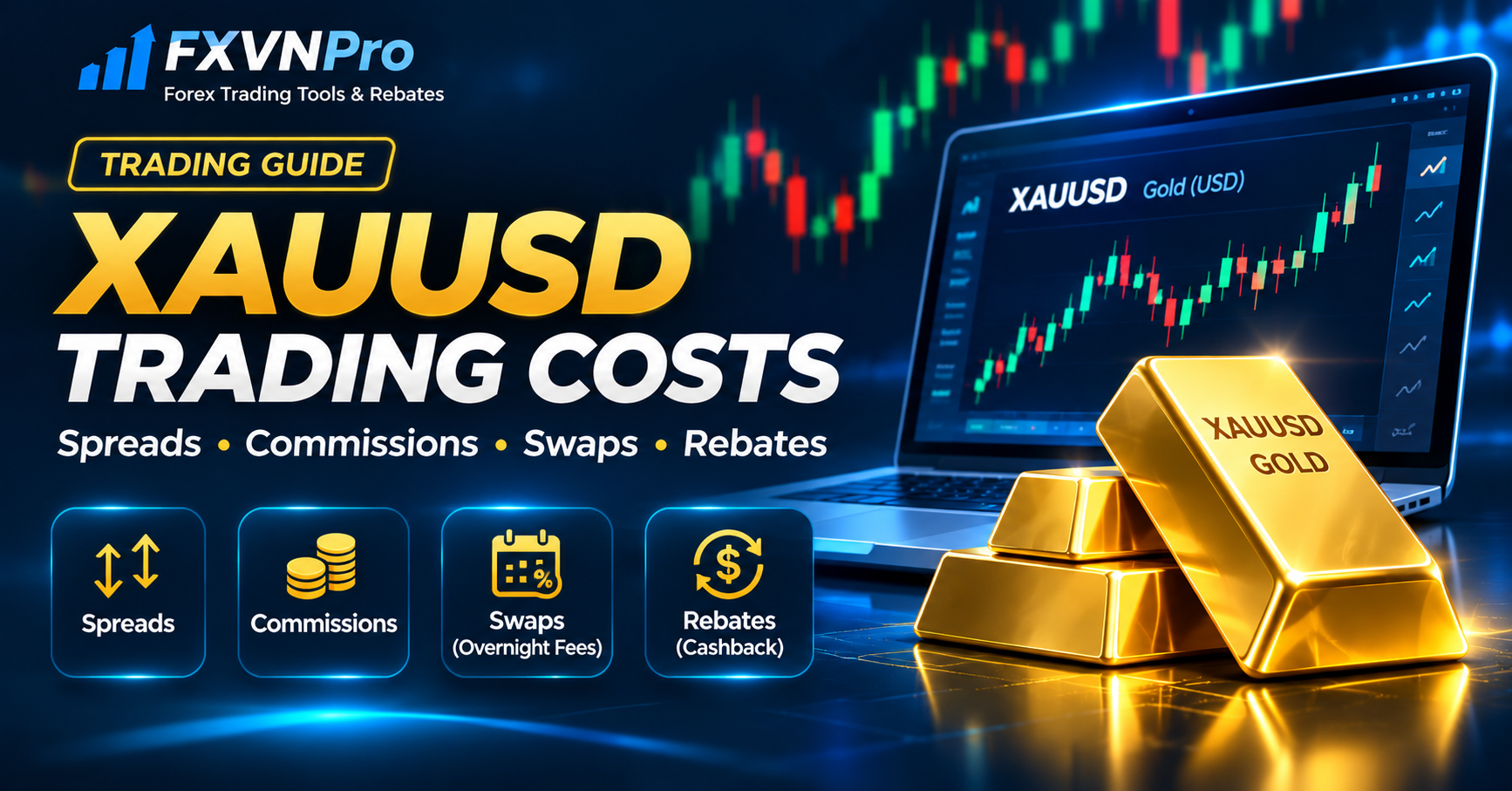
XAUUSD Trading Costs Explained: Spreads, Commissions, Swap Fees and Rebates
Rebate Savings Calculator
Estimate cashback using verified USD/lot or percentage-of-spread rates, and compare trading costs.
Illustrative estimate only. Percentage-of-spread rebates apply to the spread component, not commission. Assumes every entered lot is eligible. Excludes swaps, slippage, conversion costs and other charges unless included in the verified cost figure. Negative net costs are possible mathematically and do not represent guaranteed profit. Actual rebate is subject to broker attribution, eligibility and reconciliation.
Open Rebate Wallet →Two brokers may display similar gold prices while charging very different amounts for the same transaction. One might offer a wider spread with no separate commission. Another might advertise a tighter spread but charge a commission when a position is opened and closed.
Neither arrangement is automatically cheaper.
Understanding XAUUSD trading costs means looking beyond the advertised spread and calculating the total cost of the trade. This guide explains the main expenses, how to compare account types, and where eligible forex rebates fit into the calculation.
What Makes Up the Cost of Trading XAUUSD?
For most retail traders using leveraged gold CFDs, the main transaction-related costs fall into four categories:
- Spread: The difference between the broker’s bid and ask prices.
- Commission: A separate fee charged by some brokers or account types.
- Swap or overnight financing: A charge or credit that may apply when a position is held beyond the broker’s rollover time.
- Slippage: The difference between the expected execution price and the price at which an order is actually filled.
Other expenses may also matter, including currency conversion, account administration charges, or payment-related fees. These depend on the broker and the client’s circumstances.
It is useful to separate predictable published charges from costs that vary with market conditions. Spreads, for example, may widen during volatile periods. Slippage cannot be known with certainty before execution.
1. Understanding the XAUUSD Spread
The spread is the difference between the price at which a trader can buy gold and the price at which the trader can sell it at the same moment.
Consider the following hypothetical XAUUSD quote:
- Bid: $3,999.80
- Ask: $4,000.00
- Spread: $0.20 per troy ounce
A market buy is executed at the ask, while an immediate sale would generally take place at the bid. The position therefore begins with a negative mark-to-market difference equivalent to the spread, before other charges or price changes.
How Much Does a $0.20 Gold Spread Cost?
The answer depends on the contract size and trading volume.
Many XAUUSD CFD contracts use 100 troy ounces per standard lot, although traders must check the contract specification for their particular broker and account.
Assuming 100 ounces per standard lot:
Spread cost = Spread in USD per ounce × Contract size × Number of lots
| Trade volume | Gold exposure | Spread cost |
|---|---|---|
| 0.01 lot | 1 oz | $0.20 |
| 0.10 lot | 10 oz | $2.00 |
| 0.50 lot | 50 oz | $10.00 |
| 1.00 lot | 100 oz | $20.00 |
These figures are illustrative and assume a constant $0.20 spread. They do not represent a live quote from any broker.
For a trader who completes many positions, even relatively small differences in the average spread can accumulate. However, spread comparisons should use the same contract size, market period, and execution assumptions.
2. XAUUSD Commissions: Standard vs Raw Spread Accounts
Some gold trading accounts include most transaction charges in the spread. Others charge a separate commission in exchange for a different spread structure.
Broker marketing often describes these as Standard, Raw, Zero, ECN, or similar account types. The names are not standardized across the industry, so the actual contract specifications matter more than the label.
Suppose two hypothetical accounts offer the following terms for a one-lot XAUUSD round-turn trade:
| Cost component | Account A | Account B |
|---|---|---|
| Spread | $0.30/oz | $0.15/oz |
| Spread cost | $30 | $15 |
| Round-turn commission | $0 | $7 |
| Total transaction cost | $30 | $22 |
Under these assumptions, Account B is $8 cheaper for the transaction.
That does not mean Account B will always be cheaper. Actual spreads may vary, commissions may be charged differently, and execution quality can change the effective cost.
Traders should also verify whether the advertised commission is charged per side or for a completed round turn. A commission quoted as $3.50 per side would amount to $7 for a round-turn transaction, assuming the same volume is opened and closed.
3. Gold Swap Fees and Overnight Financing
Not every XAUUSD trader closes positions within the same trading session. Those who hold gold CFDs overnight may encounter financing charges or credits.
The amount can depend on the broker’s financing methodology, position direction, contract size, prevailing rates, and the number of rollover periods.
Some brokers apply an adjusted rollover on a particular day to account for non-trading days. Others use different schedules. Traders should consult the broker’s current XAUUSD swap specification rather than assuming that all gold accounts follow the same arrangement.
A position held for several days can therefore have a different cost profile from an intraday trade, even when the entry and exit prices are identical.
Accounts marketed as swap-free may also have alternative fees, eligibility restrictions, or holding-period conditions. The term should not be interpreted as a guarantee of zero financing-related costs.
4. Slippage: The Cost That Is Harder to Predict
Slippage occurs when an order is executed at a price different from the price the trader expected.
This can happen during fast market movements, thin liquidity, economic announcements, or periods when quotes change before an order reaches the execution venue.
For example, a trader might submit a market buy order expecting an XAUUSD price of $4,000.00 but receive an execution at $4,000.15.
For a one-lot contract representing 100 ounces, the $0.15 difference corresponds to $15 in additional entry cost.
Slippage can also be favorable. The important point is that realized execution prices, rather than advertised spreads alone, determine the final result.
Traders evaluating brokers should consider execution records over a meaningful sample of transactions, including periods of normal and elevated volatility.
5. The True Cost of an XAUUSD Trade
A practical comparison brings the different components together.
Consider a hypothetical one-lot gold CFD trade with these characteristics:
- Contract size: 100 ounces
- Spread: $0.20 per ounce
- Round-turn commission: $7
- Adverse entry slippage: $0.05 per ounce
- Overnight financing: $0, because the trade is closed before rollover
The estimated costs are:
| Expense | Calculation | Amount |
|---|---|---|
| Spread | $0.20 × 100 oz | $20 |
| Commission | Round turn | $7 |
| Entry slippage | $0.05 × 100 oz | $5 |
| Overnight financing | Intraday position | $0 |
| Total estimated cost | $32 |
This $32 figure describes the specified execution and transaction costs. It does not include the profit or loss resulting from the subsequent movement in gold prices, nor any additional charges not listed.
For a short-term trader, this distinction matters. A strategy can identify the market direction correctly and still produce a disappointing result if its average price movement is small relative to execution and transaction costs.
6. Can Forex Rebates Reduce XAUUSD Trading Costs?
Eligible forex rebates may return a portion of certain trading-related costs through an introducing broker arrangement.
For gold traders, the relevant rebate may be expressed as a fixed amount per lot, a percentage of an eligible spread-related amount, or another broker-defined commission model.
Rebates are not guaranteed. They depend on account eligibility, verified trading activity, and the terms agreed between the broker and rebate provider.
Fixed USD-per-Lot Rebates
Suppose a hypothetical rebate program pays $3 for every eligible round-turn XAUUSD lot.
A trader completing 40 eligible lots during a month would receive an estimated:
40 lots × $3 = $120
This amount would reduce the trader’s specified net transaction costs, assuming all 40 lots qualify and the rebate is successfully verified and paid.
Percentage-of-Spread Rebates
Other programs use percentage-based calculations.
For example, if the broker’s agreement defines eligible spread cost as the calculation basis, a 25% rebate on $20 of eligible spread cost would equal $5 per lot.
For 40 qualifying lots, that would produce an estimated $200 rebate.
However, not all percentage-based IB commissions use the client’s displayed spread as their calculation basis. Some brokers define eligible revenue differently or apply instrument-specific adjustments.
Traders should therefore avoid converting a percentage into a fixed dollar rebate unless the broker’s calculation method has been confirmed.
7. Comparing Gold Trading Costs Before and After Rebates
Consider a hypothetical trader who completes 40 round-turn XAUUSD lots in one month, with an average spread cost of $20 and a commission of $7 per lot.
| Monthly cost | Before rebate | After rebate |
|---|---|---|
| Spread costs | $800 | $800 |
| Commissions | $280 | $280 |
| Eligible rebate ($3/lot) | $0 | -$120 |
| Net specified costs | $1,080 | $960 |
The rebate reduces the specified spread and commission expenses by approximately 11.1% in this example.
It does not account for financing, slippage, other fees, or trading profits and losses. Most importantly, it does not make trading more profitable by itself if the trader increases volume simply to earn cashback.
8. How to Compare XAUUSD Brokers More Effectively
A useful broker comparison should consider more than the headline spread or rebate amount.
Check the Contract Specification
Confirm the number of ounces per lot, minimum volume, tick size, and applicable trading conditions. Without consistent contract specifications, cost comparisons can be misleading.
Compare Realistic Spreads
Use observations from comparable trading periods. A minimum advertised spread does not necessarily reflect the average cost a trader will experience.
Include Both Sides of Commission
Check whether the quoted commission covers opening and closing the position. Compare accounts using the same round-turn basis.
Consider Execution Quality
Review execution performance, order restrictions, and the potential for slippage. These factors are especially relevant for strategies with small profit targets.
Verify XAUUSD Rebate Eligibility
A broker may pay different IB commission rates for gold, currency pairs, indices, or other CFDs. Some account types may not qualify for cashback.
Before choosing an account, traders can also use FXVNPro’s Broker Comparison resources to review relevant broker features.
9. Estimate Eligible Gold Cashback with FXVNPro
The FXVNPro Rebate Savings Calculator is designed to help traders estimate cashback based on available verified broker rebate terms.
It supports two calculation approaches:
- Fixed cashback expressed in USD per eligible lot.
- Percentage-based rebates calculated against a specified eligible spread-cost basis.
Where relevant information is available, traders can compare estimated trading costs before and after rebates.
The calculator should be treated as an estimation tool. Actual amounts depend on broker reports, account attribution, eligible instruments, and the applicable agreement.
Explore the FXVNPro Rebate Center:
Compare eligible rebate rates and estimate potential cashback
Traders who already hold an account should confirm whether it can be linked to the FXVNPro partner arrangement. Existing-account transfers are not always permitted.
Frequently Asked Questions
How much does it cost to trade one lot of XAUUSD?
There is no universal amount. The cost depends on contract size, spread, commission, execution conditions, and any applicable financing charges. For a 100-ounce contract, a $0.20 spread represents $20 of spread cost for one lot.
Is a Raw account always cheaper for gold trading?
No. A Raw account may offer a tighter spread but charge separate commissions. The total cost should be calculated using realistic spread observations, round-turn commissions, and execution conditions.
Do gold traders pay swap fees?
They may. Overnight financing depends on the broker, account type, position direction, and holding period. The current XAUUSD contract specification should be checked before holding positions through rollover.
Can I receive rebates on losing XAUUSD trades?
Some rebate arrangements pay on qualifying trading activity regardless of the trade’s profit or loss. However, the broker’s eligibility rules determine whether a particular transaction qualifies. Rebates do not compensate for trading losses.
Are XAUUSD rebate rates the same across brokers?
No. Rates and calculation methods can differ by broker, account type, instrument, and IB agreement. Traders should verify the specific XAUUSD terms rather than relying on general forex rebate advertisements.
Final Thoughts: Focus on Net Trading Costs
The cheapest-looking XAUUSD account is not always the one with the lowest effective cost.
Spread, commission, financing, and execution quality all influence the result. Eligible rebates may reduce some expenses, but they should be considered only after understanding the underlying trading conditions.
For active gold traders, a disciplined comparison begins with the broker’s contract specifications and realistic trading costs, not the largest advertised cashback figure.
FXVNPro provides broker research tools and a Rebate Savings Calculator to support that comparison.
Risk Disclosure: Forex and CFD trading involve substantial risk. Leveraged gold trading can result in significant losses. Rebates do not guarantee profitability, protect against adverse market movements, or necessarily offset all trading costs. All numerical examples in this article are hypothetical and provided for educational purposes.
Trade With A Regulated Broker





Related posts:
 What Are Forex Rebates? Complete Guide to Forex Cashback (2026)
 How Forex Rebates Work (Step-by-Step Guide for Beginners)
 Forex Rebates vs Bonus – Which Is Better for Traders in 2026?
 Why Most Forex Bonuses Are Designed to Make You Lose (2026 Warning)
 Are Forex Rebates Safe? What Every Trader Must Know Before Using Cashback (2026)
 How to Maximize Forex Rebates in 2026: Smart Strategies to Cut Trading Costs & Boost Profits
 How Much Can You Earn from Forex Rebates in 2026? Real Trader Calculator Case Study
 How To Join a Forex Rebates Program (Step-by-Step Guide 2026)
 The Complete Guide to Forex Rebates (2026 Edition): How Cashback Reduces Trading Costs
 How High-Volume Traders Save $5,000+ Per Year (2026 Rebate Strategy Guide)
 Best High Volume Forex Rebates Strategies (2026 Professional Guide)
 Rebates for Day Trading Strategies: Do They Improve Net Profit in 2026?
 How to Switch Broker and Keep Rebates in 2026 (Step-by-Step Guide)
 Why Professional Traders Use Rebates (Cost Strategy Breakdown 2026)
 Rebates for Swing Traders: How to Maximize Cost Efficiency in 2026
 Forex Rebates vs Trading Bonuses (Full Comparison 2026)
 Real Forex Rebate Payout Proof (Case Study 2026) – Verified Exness & XM Earnings
 Rebate Strategy During High Volatility (2026 Risk-Adjusted Guide)
 Forex Rebates Explained: How Cashback Works