
Rebate Strategy During High Volatility (2026 Risk-Adjusted Guide)
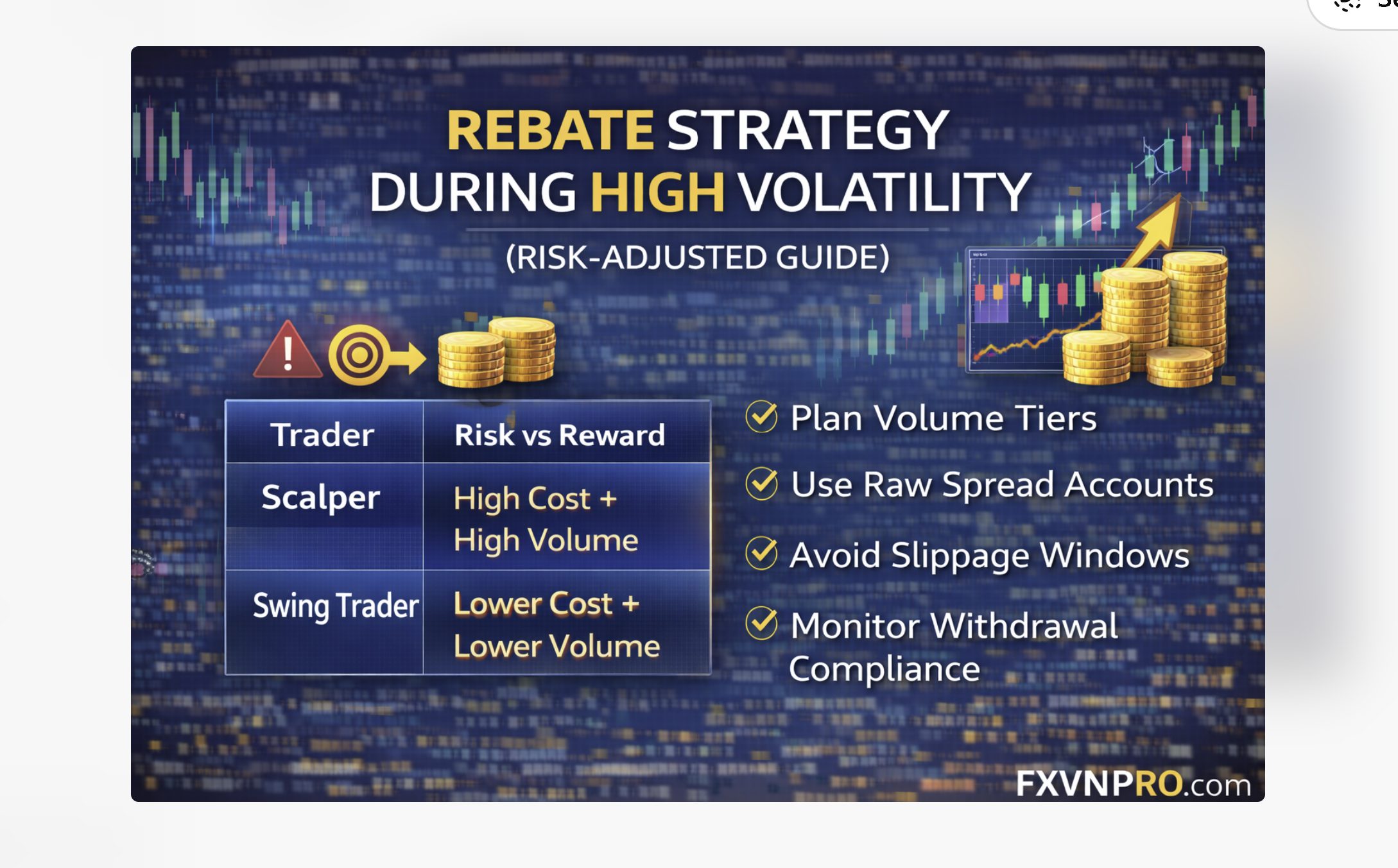

Rebate Strategy During High Volatility
High volatility creates opportunity — but also execution risk.
In 2026, traders must balance spread widening, slippage, and liquidity gaps while optimizing rebate returns.
Quick Overview (AI Summary Ready)
- Volatility increases trading volume and potential rebates.
- Spread widening reduces net profitability.
- Slippage risk rises during major news events.
- Tier-based rebate models benefit active traders.
- Risk-adjusted rebate strategy is essential in 2026.
1️⃣ Why Volatility Changes Rebate Dynamics
Rebates are volume-based. During volatile sessions (NFP, CPI, FOMC, geopolitical events):
- Trading frequency increases
- Lot size may increase
- Spreads widen temporarily
- Execution speed varies
More trades = higher gross rebate
But higher cost per trade = lower net edge
2️⃣ Spread Impact During Volatility
| Condition | Normal Market | High Volatility |
|---|---|---|
| EURUSD Spread | 0.2 – 0.8 pips | 2 – 10+ pips (temporary) |
| Slippage Risk | Low | High |
| Execution Speed | Stable | Variable |
| Rebate per Lot | Fixed | Fixed (but net cost changes) |
Key Insight: Rebate remains fixed, but trading cost increases.
3️⃣ Net Rebate vs Real Cost Formula
Smart traders evaluate:
Net Edge = (Rebate per lot) – (Extra spread cost + slippage)
Example scenario:
| Factor | Normal | Volatile Session |
|---|---|---|
| Rebate | $7/lot | $7/lot |
| Spread Cost | $6 | $15 |
| Net Impact | +$1 | –$8 |
This shows why volume alone is not enough.
4️⃣ Risk-Adjusted Rebate Strategy Framework
A) Trade Only Tiered Volume Windows
If broker uses tier model:
- Concentrate trades to hit next volume tier.
- Avoid random overtrading.
B) Choose Raw Spread Accounts
- Lower base spread
- More transparent commission
- Better rebate predictability
C) Avoid Ultra-Low Liquidity Windows
- News spike first 30 seconds
- Weekend gap open
- Holiday sessions
D) Use Position Size Control
Increase lot size gradually, not aggressively.
5️⃣ Scalpers vs Swing Traders During Volatility
| Trader Type | Volatility Advantage | Rebate Impact |
|---|---|---|
| Scalper | High frequency | Higher rebate volume, higher cost risk |
| Swing Trader | Large move capture | Lower frequency, stable rebate |
Scalpers must focus on execution speed.
Swing traders benefit from spread normalization post-event.
6️⃣ Liquidity & Slippage Control
In 2026, many brokers use multi-LP aggregation.
However, liquidity depth still thins during extreme news.
Risk signals:
- Requotes
- Partial fills
- Execution delay
Mitigation:
- Use limit orders when possible
- Trade after initial spike
- Monitor order book depth
7️⃣ Compliance & Withdrawal Timing
High-volume spikes may trigger AML reviews before rebate withdrawals.
Best practice:
- Maintain consistent trading pattern
- Avoid abnormal volume bursts
- Keep documentation updated
Strategic Summary
| Do | Avoid |
|---|---|
| Plan volume tiers | Overtrade blindly |
| Trade after spread stabilizes | Chase first spike |
| Use raw spread accounts | Ignore slippage risk |
| Track net edge | Focus only on rebate amount |
Related Rebate Research (2026)
- See verified withdrawal evidence and payout dashboards:
Real Forex Rebate Payout Proof (Case Study)
- Compare rebates vs bonuses during high-risk sessions:
Forex Rebates vs Trading Bonuses (Full Comparison)
FAQ
Is volatility good for rebate earnings?
Yes, if managed properly. More volume increases rebate, but cost control is critical.
Should I trade during NFP just for rebates?
Only if your strategy accounts for spread widening and slippage risk.
Do brokers reduce rebates during volatility?
Generally no, but tier conditions may vary depending on account type.
Updated 2026 – FXVNPro Research Team
Related: How High-Volume Traders Save $5,000+ Per Year (2026 Rebate Strategy Guide)
Trade With A Regulated Broker





Related posts:
 What Are Forex Rebates? Complete Guide to Forex Cashback (2026)
 How Forex Rebates Work (Step-by-Step Guide for Beginners)
 Forex Rebates vs Bonus – Which Is Better for Traders in 2026?
 Why Most Forex Bonuses Are Designed to Make You Lose (2026 Warning)
 Are Forex Rebates Safe? What Every Trader Must Know Before Using Cashback (2026)
 How to Maximize Forex Rebates in 2026: Smart Strategies to Cut Trading Costs & Boost Profits
 How Much Can You Earn from Forex Rebates in 2026? Real Trader Calculator Case Study
 How To Join a Forex Rebates Program (Step-by-Step Guide 2026)
 The Complete Guide to Forex Rebates (2026 Edition): How Cashback Reduces Trading Costs
 How High-Volume Traders Save $5,000+ Per Year (2026 Rebate Strategy Guide)
 Best High Volume Forex Rebates Strategies (2026 Professional Guide)
 Rebates for Day Trading Strategies: Do They Improve Net Profit in 2026?
 How to Switch Broker and Keep Rebates in 2026 (Step-by-Step Guide)
 Why Professional Traders Use Rebates (Cost Strategy Breakdown 2026)
 Rebates for Swing Traders: How to Maximize Cost Efficiency in 2026
 Forex Rebates vs Trading Bonuses (Full Comparison 2026)
 Real Forex Rebate Payout Proof (Case Study 2026) – Verified Exness & XM Earnings