
Forex Rebate Calculator: How to Calculate USD/Lot and Spread-Based Cashback
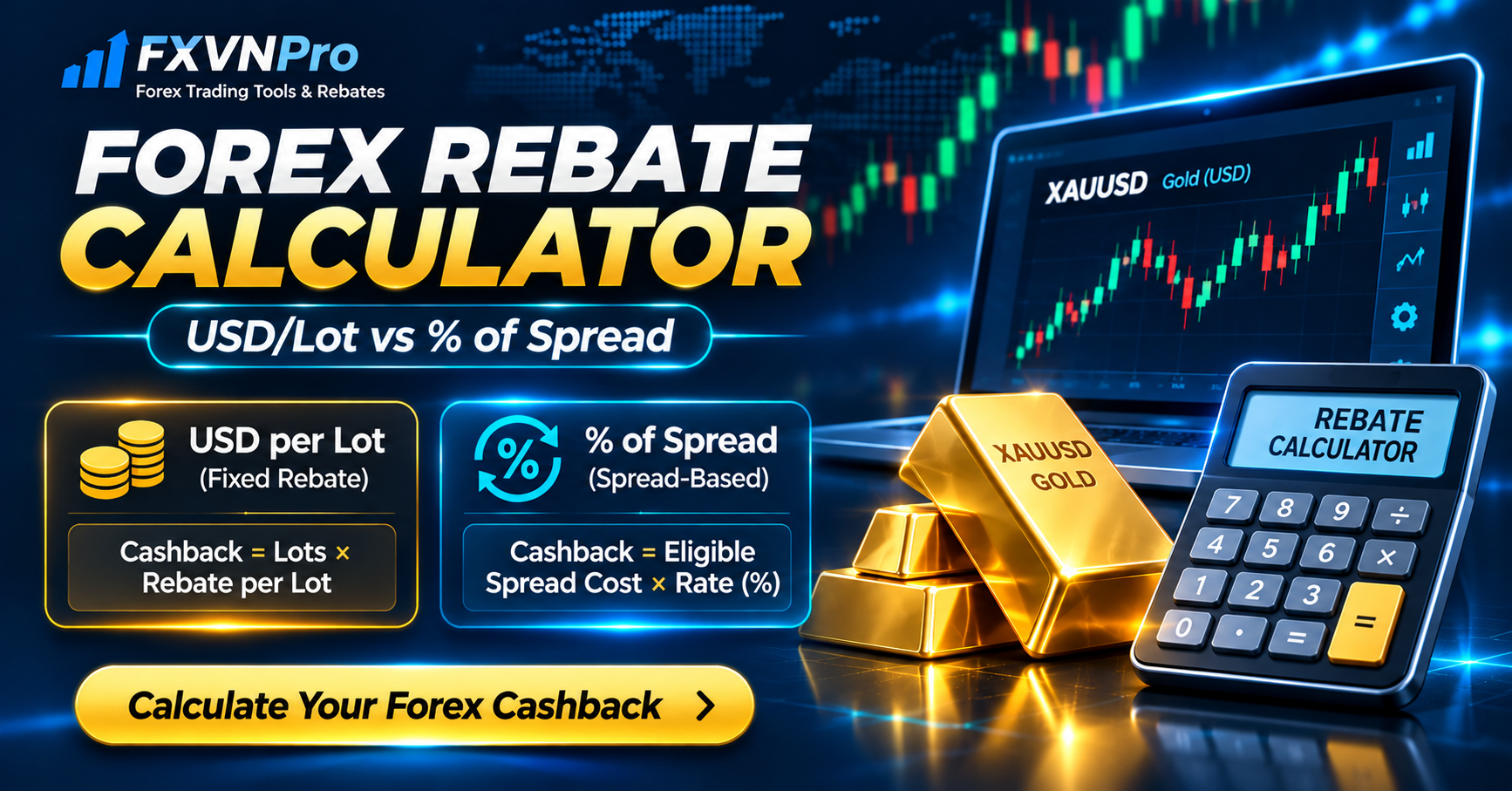
Rebate Savings Calculator
Estimate cashback using verified USD/lot or percentage-of-spread rates, and compare trading costs.
Illustrative estimate only. Percentage-of-spread rebates apply to the spread component, not commission. Assumes every entered lot is eligible. Excludes swaps, slippage, conversion costs and other charges unless included in the verified cost figure. Negative net costs are possible mathematically and do not represent guaranteed profit. Actual rebate is subject to broker attribution, eligibility and reconciliation.
Open Rebate Wallet →Two forex traders can generate the same trading volume and receive different cashback amounts. The reason is not always the broker or the instrument. Often, it comes down to how the rebate agreement calculates eligible commissions.
Some forex rebate programs offer a fixed dollar amount per lot. Others use a percentage of spread-related revenue or another commission basis defined by the broker. These arrangements may look similar in a promotional table, but they can produce very different results.
Understanding the calculation matters, especially for active traders who want to estimate potential cashback before opening a new account or joining an introducing broker (IB) program.
In this guide, we explain both models, work through practical Forex and XAUUSD examples, and show how to use a forex rebate calculator without confusing estimated cashback with a guaranteed payment.
What Is a Forex Rebate Calculator?
A forex rebate calculator estimates the cashback associated with eligible trading volume under a particular broker’s rebate arrangement.
Its purpose is straightforward: translate a published rebate rate into a potential monetary amount using assumptions about trading volume, instrument, account type, and calculation method.
For example, a trader who completes 50 eligible lots per month might want to know how much cashback a fixed USD-per-lot program could generate. Another trader might need to calculate a rebate expressed as a percentage of the broker’s eligible spread-related amount.
These are different calculations. A useful calculator should distinguish between them rather than applying the same formula to every broker.
It should also make clear that the final rebate depends on broker verification, referral attribution, trading restrictions, and the terms of the partnership.
Understanding the Two Main Forex Rebate Models
Forex cashback arrangements are commonly described using either a fixed amount per lot or a percentage-based rate.
Neither model is automatically better. The relevant question is how much the trader may receive for the same eligible trading activity, under comparable account conditions.
1. Fixed USD-per-Lot Rebates
A fixed rebate specifies a monetary amount for each qualifying unit of trading volume.
For instance, a program might offer a hypothetical $4 per completed standard lot on an eligible currency pair.
The basic calculation is:
Estimated cashback = Eligible lots × Rebate rate per lot
If the trader completes 25 qualifying lots:
25 × $4 = $100
The estimated cashback would be $100, assuming all transactions qualify and the quoted rate applies to completed round-turn lots.
That last condition is important. Some commission schedules use opening volume, closing volume, or per-side conventions. A rate quoted per side should not be compared directly with a round-turn rate without adjusting the calculation.
2. Percentage-of-Spread Rebates
Percentage-based rebates require more careful interpretation.
A broker may calculate partner commission using a percentage of an eligible spread-related amount. However, that amount is not necessarily identical to the spread cost displayed in the trader’s terminal.
When the agreement explicitly defines the trader’s eligible spread cost as the calculation basis, the simplified formula is:
Estimated cashback = Eligible spread cost × Rebate percentage
Suppose a hypothetical program pays 20% of an eligible spread cost totaling $150.
$150 × 20% = $30
The estimated rebate would be $30.
But if the broker defines the percentage against a different revenue base, the calculation must use that specific base instead. Applying 20% directly to the displayed spread without confirmation could materially overstate or understate the expected cashback.
USD/Lot vs Percentage of Spread: Key Differences
| Feature | USD per lot | Percentage of spread |
|---|---|---|
| Rate format | Fixed amount per eligible lot | Percentage of an eligible calculation basis |
| Main inputs | Eligible volume and rate | Eligible spread-related amount and percentage |
| Ease of estimation | Usually straightforward | Depends on broker methodology |
| Effect of spread changes | Rate may remain fixed under the agreement | May affect the rebate if the calculation basis changes |
| Main verification point | Volume convention and eligible instruments | Definition of the eligible spread or revenue basis |
A fixed rate can be easier to budget around, while a percentage-based model may vary with the eligible revenue or cost basis. Actual outcomes depend on the broker’s commission agreement.
Example 1: Calculating Forex Rebates in USD per Lot
Consider a trader who regularly trades EURUSD through an account eligible for a hypothetical fixed cashback rate of $3.50 per completed standard lot.
Assume the trader completes the following qualifying volumes:
| Monthly volume | Rebate rate | Estimated cashback |
|---|---|---|
| 10 lots | $3.50/lot | $35 |
| 25 lots | $3.50/lot | $87.50 |
| 50 lots | $3.50/lot | $175 |
| 100 lots | $3.50/lot | $350 |
These examples show how the arithmetic scales with volume. They are not verified broker offers or predictions of future trading activity.
Importantly, traders should not increase position sizes or execute unnecessary trades simply to generate more rebates. Additional trading can introduce transaction costs and market risk that exceed the cashback received.
Example 2: Calculating XAUUSD Rebates per Lot
Gold traders often have different contract specifications and commission schedules from currency-pair traders.
Many XAUUSD CFD accounts use a standard contract size of 100 troy ounces per lot, but this convention is not universal. The broker’s contract specification must be checked before comparing rates.
Suppose an eligible XAUUSD account offers a hypothetical $5 cashback per completed round-turn lot.
If a trader completes 40 qualifying lots:
40 lots × $5 = $200 estimated cashback
Now consider a smaller trading volume of 0.10 lot per completed trade.
Under a proportional volume model, each qualifying 0.10-lot round turn would generate:
0.10 × $5 = $0.50
After 100 such completed trades, total qualifying volume would be 10 lots, producing an estimated $50 rebate.
This assumes fractional lots qualify proportionally and that the broker imposes no minimum volume, rounding adjustment, or excluded-trade rule.
For a broader explanation of gold trading expenses, read our guide to XAUUSD trading costs, spreads, commissions and overnight fees.
Example 3: Calculating a Percentage-of-Spread Rebate
Percentage-based cashback requires a defined calculation basis.
For this example, assume a hypothetical broker agreement explicitly uses the trader’s eligible spread cost and pays 25% of that amount.
Suppose the qualifying spread-related costs are:
- Eligible spread cost per completed lot: $12
- Qualifying monthly volume: 30 lots
- Applicable rebate percentage: 25%
The eligible spread cost for the month is:
30 × $12 = $360
The estimated cashback is:
$360 × 25% = $90
This produces a $90 estimate under the stated assumptions.
If the broker instead calculates the 25% against a different eligible revenue amount, the result changes accordingly. That is why the commission schedule must be reviewed before publishing a percentage-based rebate rate.
Which Rebate Model Pays More?
There is no universal winner.
Consider two hypothetical programs applied to the same 30 eligible round-turn lots:
| Comparison | Program A | Program B |
|---|---|---|
| Rebate model | Fixed USD/lot | Percentage of eligible spread cost |
| Rate | $4/lot | 25% |
| Eligible volume | 30 lots | 30 lots |
| Eligible spread cost | Not required | $360 |
| Estimated cashback | $120 | $90 |
Program A produces $30 more cashback in this illustration.
However, that does not establish that the account associated with Program A is cheaper overall.
One broker might charge wider spreads, higher commissions, or additional financing fees. A meaningful comparison must evaluate the total cost of trading, not simply the amount returned as cashback.
How to Calculate Net Trading Costs After Rebates
Rebates are best understood as one component of trading cost management.
A simplified calculation is:
Net specified trading costs = Spread costs + Commissions + Financing + Execution-related costs − Eligible cashback
Consider a hypothetical monthly trading summary:
| Cost component | Amount |
|---|---|
| Spread costs | $450 |
| Commissions | $150 |
| Financing and execution-related costs | $50 |
| Total specified costs | $650 |
| Eligible cashback | -$100 |
| Net specified costs | $550 |
In this illustration, cashback reduces the specified costs by approximately 15.4%.
The example does not include market-related trading profits or losses. A lower transaction cost does not eliminate the possibility of losing money on the underlying positions.
How to Use the FXVNPro Rebate Savings Calculator
Manually calculating cashback can become inconvenient when comparing multiple brokers, instruments, and account types.
The FXVNPro Rebate Savings Calculator provides a way to estimate potential cashback using the rebate information configured for supported broker arrangements.
To evaluate an available rebate arrangement:
- Choose a supported broker. Start with the broker or trading account you want to evaluate.
- Review the account type. Standard, Raw, ECN, and other accounts may have different commission terms.
- Check the instrument. XAUUSD, EURUSD, and other instruments may qualify for different rates.
- Identify the rebate model. Confirm whether the applicable rate uses USD per lot or a percentage-based calculation.
- Enter the relevant trading assumptions. Use realistic volume and cost inputs where the calculator requests them.
- Review the estimate and eligibility conditions. Treat the result as an estimate until the broker verifies the qualifying activity.
Not every broker or account type necessarily has an approved rate available. If a rate has not been verified, traders should request confirmation rather than assuming that an estimated amount will be paid.
Open the calculator: FXVNPro Forex Rebate Savings Calculator.
Why a Rebate Estimate May Differ from the Final Payment
Even a mathematically correct estimate can differ from the final cashback credited to a client.
Several factors may explain the difference.
Account Attribution
The trading account must be correctly attributed to the relevant IB partnership. Opening an account directly with a broker does not automatically make it eligible for a third-party rebate program.
Excluded Instruments or Account Types
Some arrangements apply different rates to gold, currency pairs, indices, cryptocurrencies, or particular account categories.
Trading Volume Adjustments
Brokers may calculate eligible volume using specific rules for partial closes, fractional lots, cancelled transactions, or other adjustments.
Commission Reconciliation
The final cashback may depend on the broker’s commission report, applicable corrections, and the rebate provider’s verification process.
Payment Terms
Minimum payout amounts, processing schedules, payment fees, or other conditions can affect when and how an eligible balance is withdrawn.
For these reasons, an estimate should never be presented as guaranteed income.
Can Existing Trading Accounts Receive Forex Rebates?
This is one of the most important questions for traders who already have a broker account.
Eligibility depends on the broker’s referral attribution policies. Some brokers permit an existing client to request an IB reassignment under specific conditions. Others may restrict transfers or require a new eligible account.
Before making changes, traders should confirm the broker’s requirements and avoid assuming that previously completed transactions can receive retroactive cashback.
FXVNPro’s rebate service includes an account-linking and verification process. Linking an account is a request for eligibility review; it does not itself guarantee approval or payment.
Forex Rebates and Automated Trading Strategies
Traders using Expert Advisors or other automated strategies may generate a substantial number of transactions, making trading costs an important consideration.
However, an automated strategy should be evaluated on its own risk and execution characteristics before considering any cashback benefit.
A rebate cannot repair a strategy with unfavorable trading economics. Excessive turnover, slippage, and unfavorable market movements may outweigh any commission returned to the client.
Automated traders should also confirm whether their broker’s rebate agreement permits their trading style, including scalping, hedging, or other relevant execution patterns.
For broker research, FXVNPro also provides Forex Broker Comparison resources.
Frequently Asked Questions
How do I calculate a forex rebate per lot?
Multiply the number of eligible lots by the applicable rebate amount per lot. For example, 20 qualifying lots at a hypothetical $4 per lot produce an estimated $80 rebate, assuming the rate is defined on the same volume basis.
How is a percentage-of-spread rebate calculated?
Multiply the broker-defined eligible spread-related amount by the applicable rebate percentage. The calculation is reliable only when the agreement clearly identifies the correct calculation basis.
Is a higher forex rebate always better?
No. A higher rebate may be offset by wider spreads, commissions, financing costs, or poorer execution. Compare the net cost of trading under equivalent conditions.
Can I calculate XAUUSD cashback using standard forex lot assumptions?
Not automatically. Gold contract sizes, commission conventions, and rebate eligibility can differ from currency pairs. Always check the broker’s XAUUSD specifications.
Does the FXVNPro calculator guarantee cashback payments?
No. The calculator provides estimates based on configured rates and assumptions. Actual cashback depends on broker confirmation, eligible trading volume, account attribution, and applicable payment terms.
Final Thoughts: Calculate Before You Commit
Forex rebates can help eligible traders recover a portion of certain transaction costs, but the headline rate is only the beginning of the calculation.
A fixed USD-per-lot arrangement is usually straightforward to estimate. A percentage-based rebate requires a clear understanding of the broker’s eligible spread or revenue calculation.
For both models, the most useful comparison is not simply how much cashback appears on the screen. It is how the rebate affects the total cost of trading under realistic account conditions.
If you are evaluating cashback for Forex or XAUUSD, visit the FXVNPro Rebate Center to review available rebate information, estimate potential savings, and learn about account eligibility.
Risk Disclosure: Forex and CFD trading involve significant risk and may result in substantial losses. Rebates do not guarantee profitability, reduce market exposure, or protect against trading losses. All monetary examples in this article are hypothetical and do not represent verified broker offers. Actual eligibility and payments are subject to applicable broker and rebate program terms.
Trade With A Regulated Broker





Related posts:
 What Are Forex Rebates? Complete Guide to Forex Cashback (2026)
 How Forex Rebates Work (Step-by-Step Guide for Beginners)
 Forex Rebates vs Bonus – Which Is Better for Traders in 2026?
 Why Most Forex Bonuses Are Designed to Make You Lose (2026 Warning)
 Are Forex Rebates Safe? What Every Trader Must Know Before Using Cashback (2026)
 How to Maximize Forex Rebates in 2026: Smart Strategies to Cut Trading Costs & Boost Profits
 How Much Can You Earn from Forex Rebates in 2026? Real Trader Calculator Case Study
 How To Join a Forex Rebates Program (Step-by-Step Guide 2026)
 The Complete Guide to Forex Rebates (2026 Edition): How Cashback Reduces Trading Costs
 How High-Volume Traders Save $5,000+ Per Year (2026 Rebate Strategy Guide)
 Best High Volume Forex Rebates Strategies (2026 Professional Guide)
 Rebates for Day Trading Strategies: Do They Improve Net Profit in 2026?
 How to Switch Broker and Keep Rebates in 2026 (Step-by-Step Guide)
 Why Professional Traders Use Rebates (Cost Strategy Breakdown 2026)
 Rebates for Swing Traders: How to Maximize Cost Efficiency in 2026
 Forex Rebates vs Trading Bonuses (Full Comparison 2026)
 Real Forex Rebate Payout Proof (Case Study 2026) – Verified Exness & XM Earnings
 Rebate Strategy During High Volatility (2026 Risk-Adjusted Guide)
 Forex Rebates Explained: How Cashback Works
 XAUUSD Trading Costs Explained: Spreads, Commissions, Swap Fees and Rebates