
Gold Price (XAU/USD) Edges Lower Amid Early US Midterm Trends Favoring Democrats
Gold price trades cautiously below key technical levels as early US midterm election trends suggest a Democratic lead in the House, with market focus
Gold Price Movement and US Midterm Election Context
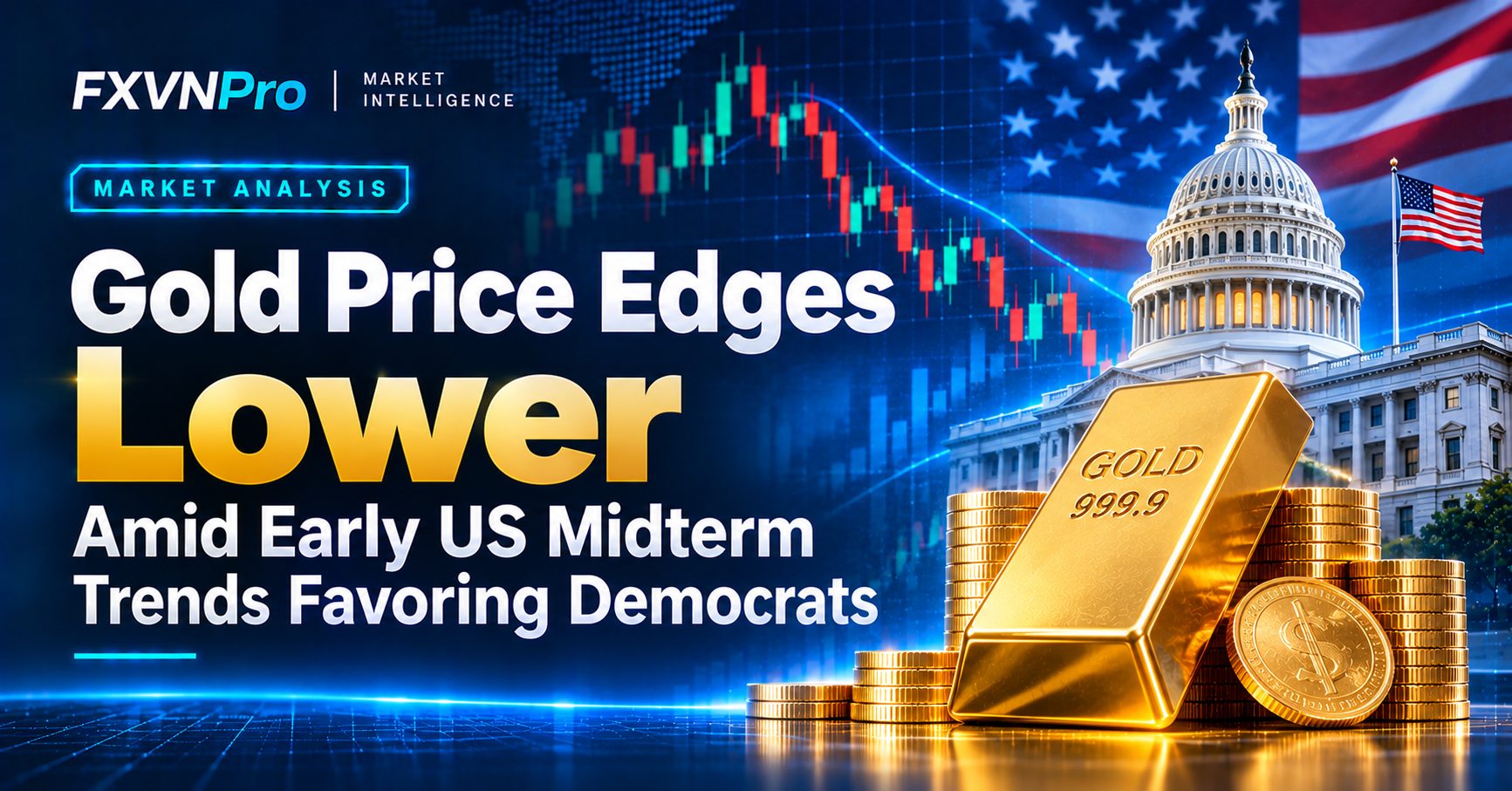
As of the Asian trading session on November 4, 2026, gold (XAU/USD) traded cautiously around $3,930, showing limited directional momentum. This subdued price action coincides with investors closely monitoring the US midterm elections, where early trends indicate a potential Democratic majority in the House of Representatives. According to partial counts reported by the BBC, Democrats lead with 114 seats out of 179 counted, with 218 seats required for a clear majority.
Market strategists and betting markets have reflected this outlook, with some sources suggesting approximately a 70% probability of a Democratic sweep in both the House and Senate. Such an outcome is interpreted by some analysts as potentially bearish for the US dollar, given expectations of increased political gridlock, including challenges around the debt ceiling and possible government shutdowns. These political risks may influence investor sentiment toward gold, which often benefits from a weaker dollar environment.
Technical Analysis and Upcoming Economic Data
From a technical perspective, gold’s near-term price action remains bearish. The spot price at $3,937.90 is trading below the 20-day exponential moving average (EMA) of $4,050.63, a level that has acted as resistance. The Relative Strength Index (RSI) stands at 37, indicating downward pressure but not yet reaching oversold territory. This suggests that while rallies may be capped, there is room for further downside or consolidation.
Looking ahead, market participants are awaiting key US economic indicators that could influence Federal Reserve policy expectations and, by extension, gold prices. The US ADP Employment Change data for October is expected to show a slowdown in private sector job creation compared to September. Additionally, the US Nonfarm Payrolls (NFP) report scheduled for Friday is anticipated to be a significant market mover. Recent US JOLTS Job Openings data for September showed stronger-than-expected labor demand, which adds complexity to interpreting upcoming employment figures.
FXVNPro Market Perspective
Gold prices are sensitive to shifts in US dollar strength, which in turn are influenced by political developments and economic data. A Democratic majority in the House could increase the likelihood of legislative gridlock, potentially weakening the dollar due to concerns over fiscal policy and government operations. A softer dollar typically supports higher gold prices by making the metal cheaper for holders of other currencies.
Conversely, strong US labor market data could reinforce expectations of continued Federal Reserve tightening, which tends to strengthen the dollar and exert downward pressure on gold. Therefore, gold’s price trajectory will depend on the balance between political risk factors and economic fundamentals, as well as how these influence Fed policy expectations.
Trading Scenarios
- If the Democrats secure a clear majority and political gridlock intensifies, then the US dollar may weaken, potentially providing upward support to gold prices as investors seek safe-haven assets.
- If upcoming US employment data, particularly the NFP report, indicates robust job growth, then expectations for further Fed tightening could strengthen the dollar, maintaining pressure on gold prices and keeping XAU/USD below the 20-day EMA at $4,050.63.
What Traders Should Watch
- Developments in the US midterm election results, especially the final seat count in the House of Representatives.
- US ADP Employment Change data for October and the Nonfarm Payrolls report, which could shift Fed rate expectations.
- Technical levels including the 20-day EMA at $4,050.63 and the RSI at 37, which may indicate potential shifts in momentum.
- Broader market reactions to political risk and fiscal policy outlooks that could influence the US dollar and gold prices.
Trade With A Regulated Broker





Related posts:
 Australian Dollar Trades Near Monthly High Above 0.7000 Amid Hawkish RBA Signals and USD Dynamics
 Bitcoin Price Outlook: BTC Eyes Break Above Key Resistance Amid Institutional ETF Inflows
 SpaceX Earnings Highlight AI Supercycle Momentum and Compute Expansion
 Bitcoin’s Quantum Computing Threat Accelerates: Implications for Cryptocurrencies and Market Dynamics
 Cardano Price Forecast: Whale Selling Pressure Deepens ADA Correction
 WTI Rally Runs Ahead of Positioning: Insights from the October 2026 CFTC Report
 XAU/USD Outlook: Gold Gains as Fed Policy Week Begins Amid Inflation Concerns
 Central Banks Brace for Hawkish Moves Amid Energy-Driven Inflation, But Dovish Surprises Remain Possible
 BoJ Expected to Hold Rates Friday as Yen Retraces Half Its Recent Gains
 Ripple Secures OCC Approval for National Trust Bank, Impacting RLUSD Infrastructure
 MTrading $100 No Deposit Welcome Bonus (Malaysia Only): Terms, Limits & How It Really Works
 Altcoins XRP, Cardano, and Solana Face Continued Downside Pressure Amid Key Technical Tests
 Singapore Dollar Range-Bound Against US Dollar Amid Limited Momentum – UOB Analysis
 Bitcoin Faces AI-Linked Selloff Risk Amid Anthropic IPO and Inflation Concerns
 Zcash Price Forecast: Bullish Momentum Builds on ETF Inflows and Retail Interest
 Pi Network Price Outlook: PI Stalls Amid Core Team’s Investment Expansion to Axis Robotics
 Bitcoin Volatility Drops to 2023 Lows Amid Fed Rate Pause and Market Support Levels
 Crypto Market Pullback on Hawkish Fed Tone and Inflation Data – Bitcoin, Ethereum, XRP Under Pressure
 Gold (XAU/USD) Rebounds Near $3,900 Amid Inflation Concerns and Interest Rate Outlook
 Zcash Price Forecast: ZEC Rebounds Amid Support for Ending Community Grants and Upcoming Network Upgrade
 Dogecoin Price Outlook: Diverging Whale Activity and Technical Resistance Levels Signal Caution
 Understanding Inflation in November 2026: The Impact of Fuel Costs and Producer-Consumer Price Divergence
 Strategy Resumes Bitcoin Purchases with $65.5M Acquisition Amid Market Pressure
 Can the New Zealand Dollar Hold 0.5600 Amid RBNZ Policy Uncertainty?