

OCTA
FVP Score
6.6/10
OCTA
- Minimum Deposit$25
- RegulationFSC, FSCA, CySEC, MISA
- PlatformsMT4, MT5
- SpreadFrom 0.1 pips
Start with your goal. You do not have to learn the FXVNPro architecture before using the tools.
Build an idea, use Telegram signals, trade from Chrome or follow a trader while technical setup stays in the background.
Technical connection details remain available inside each product when needed.
Compare OCTA and Titan FX by rating, regulation, minimum deposit, platforms, spreads, and overall trading conditions.
Use the FXVNPro Broker Checker Chrome extension to quickly review broker trust signals, ratings, and safety information while browsing broker websites.

| Feature | OCTA | Titan FX |
|---|---|---|
| Rating | 6.6 | 6.3 |
| Minimum Deposit | $25 | $50 |
| Regulation | FSC, FSCA, CySEC, MISA | VFSC, FSA, FSC |
| Platforms | MT4, MT5 | MT4, MT5 |
| Spread | From 0.1 pips | From 0.1 pips |
Below is a detailed breakdown of fees, spreads, regulation, platforms, and real trading suitability to help you decide which broker fits your trading style better.
If you’ve ever looked at your trading history and thought, “How did I lose on a setup that looked fine?”—there’s a good chance trading costs had a say in it. Not always the obvious stuff like spreads, either. Sometimes it’s execution quality, rollover-style frictions, or even just the way fills behave when volatility spikes.
This is exactly why “which broker is better” isn’t a trivia question for most traders. It’s a decision about your monthly P&L. In this OCTA vs Titan FX comparison, I’m focusing on the stuff that matters during real trading sessions: fees comparison, spreads and trading costs, regulation, and how platforms tend to feel when you’re actually placing trades—especially under pressure.
Quick snapshot: OCTA has a lower minimum deposit ($25 vs $50) and a similar “from 0.1 pips” spread headline. Titan FX is close on spreads too, but its regulatory footprint is different, and that can influence trust and how you think about risk. Both offer MT4 and MT5, which matters if you rely on automation or want a familiar interface.
Who should care most? Anyone trading frequently enough that a few extra tenths of a pip or one awkward fill pattern becomes real money. Also beginners comparing ease of funding and the “first month” experience. Let’s break it down properly.
Let’s talk spreads and trading costs first, because this is where brokers often look similar on paper and diverge in practice. Both OCTA and Titan FX advertise spreads “from 0.1 pips,” and on calm market conditions that can be believable. But spreads aren’t the whole story—execution speed, slippage, and any commission/markup structure (if applicable) can swing your results.
Here’s a practical scenario. Imagine you’re day trading EURUSD around London open, stacking multiple trades per session using a 10–20 pip stop. On paper, if both brokers give you 0.1 pip spreads, the difference looks tiny. But if one broker’s average effective spread creeps higher during fast moves—even by 0.3–0.6 pips—that compounds quickly.
Now add slippage. In real trading conditions (news, sudden breakouts, thin liquidity), “from” spreads can look great while your fills are slightly worse than expected. That’s why I always think in terms of effective cost per trade, not just the minimum spread number. For scalpers, that difference can be the difference between a strategy that survives and one that slowly dies.
Also watch out for hidden friction. Some brokers rely on spread widening during volatility rather than explicit fees; others may use commission structures. The data you provided doesn’t include commission details, so I can’t claim a specific commission advantage. What I can say is: if both advertise similar spread starts, the cheaper broker in real life is usually the one that keeps your average cost stable when markets get messy.
So which one is cheaper? Based on what we have, it’s too close to call purely on headlines. But your best bet is to track “average spread + slippage” for 2–3 weeks on the Connects and sessions you actually trade. That will tell you which broker is cheaper for you, not just which one looks better in a table.
Broker safety comes down to regulation, but also to what those regulators actually mean in day-to-day terms. OCTA is listed under FSC, FSCA, CySEC, and MISA. Titan FX is under VFSC, FSA, and FSC. The important part isn’t just “more regulators” vs “fewer.” It’s what level of oversight those regulators tend to provide and how confident you should feel about enforcement and consumer protections.
Why does this matter? Because trading is risky enough without adding broker risk. If a broker’s regulatory environment is weaker or enforcement is inconsistent, you might get more variability in execution policies, dispute handling, or operational stability. And when you’re dealing with losses, you don’t want the additional stress of arguing about withdrawals or account conditions.
Now, let’s be realistic. Even regulated brokers can have issues—any broker can, in theory, face operational shocks. But regulation affects how likely it is that those problems are handled with clear rules, transparency, and accountability. That’s the practical angle.
Verification is also key. Before you fund, verify the broker’s registration details through the regulator’s public records (where available). I’ve seen cases where traders assumed regulation coverage based on marketing, only to find the entity and jurisdiction didn’t map cleanly to their account.
With the information given, OCTA’s regulatory list includes CySEC and FSCA, which many traders associate with more mainstream oversight frameworks. Titan FX’s list includes VFSC and FSA and FSC, but the overall perception among retail traders can differ because regulatory “feel” varies by jurisdiction. I’m not saying one is unsafe and the other is safe—rather, OCTA looks more reassuring to the majority of traders who care about regulation credibility.
Both brokers offer MT4 and MT5, so on paper you’re not locked into a proprietary platform. That matters if you use Trading Programs (Expert Advisors), rely on indicators you already know, or want the flexibility of MT4’s simplicity versus MT5’s more advanced features.
But here’s the thing: the platform UI is rarely what makes you money. Execution behavior does. MT4/MT5 can feel identical across brokers until you start pressing buttons during fast markets. Then you notice differences in requotes, latency, and how “smooth” order placement feels.
For example, if you scalped GBPJPY using a tight spread-based system, the setup might work on demo but degrade on live once volatility kicks in. You might not see the problem until you compare expected entry vs actual fill and notice that slippage happens more frequently on one broker. With MT4/MT5, you can still monitor this—trade reports, ticket history, and terminal logs help you spot patterns.
Also consider your trading experience. If you’re a trader who writes or tweaks EAs, MT5 can be attractive for its hedging/multi-asset workflows (depending on broker configuration). But many EAs are still MT4-first, so you might live in MT4 anyway. The good news is both brokers support both platforms, so you’re not boxed in.
In terms of tools, your provided data doesn’t list additional platform features beyond MT4/MT5. So the “better broker” in this category mostly comes down to execution speed and consistency, plus how stable the platform is during active trading sessions. If you trade during rollover and news windows, spend a few sessions testing order placement before committing real size.
Minimum deposit is one of the most underrated parts of a broker experience. OCTA’s minimum deposit is $25, while Titan FX’s is $50. That doesn’t sound dramatic, but it changes how quickly you can run proper testing. If you’re a trader who needs time to evaluate spreads and slippage on your real Connects, a lower minimum deposit makes it easier to iterate without “risking the rent” on the first week.
Now, let’s talk about deposit/withdrawal friction. We don’t have specific processing times or fee schedules in the data you shared, so I can’t claim one broker is faster or cheaper on withdrawal charges. What I can tell you from experience is that the biggest operational pain usually comes from two places: funding method compatibility and withdrawal processing requirements.
Real-world scenario: you deposit, trade for a couple of weeks, then try to withdraw a modest amount. If the broker requires additional verification steps, or if your withdrawal method isn’t supported smoothly, it can delay your funds. That’s when traders get frustrated—not because of a big trading loss, but because the “easy money” path turned into paperwork.
So what should you do? Before you fund, check supported payment methods, any minimum withdrawal limits, and whether the broker pushes you to complete identity checks early. If you’re in a hurry to trade live, you don’t want to discover verification requirements after you’ve already started building positions.
Given the lower minimum deposit, OCTA tends to be the more forgiving option for testing and onboarding. Titan FX’s higher minimum deposit isn’t automatically worse—it just means you may feel the cost of mistakes more quickly while you evaluate trading conditions.
Beginner suitability is less about whether a broker has MT5 and more about whether you can learn without getting punished by process friction. A $25 minimum deposit (OCTA) gives new traders room to practice with smaller risk while they figure out platform basics, order types, and typical spread behavior. Titan FX asks for $50, which isn’t huge, but it can make early mistakes more expensive.
In real trading conditions, beginners often do two things that amplify costs: they trade too often, and they enter during the wrong liquidity moments (like chasing moves right as spreads widen). When a broker’s spreads are “from 0.1” but widen unpredictably, beginners can get an unpleasant surprise. This is exactly why tracking average cost matters even more for new traders—because beginners don’t have the discipline yet to minimize overtrading.
There’s also the learning curve around execution. If your broker environment produces occasional requotes or worse fills than expected, the learning process gets harder. You start blaming your strategy for issues that are actually execution-related. MT4/MT5 helps because you can review fills and understand what happened, but that only works if the broker behaves consistently.
Between OCTA and Titan FX, the edge for beginners based on your data is likely OCTA, mainly due to the lower minimum deposit and the broader regulator presence that many beginners find reassuring when they’re still building trust in the process. Still, don’t skip the practical step: open a demo (if available) or start with small live size and test your typical Connects at your typical times.
Ask yourself: do you want to spend your first month learning charts, or do you want to spend it troubleshooting your broker?
Active traders care about costs and execution quality more than almost anything else. If you’re scalping, you’re fighting spread and slippage every minute. If you’re day trading, you’re fighting “effective cost” across multiple entries and exits, especially when markets trend or whip around news.
Both brokers advertise spreads “from 0.1 pips,” which is a decent starting point. But for high-frequency styles, you want to know how spreads behave during the sessions you trade. London and New York can be very different markets. Also, for many Connects, spreads can be tight until a volatility event—then the spread widens, and your strategy either adapts or it bleeds.
Here’s a scenario I’ve seen repeatedly: a day trader uses a mean reversion system on USD Connects, targeting 8–12 pip moves with frequent entries. On Broker A, the average effective spread plus slippage averages out to a manageable level. On Broker B, the same strategy produces a steady negative drift because fills are worse during the exact moments the signals trigger. The setup still looks “right” on a chart, but the math doesn’t work anymore.
So which broker suits active traders better? Based purely on the data you provided, it’s close. The deciding factor should be your own measurement: track average spread and slippage over at least 200–300 trades (or multiple weeks) for your main instruments and times. Then compare results.
Regulation also matters more for active traders because withdrawals and operational stability become part of your risk plan. If you’re moving money frequently, a broker with a stronger compliance perception can reduce stress.
If you’re an active trader, don’t ask “which broker is best overall.” Ask: “Which broker gives me the lowest and most stable effective cost in my hours?” That answer will be very different for different people.
If you want a quick decision framework: OCTA looks more approachable for both beginners and traders who want to test quickly. Titan FX looks viable if your priority is also MT4/MT5 TRADE and you’re comfortable evaluating costs without relying on headline numbers.
Let’s make the recommendation clear, because “both are fine” is not a useful answer when you’re trying to protect your edge.
OCTA is the better choice for most traders who want a smoother start and a more reassuring regulatory backdrop. The $25 minimum deposit is a real advantage for onboarding and for running the kind of cost testing you should do before sizing up. Add the broader regulator presence you provided, and OCTA edges out for traders who care about trust and practical onboarding friction. For many, this matters more than a marketing spread number.
Titan FX is a reasonable alternative for experienced traders who are already comfortable measuring execution costs and don’t mind the higher minimum deposit. If you’re the type who will track effective spreads and slippage by instrument and session, Titan FX can still work—especially since MT4 and MT5 support is there and the spread headline matches. But you should treat it as a “verify in live trading” broker, not a “set and forget” one.
If you’re asking which broker is better in “fees comparison” terms: you can’t responsibly crown a winner without commission details and without your own cost measurements. However, given the available data, OCTA is more favorable to start with, while Titan FX is more suitable once you’ve done your due diligence on execution speed and slippage.
My suggestion? Open demo or start with small size, test your main Connects during your usual sessions, and calculate your real effective cost per trade. That’s the only way to turn OCTA vs Titan FX from a guess into a decision.
One real XAUUSD trade: created before the outcome, sent to Telegram, TRADEd in MT5 and returned as a verified result.
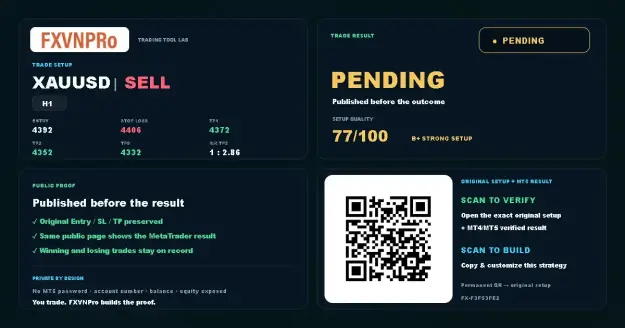 1 · SETUP
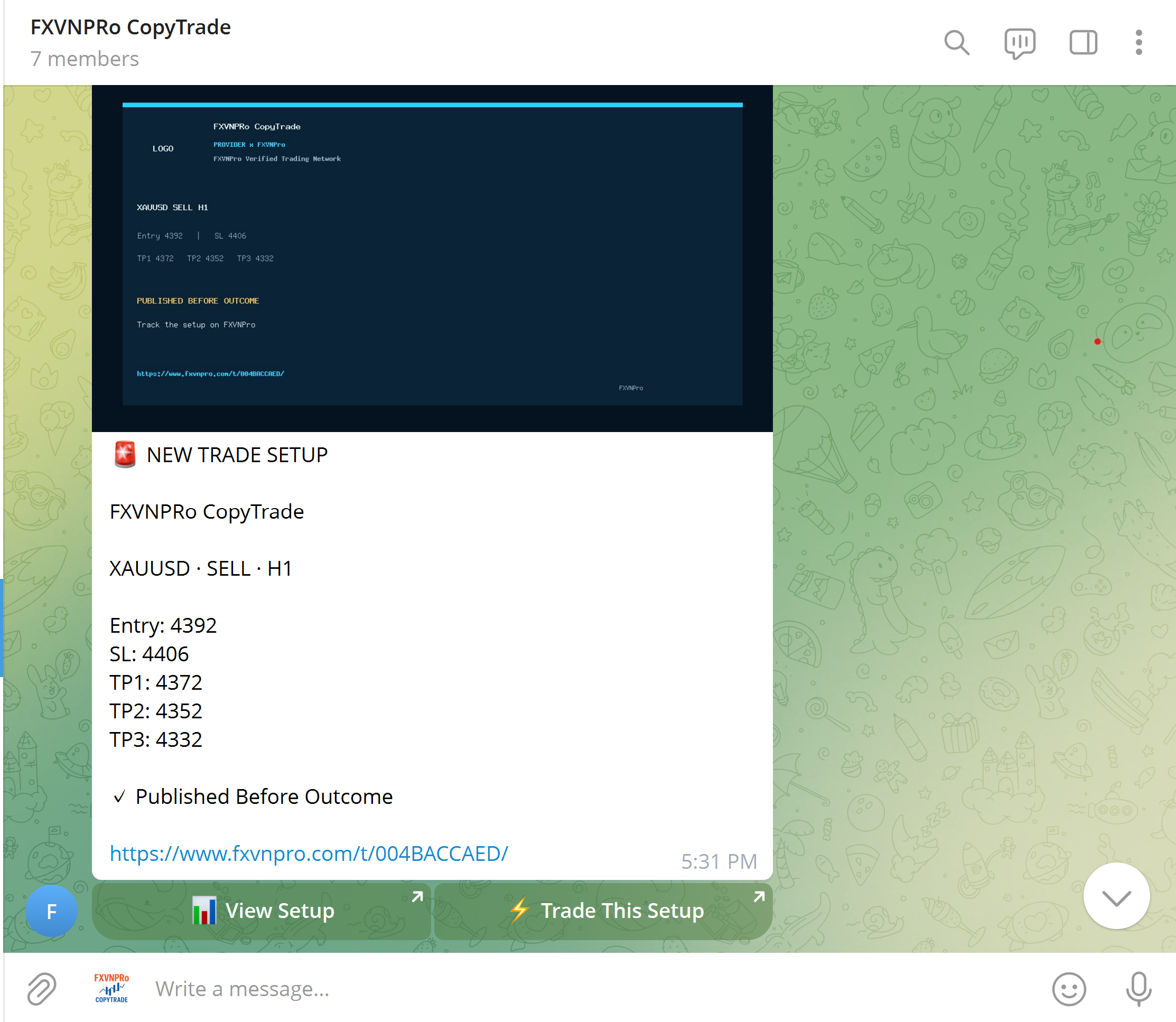 2 · TELEGRAM
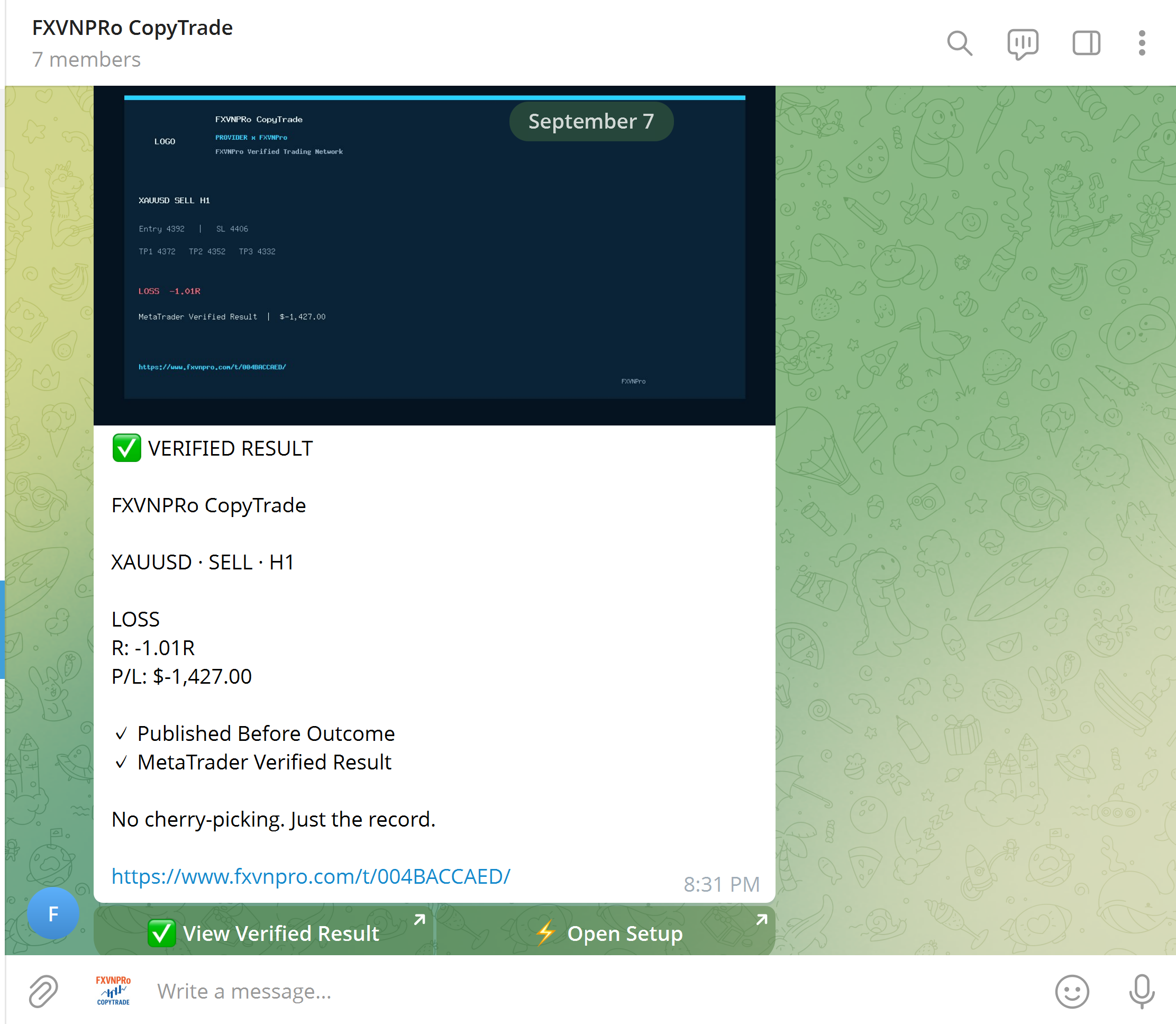 3 · VERIFIED
FXVNPro connects trade plans, Telegram trading communities and verified CopyTrade activity in one practical MT4/MT5 ecosystem.
Turn Entry, Stop Loss and Targets into a trade plan. Publish it before the outcome, then track and verify the result.
Turn Telegram signals into actionable MT4/MT5 setups. Signal Admins create the strategy while Members stay in control of risk.
Discover TRADERs, inspect verified trading history and performance, then decide who you want to follow across MT4 & MT5.
Build your strategy, distribute it to a community, or follow trading activity across MT4 & MT5.
Create Entry, Stop Loss and Targets before the outcome, then build a verified trading record.
Turn Telegram signals into an actionable workflow while followers keep control of their own risk.
Connect Chrome to MT4 or MT5 and open, modify or close trades from your browser.
Explore Masters and copy trading activity to your own MT4 or MT5 terminal with independent risk rules.