

PU PRIME
FVP Score
6.8/10
PU PRIME
- Minimum Deposit$20
- RegulationASIC, FSA
- PlatformsMT4, MT5
- SpreadFrom 0.1 pips
Start with your goal. You do not have to learn the FXVNPro architecture before using the tools.
Build an idea, use Telegram signals, trade from Chrome or follow a trader while technical setup stays in the background.
Technical connection details remain available inside each product when needed.
Compare PU PRIME and Titan FX by rating, regulation, minimum deposit, platforms, spreads, and overall trading conditions.
Use the FXVNPro Broker Checker Chrome extension to quickly review broker trust signals, ratings, and safety information while browsing broker websites.

| Feature | PU PRIME | Titan FX |
|---|---|---|
| Rating | 6.8 | 6.3 |
| Minimum Deposit | $20 | $50 |
| Regulation | ASIC, FSA | VFSC, FSA, FSC |
| Platforms | MT4, MT5 | MT4, MT5 |
| Spread | From 0.1 pips | From 0.1 pips |
Below is a detailed breakdown of fees, spreads, regulation, platforms, and real trading suitability to help you decide which broker fits your trading style better.
Here’s the thing most traders only learn after a few months of live trading: the broker you pick quietly decides how painful your edge becomes. In backtests, spreads are “average.” In real markets, costs show up exactly when you least want them—during news spikes, illiquid hours, and when your stop-loss is sitting a few pips too close.
So if you’re comparing PU PRIME vs Titan FX, don’t treat it like a brochure match. Treat it like an account-level question: what will your monthly trading actually cost, how stable is execution, and how much friction will you face when money moves in and out?
Both brokers offer MT4 and MT5, and both advertise spreads “from 0.1 pips.” On paper, that sounds close enough to ignore. But the details around minimum deposit, regulation mix, and the way spreads/fees behave in typical trading sessions can easily swing your results—especially if you scalp or trade frequently.
Quick snapshot: PU PRIME has a lower minimum deposit ($20) and a slightly higher rating (6.8 vs 6.3). Titan FX asks for more ($50) and has a different regulatory footprint (VFSC, FSA, FSC). If you’re asking which broker is better, the answer depends on how you trade—cost sensitivity, withdrawal friction, and whether you can afford to “learn” with a smaller or bigger starter account.
Let’s talk costs the way a trader actually experiences them: not in “from” numbers, but in the moments where slippage and spread widening hurt. Both brokers list spreads from 0.1 pips, which is great for headline comparisons. But spreads aren’t static. They widen on volatility, sometimes during rollover, and often around news when liquidity thins out.
PU PRIME’s minimum deposit is $20, which matters because it changes your “risk per attempt.” If you’re running smaller position sizes while you’re still learning, spread and any commission-like charges (if applicable) will take a bigger percentage out of your account. In real trading conditions, that can slow your progress more than you’d expect.
Titan FX’s minimum deposit is $50, which usually nudges traders to start with slightly larger buffers. That’s not automatically “better,” but it can make costs feel less brutal if your early learning process involves more trial trades.
Now, the big practical point: when brokers advertise spreads starting at 0.1 pips, you want to know what you’ll pay during the sessions you trade. For example, if you scalp during London open (often tight spreads), the advertised spread may show up more often. If you trade US news or late-session chop, the “from” spread can be misleading.
Which broker is cheaper in real scenarios? Based on the available data alone, you can’t prove commission differences, because neither listing includes a clear commission schedule here. But if spreads are truly comparable in normal conditions, PU PRIME’s lower minimum deposit makes it the cheaper entry for frequent smaller traders. For larger accounts and heavier trading, the deciding factor is less “minimum deposit” and more how spreads behave during your active hours.
When traders say “regulation matters,” they often mean it vaguely. You and I both know it’s more specific than that. Regulation affects oversight, complaint handling, and the broader credibility of the brokerage model. It doesn’t eliminate risk, but it changes how seriously the business is monitored.
PU PRIME lists regulation under ASIC and FSA. Titan FX lists VFSC, FSA, and FSC. The key isn’t just that there are multiple regulators—it’s what those regulators represent in terms of supervision standards and the trust level traders tend to assign.
In practice, traders should verify the exact entity and account type that corresponds to the regulator. “Broker is regulated by X” can mean different things depending on jurisdiction structure, client classification, and whether your account is held under the same legal entity. This matters because your recourse options (in the worst case) are tied to the correct entity.
Here’s a real-world scenario: let’s say you’re trading size, everything runs smoothly for months, then you want a fast withdrawal after a profitable week. If the broker’s regulatory framework aligns well with your account jurisdiction, the process usually feels more predictable. If it doesn’t, you may run into extra verification steps or slower processing.
So which is safer? With PU PRIME’s ASIC involvement, many traders will lean toward it for perceived oversight strength. Titan FX’s multi-regulator footprint can also be legitimate, but the trust premium often goes to ASIC-regulated structures. Still—always verify the specific licensed entity before you deposit meaningful funds.
Both PU PRIME and Titan FX offer MT4 and MT5. That’s a big deal because it means you can keep your workflow: indicators you already use, Trading Programs (Expert Advisors) (EAs), and chart templates. If you’re coming from MT4, you don’t have to “relearn” the platform.
But the reality is that MT4/MT5 experience isn’t only about the software interface. It’s also about how your broker handles execution, how stable the connection is, and how cleanly the platform reflects real fills. Execution speed doesn’t show up on a feature list, and usability won’t save you if your orders are consistently delayed when liquidity drops.
Consider a simple but common trader behavior: you set limit orders during range markets and you expect them to fill at the level you see. In live trading, the difference between “market moves” and “execution reflects the market” becomes obvious quickly. If one broker tends to show wider effective spreads or occasional slippage more often during volatile candles, your strategy performance changes even if both brokers claim similar base spreads.
Another angle is advanced users: if you run EAs, you care about order handling reliability, trade context stability, and whether the broker environment is “EA-friendly” under stress. MT5 tends to handle some coding workflows better, but MT4 still dominates for many retail scalpers.
Bottom line: with both using MT4/MT5, the platform decision is mostly about broker execution quality and stability. Based on trader logic, you’ll notice differences only after you trade the same strategy across multiple sessions—so keep that in mind when you ask which broker is better for your trading experience.
A broker can look great on spreads and still frustrate you if deposits and withdrawals are slow or complicated. In real trading, withdrawals aren’t just “admin”—they’re how you manage risk and keep your account aligned with your plan.
PU PRIME’s minimum deposit is $20. For beginners, that’s a big psychological advantage. You can fund, test execution, and learn the platform without committing serious money upfront. The downside is that some brokers treat very small accounts differently operationally, and you may hit extra verification steps sooner because you’re “new” in their system.
Titan FX’s minimum deposit is $50. That typically means more friction at the start for some traders, but once you’re funded, it can reduce the feeling of “I’m gambling with small change.” If your goal is to actively trade rather than experiment, $50 is still manageable, but it’s enough to make costs feel less punishing.
Now think about withdrawal behavior. After a strong trading week, you want to withdraw without drama. The practical questions are: how long does it take, are fees involved, and will the broker request repeated documentation? Even if both brokers are capable, the operational style can differ.
Since the provided data doesn’t specify withdrawal timelines or fee schedules, you should treat this as a due-diligence checklist item. Look for whether the broker processes withdrawals consistently and whether they have transparent steps for verification.
In plain terms: PU PRIME is easier to start with due to the lower minimum deposit. Titan FX may be slightly more “serious account” oriented due to the higher starting threshold. Either way, don’t deposit more than you’re willing to troubleshoot during the first week.
If you’re new, you’re not really choosing between spreads—you’re choosing between stress levels. Beginners often misread early losses as “strategy failure,” when it’s actually cost drag, slow execution, or simply market conditions not matching what they assumed.
On that front, PU PRIME looks more beginner-friendly because of the $20 minimum deposit. That matters because you can test your basic setup: placing market orders, understanding how stops behave, checking how long fills take, and seeing how spread looks during the hours you trade. When you’re learning, smaller deposits reduce the damage from inevitable mistakes.
Titan FX’s $50 minimum deposit isn’t outrageous, but it’s more commitment. If you’re still figuring out position sizing, risking 1–2% per trade, and learning how spreads widen outside your preferred hours, that extra $30 can feel meaningful.
Regulation also affects beginners. Many newer traders are understandably anxious about safety, so the regulatory perception matters. PU PRIME’s ASIC involvement is likely to feel more reassuring to a lot of people, while Titan FX’s combination (VFSC, FSA, FSC) can still be credible—just less familiar to some retail traders.
Here’s the beginner scenario that repeats constantly: you place a trade, it doesn’t go where you expected, and you blame yourself. But if the broker’s execution is less consistent during volatility, you can end up doubting your entire approach. That’s why your first 20–30 trades should be treated like a live demo with real money.
Which broker is better for beginners? Based on the available details, PU PRIME edges it primarily due to the lower minimum deposit and a strong “start small, learn fast” fit.
For active traders, the broker is less about comfort and more about performance consistency. You care about spreads and trading costs, but also about execution speed, slippage, and how often your orders get filled at the price you expect.
Both PU PRIME and Titan FX advertise spreads from 0.1 pips. For scalping and day trading, that’s the right direction—tight spreads reduce the “time you need to be right” before your trade becomes profitable. But tight spreads alone don’t make a broker ideal. The real test is what happens when the market stops being polite.
Imagine a day trader trading EUR/USD around major US data releases. One broker might keep spreads tight until the news hits, then widen sharply. Another might widen less but show more slippage. Which is better? That depends on your strategy: do you rely on limit orders at specific levels, or do you use market execution and accept minor variance?
Titan FX has a higher minimum deposit ($50). Active traders sometimes prefer that because it encourages accounts to be funded more meaningfully from day one. But minimum deposit isn’t an execution metric, so it won’t directly improve fills.
What you should check (and traders often forget): whether the broker’s MT4/MT5 environment remains stable during high activity. Does the platform lag when you’re placing multiple orders? Do trade reports and fills match what you see on the chart? These are the “hidden frictions” that show up after dozens of trades.
Active-trader takeaway: both brokers can work, but if you’re serious about scalping, you should trial both during your exact trading hours. If PU PRIME’s execution is consistently cleaner for you, it becomes the easier choice—especially with its lower barrier to experimentation.
One practical note: don’t judge a broker solely on rating numbers (6.8 vs 6.3). Ratings are useful as a signal, but trading outcomes depend on your personal execution experience—especially slippage and spread behavior during your strategy’s target conditions.
If you forced me to give a clear recommendation from the information provided, I’d say PU PRIME is the better starting point for most traders—mainly because of the $20 minimum deposit and the slightly higher overall rating. For beginners and even intermediate traders who want to test execution without tying up a larger sum, that lower barrier is meaningful. In the early stage, money spent “learning” is still money spent, and PU PRIME gives you more room to learn with less pressure.
For active traders, the decision tightens. Both brokers advertise spreads from 0.1 pips and both offer MT4/MT5. That means the edge will come down to your lived experience: slippage frequency, spread widening during your busiest hours, and how consistently fills match the chart. If PU PRIME delivers cleaner execution for your strategy during news and high-volume sessions, it becomes the practical winner.
Titan FX may be the better fit for traders who prefer its specific regulatory setup and who are comfortable starting at $50. But I wouldn’t call it the “cheaper” option without a clear commission/fee schedule, because the cost difference can flip in real trading once you factor in execution realities.
So which broker is better for you? If you’re asking “PU PRIME vs Titan FX” because you want a low-friction entry and a strong chance of favorable early execution testing, pick PU PRIME. If you specifically want Titan FX’s regulatory mix and you’re ready to start with a bigger minimum deposit, then Titan FX is worth trialing—ideally with a short, controlled live test on the Connects and sessions you trade.
One real XAUUSD trade: created before the outcome, sent to Telegram, TRADEd in MT5 and returned as a verified result.
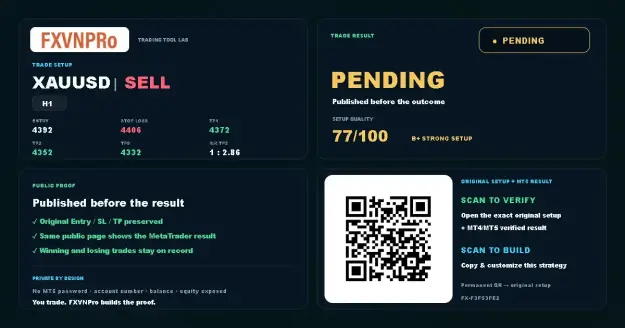 1 · SETUP
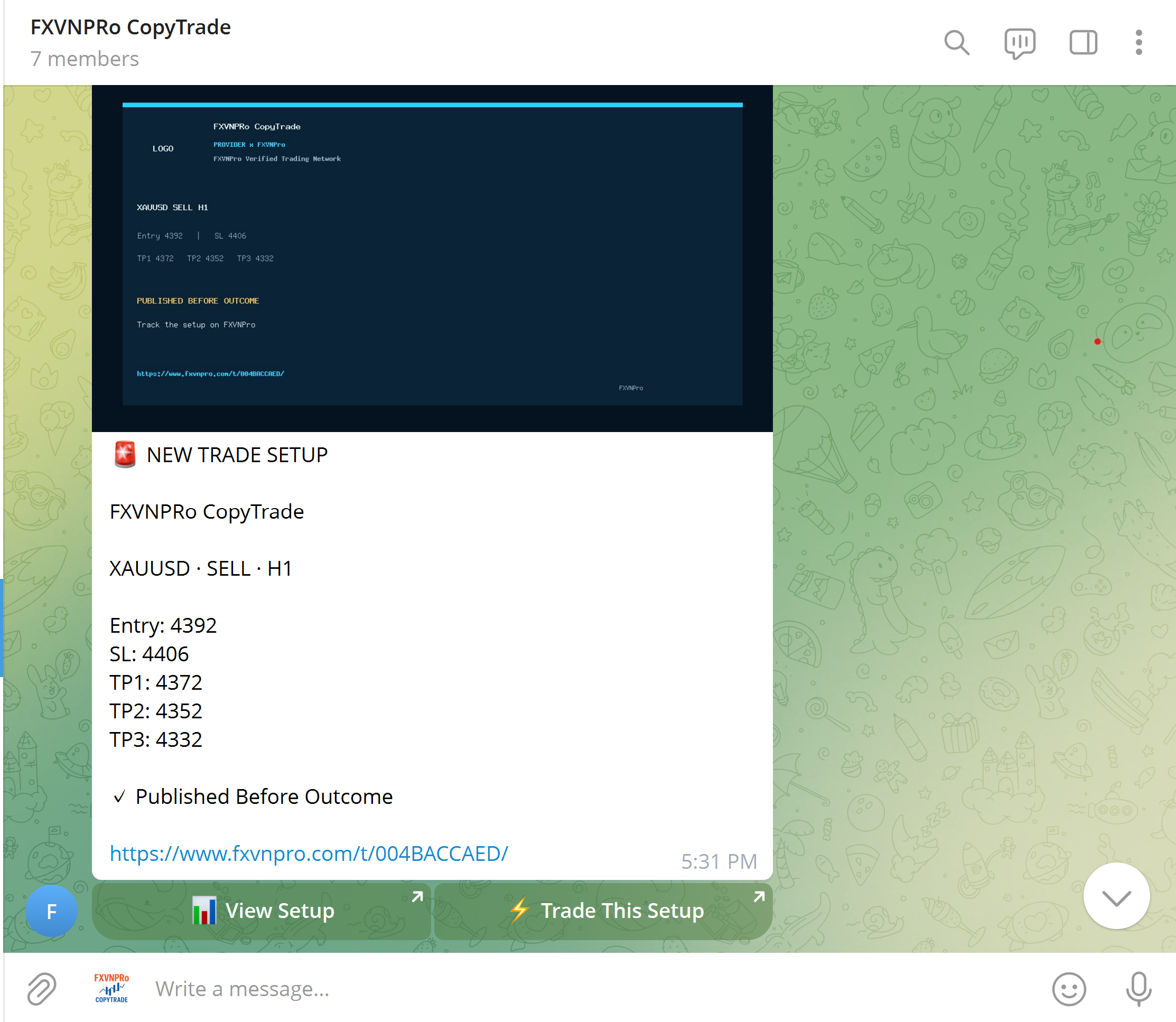 2 · TELEGRAM
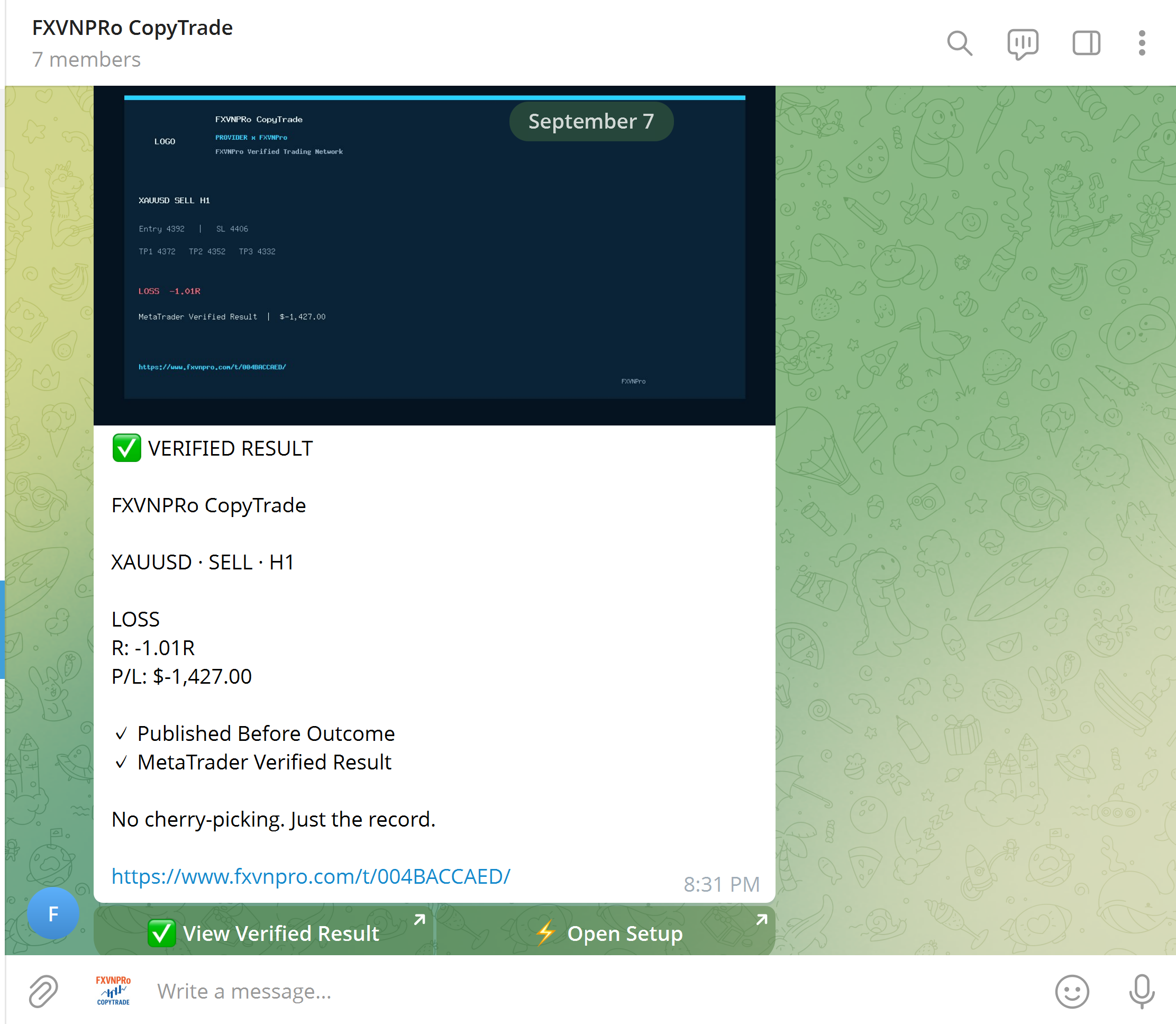 3 · VERIFIED
FXVNPro connects trade plans, Telegram trading communities and verified CopyTrade activity in one practical MT4/MT5 ecosystem.
Turn Entry, Stop Loss and Targets into a trade plan. Publish it before the outcome, then track and verify the result.
Turn Telegram signals into actionable MT4/MT5 setups. Signal Admins create the strategy while Members stay in control of risk.
Discover TRADERs, inspect verified trading history and performance, then decide who you want to follow across MT4 & MT5.
Build your strategy, distribute it to a community, or follow trading activity across MT4 & MT5.
Create Entry, Stop Loss and Targets before the outcome, then build a verified trading record.
Turn Telegram signals into an actionable workflow while followers keep control of their own risk.
Connect Chrome to MT4 or MT5 and open, modify or close trades from your browser.
Explore Masters and copy trading activity to your own MT4 or MT5 terminal with independent risk rules.