Plan a Trade
Build a trade plan and use practical trading tools before you act.
Trade IdeasRisk ToolsCalculators
BUILD A TRADE IDEA →
Start with your goal. You do not have to learn the FXVNPro architecture before using the tools.
Build an idea, use Telegram signals, trade from Chrome or follow a trader while technical setup stays in the background.
Technical connection details remain available inside each product when needed.
Plan trades, connect MT4 & MT5, review verified execution, explore traders and research brokers — without learning the whole platform first.
Build a trade plan and use practical trading tools before you act.
Use Browser Trading or turn supported Telegram signals into a structured trading workflow.
Explore CopyTrade TRADERs, review their records and choose your own risk settings.
Everything is still here — organized by what it helps you do.
Compare Just Markets and PU PRIME by rating, regulation, minimum deposit, platforms, spreads, and overall trading conditions.
Use the FXVNPro Broker Checker Chrome extension to quickly review broker trust signals, ratings, and safety information while browsing broker websites.


| Feature | Just Markets | PU PRIME |
|---|---|---|
| Rating | 6.5 | 6.8 |
| Minimum Deposit | $10 | $20 |
| Regulation | CySEC, FSA, FSCA, FSC | ASIC, FSA |
| Platforms | MT4, MT5 | MT4, MT5 |
| Spread | From 0.1 pips | From 0.1 pips |
Below is a detailed breakdown of fees, spreads, regulation, platforms, and real trading suitability to help you decide which broker fits your trading style better.
If you’ve ever placed a trade and watched the price move like it’s trolling you, you already know forex costs aren’t just “the spread.” They’re also slippage, execution quality, and how your broker handles normal market chaos—news spikes, thin liquidity hours, and those annoying moments when your stop-loss gets tagged a few ticks early.
This is exactly why Just Markets vs PU PRIME is a comparison worth taking seriously. On paper, both brokers advertise tight spreads (from 0.1 pips) and both offer MT4 and MT5. But in real trading conditions, the details behind the headline numbers can decide whether you’re compounding or slowly bleeding out.
This review is aimed at active retail traders—especially those who trade intraday, use automated strategies, or care about execution speed. If you’re a long-term swing trader, you can still benefit from reading, but your cost sensitivity is usually lower.
Quick snapshot of the differences: Just Markets starts at a lower minimum deposit ($10) and operates under a wider set of regulators (CySEC, FSA, FSCA, FSC). PU PRIME starts a bit higher ($20) and is regulated by ASIC and FSA. Both provide MT4/MT5 and spreads “from 0.1.”
So which broker is better for your trading style? Let’s get into the fees comparison, spreads and trading costs, and the stuff traders actually feel in their account balance.
Let’s talk about costs the way a trader experiences them: not as marketing claims, but as repeated micro-losses that add up. Both Just Markets and PU PRIME list spreads starting from 0.1 pips. That’s a strong headline, but spreads are most competitive in ideal conditions—major Connects during liquid hours, not during news or end-of-day chop. The question is: what happens when conditions aren’t “ideal”?
First, the obvious. If there’s no commission model mentioned in the provided data, your primary direct cost becomes the spread itself. In practice, that means the spread width you see on your platform and how consistently it holds during the hours you trade. A broker can advertise “from 0.1,” yet still widen aggressively at the moments that hurt most.
Now the less obvious part: execution and slippage. Even if spreads look similar, a broker with slower execution can turn a “tight spread” into a worse average fill price. For example, during a US CPI release, EUR/USD might show a tight quoted spread, but your order fill could slip through the market. That slippage behaves like a hidden fee.
For a real trading scenario: imagine you run a day-trading plan on EUR/USD with 30 trades per month. If one broker averages 0.2 pips wider over your trade set—whether due to spread widening or execution—at typical pip value, you’ll feel it in monthly P&L. Over a year, that can be a meaningful performance gap.
Between these two, the “fees comparison” hinges on consistency, not the lowest print. With the data we have (both “from 0.1”), the safer assumption is that the winner will be the broker that keeps execution cleaner when volatility hits. In my experience, that’s often where regulation footprint and infrastructure choices show up indirectly.
When traders ask about safety, they often want a simple answer: “Are they regulated?” The better question is: what does that regulation mean for you when something goes wrong? Because regulation affects complaint handling, oversight standards, and the likelihood that the broker’s operations stay aligned with market rules.
Just Markets is listed under CySEC, FSA, FSCA, and FSC. That’s a broader regulatory spread than most retail brokers. Multiple regulators can mean the broker has to maintain processes that satisfy different jurisdictional expectations—risk controls, reporting, and operational standards. For a trader, that typically translates into a more stable trading environment, particularly around client money handling and governance.
PU PRIME is listed under ASIC and FSA. ASIC is generally viewed as strict in terms of compliance culture. Still, fewer regulatory jurisdictions doesn’t automatically mean “worse,” but it can mean fewer external layers of oversight depending on where you’re located and how the broker structures operations for different regions.
Here’s the practical angle: regulation matters most when traders are stressed—when they’re trying to withdraw, when spreads blow out during volatility, or when there’s a dispute. Verification isn’t just “nice to have.” It’s how you reduce the risk that you’re dealing with a broker that can change policies without much friction.
So which one feels safer? Based purely on the provided regulation footprint, Just Markets looks stronger on breadth. That said, your own residency and the exact entity you trade with matters a lot. Always verify the regulated entity on your account details—don’t rely on the headline page.
Both brokers offer MT4 and MT5, which is good news because it means you’re not locked into some proprietary platform. For traders, the platform is where execution, charting, order handling, and indicator reliability become real. MT5 often feels better for multi-timeframe work and strategy testing, but MT4 still wins for simplicity and long-standing ecosystem compatibility.
In day-to-day use, what you’ll notice isn’t just the presence of MT4/MT5—it’s how smooth the experience is: does your order ticket load instantly, does the platform freeze during high tick activity, and does the broker’s server respond quickly when you place market orders? Those things influence whether your trading is precise or sloppy.
Execution speed and slippage aren’t purely “broker magic.” They’re tied to server performance and how your orders are routed. Even with the same platform, different brokers can create very different fill quality.
Tools also matter. If you run an EA (expert advisor), what you care about is whether the backtest assumptions align with forward execution. If a broker’s execution model differs, you can get the classic “my EA worked in backtests but fails live” problem. That’s not the EA’s fault every time, and it’s definitely not a concept you want to discover after you’ve deployed size.
For a practical scenario: if you’re placing stop orders around key levels and using tight risk (say, 10–15 pip stops on major Connects), the platform’s responsiveness to price changes and how quickly stop-loss orders are acknowledged can affect how often you get stopped out.
Given the shared platform availability, the deciding factor comes down to how each broker’s MT4/MT5 feed and execution behave under stress. If you’re serious about execution quality, you should test both brokers with a small live account and a simple strategy for a week.
Traders often obsess over spreads and forget the boring parts—until they need to withdraw. Deposit speed, withdrawal processing times, and any friction around payment methods can shape your real trading experience more than you’d think.
Based on the provided minimum deposits, Just Markets starts at $10, while PU PRIME starts at $20. That difference looks small, but it matters if you’re funding multiple strategies, running a trial, or testing execution with limited risk. A lower minimum can reduce your “test cost” and help you iterate faster.
Withdrawal experience is where patience gets tested. In real trading conditions, you’re not always withdrawing on calm days—sometimes it’s after a good week, sometimes right after a losing streak when you want to reset. If a broker’s withdrawal process is slow or requires extra verification steps, it can disrupt your risk management.
Also pay attention to fees. Even if the broker doesn’t advertise withdrawal fees clearly, payment Signal Admins or intermediary banks can charge their own costs. Those charges effectively raise your total trading cost, especially if you withdraw frequently.
Here’s a scenario: you trade actively, then decide to move funds to another broker after testing. If one broker makes withdrawals take days and adds document requests, you lose time and flexibility. Time is risk, too—markets don’t wait.
In general, the best approach is to choose the broker that matches your funding style. If you want quick onboarding and the ability to test with small capital, Just Markets’ $10 minimum has an advantage. But the real differentiator will be the withdrawal flow on your chosen payment method, which you should verify before you commit serious size.
If you’re new, the goal isn’t just to trade—it’s to trade without adding unnecessary friction. Beginners struggle with emotions, inconsistent strategy rules, and overtrading. So when you’re comparing brokers, you want a setup that reduces surprises.
Both brokers offer MT4 and MT5, which helps because you likely won’t feel like you’re learning an unfamiliar platform. That matters. A beginner should focus on position sizing, stop-loss placement, and understanding what spreads mean, not figuring out how a broker’s order execution behaves.
Then there’s the minimum deposit. Just Markets at $10 is more forgiving if you’re learning and still making mistakes. PU PRIME at $20 is also workable, but it’s slightly less forgiving for someone who wants to keep risk small while they build confidence.
Another beginner factor is cost visibility. When spreads widen unexpectedly, beginners often misread it as “the market moved against me” rather than “my broker’s execution in that condition was worse.” Over time, that can mess with your confidence and distort your learning curve.
For example, a new trader might place a trade during a low-liquidity hour expecting a tight spread, only to see the spread widen and the position move quickly. That doesn’t mean they’re wrong about trading—it means they need a broker that behaves predictably.
Based on the information given, Just Markets edges out for beginners mainly due to the lower minimum deposit and broader regulatory footprint. But beginners should still do one crucial thing: test execution with a tiny live account and compare average fills on the Connects they actually trade.
Active traders don’t live on “from 0.1” spreads—they live on what the broker delivers repeatedly. Scalping is especially brutal because you’re taking many small edges. If your average spread or slippage is even slightly worse, the strategy can quietly underperform despite decent backtests.
Both brokers list spreads starting from 0.1 pips and support MT4/MT5, so on paper they’re both viable. But active traders should look at execution speed and how spreads behave around the trading session boundaries and during news. In real trading conditions, that’s when the market becomes less forgiving.
Consider a day trader who trades only during London and the first part of New York. They might run quick entries around breakouts, using tight stops and expecting clean fills. If one broker widens spreads modestly during spikes, the trader’s risk-reward ratio changes—sometimes by enough to flip a strategy from profitable to just barely break-even.
For scalpers, the difference between a broker that fills orders cleanly and one that introduces extra slippage can be the difference between a stable monthly result and a frustrating grind. You don’t want to discover this after you’ve scaled up. Test with low size first, then observe your average fill quality and whether spreads widen more than expected.
Also think about platform behavior. MT4/MT5 can handle high-frequency activity, but your broker’s server and order routing determine whether you experience delays or requotes. Those are death by a thousand cuts for active traders.
With the limited data provided, I’d rank PU PRIME slightly closer to parity with Just Markets for active trading because their spread positioning is identical and they have a major-regulator presence (ASIC). But the actual edge depends on execution consistency, which you can only confirm with short live testing.
If you forced me to give a clear decision from the information provided, I’d choose Just Markets as the better overall option—mainly because it Connects a lower minimum deposit ($10) with a wider regulatory footprint (CySEC, FSA, FSCA, FSC). For most traders, that combination reduces friction when you’re starting and adds a bit more comfort around operational oversight.
That said, PU PRIME is not automatically “worse.” It’s very competitive on the headline spreads (from 0.1 pips) and has ASIC listed, which can be a meaningful signal for stability. If you’re an active trader who cares about execution discipline and you’re comfortable with the $20 minimum, PU PRIME can absolutely be worth a live test.
Here’s the clean takeaway:
One last rhetorical question: why gamble your edge on assumptions when you can test both? Open small live accounts, trade the same simple plan for a week, and compare your real spreads and slippage. That practical check will answer the “fees comparison” question better than any brochure.
One real XAUUSD trade: created before the outcome, sent to Telegram, TRADEd in MT5 and returned as a verified result.
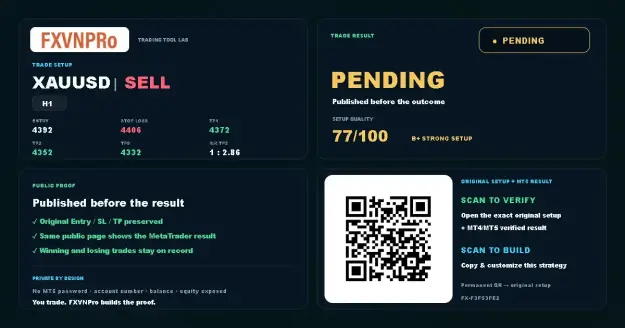 1 · SETUP
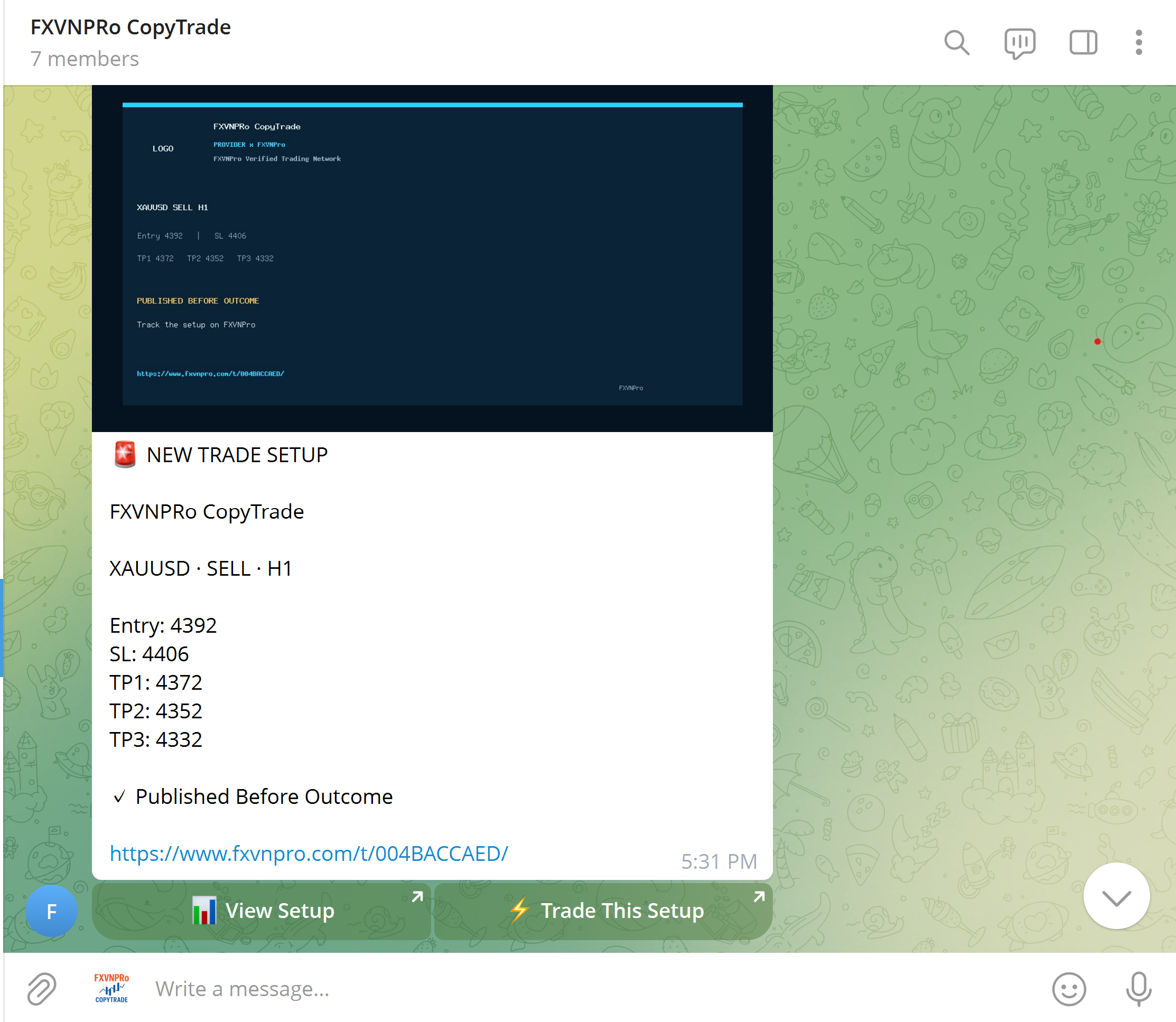 2 · TELEGRAM
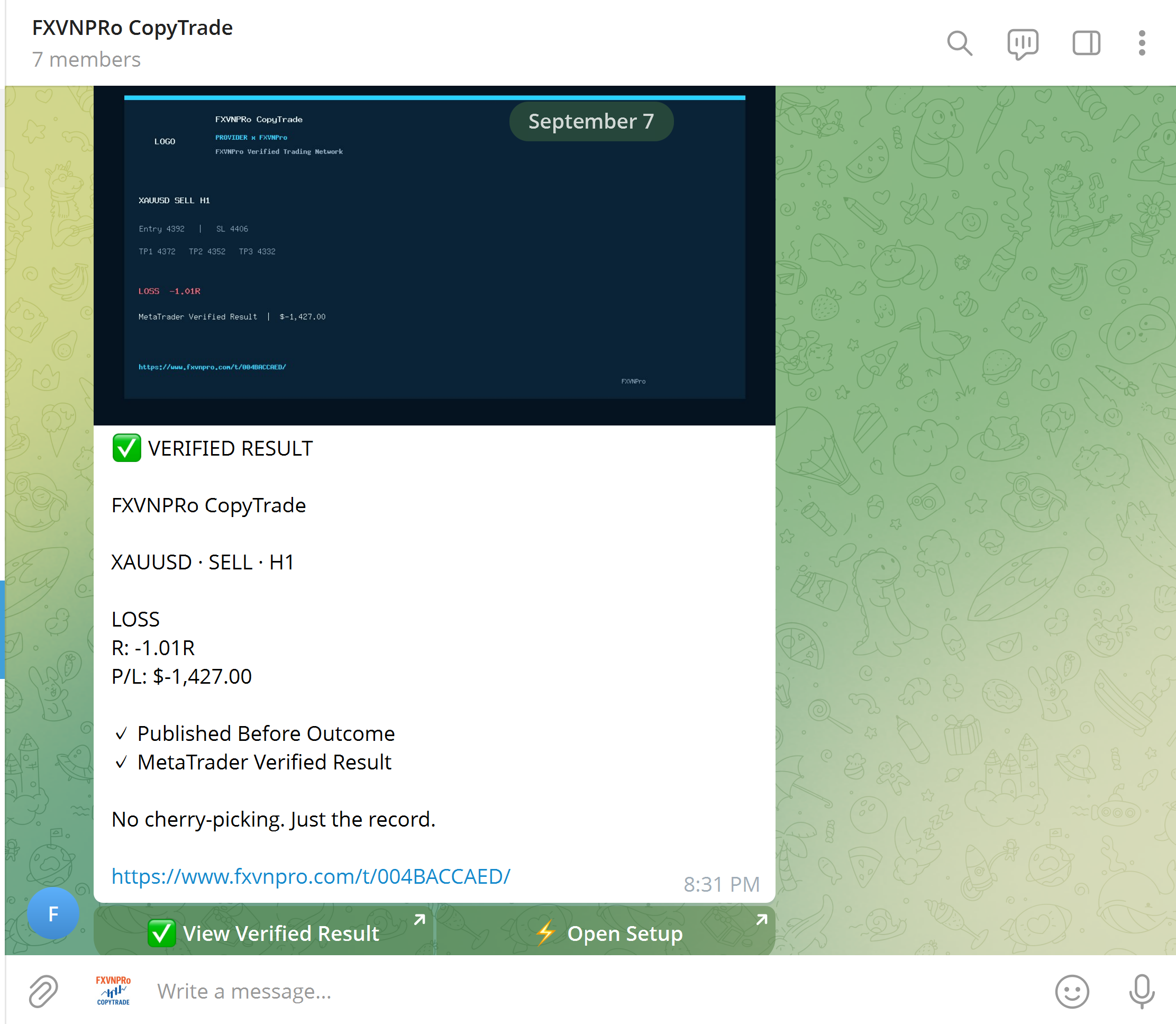 3 · VERIFIED
FXVNPro connects trade plans, Telegram trading communities and verified CopyTrade activity in one practical MT4/MT5 ecosystem.
Turn Entry, Stop Loss and Targets into a trade plan. Publish it before the outcome, then track and verify the result.
Turn Telegram signals into actionable MT4/MT5 setups. Signal Admins create the strategy while Members stay in control of risk.
Discover TRADERs, inspect verified trading history and performance, then decide who you want to follow across MT4 & MT5.
Build your strategy, distribute it to a community, or follow trading activity across MT4 & MT5.
Create Entry, Stop Loss and Targets before the outcome, then build a verified trading record.
Turn Telegram signals into an actionable workflow while followers keep control of their own risk.
Connect Chrome to MT4 or MT5 and open, modify or close trades from your browser.
Explore Masters and copy trading activity to your own MT4 or MT5 terminal with independent risk rules.