Plan a Trade
Build a trade plan and use practical trading tools before you act.
Trade IdeasRisk ToolsCalculators
BUILD A TRADE IDEA →
Start with your goal. You do not have to learn the FXVNPro architecture before using the tools.
Build an idea, use Telegram signals, trade from Chrome or follow a trader while technical setup stays in the background.
Technical connection details remain available inside each product when needed.
Plan trades, connect MT4 & MT5, review verified execution, explore traders and research brokers — without learning the whole platform first.
Build a trade plan and use practical trading tools before you act.
Use Browser Trading or turn supported Telegram signals into a structured trading workflow.
Explore CopyTrade TRADERs, review their records and choose your own risk settings.
Everything is still here — organized by what it helps you do.
Compare Just Markets and OCTA by rating, regulation, minimum deposit, platforms, spreads, and overall trading conditions.
Use the FXVNPro Broker Checker Chrome extension to quickly review broker trust signals, ratings, and safety information while browsing broker websites.


| Feature | Just Markets | OCTA |
|---|---|---|
| Rating | 6.5 | 6.6 |
| Minimum Deposit | $10 | $25 |
| Regulation | CySEC, FSA, FSCA, FSC | FSC, FSCA, CySEC, MISA |
| Platforms | MT4, MT5 | MT4, MT5 |
| Spread | From 0.1 pips | From 0.1 pips |
Below is a detailed breakdown of fees, spreads, regulation, platforms, and real trading suitability to help you decide which broker fits your trading style better.
If you’ve ever had a “great trade” turn into a frustrating loss, you already know the culprit isn’t always your strategy. Sometimes it’s the boring stuff: spreads that widen at the wrong time, execution that feels slightly off, or costs that don’t show up until you’re three weeks into live trading. That’s why I like comparisons that actually talk about money and trading conditions, not just marketing language.
This review focuses on Just Markets vs OCTA—two brokers that are often shortlisted by traders in regulated regions who want MetaTrader trading and tight spreads. On paper, both look similar: MT4/MT5 support, spreads “from 0.1 pips,” and multiple regulators. But in real trading, those small differences matter more than most people expect.
Quick snapshot: Just Markets has a lower minimum deposit ($10) and a slightly lower published rating (6.5). OCTA starts at $25 with a rating of 6.6. Both list multi-regulatory oversight (CySEC, FSCA, and others depending on jurisdiction) and both offer MT4 and MT5.
So which broker is better—and for whom? If you’re scalping, day trading, or running frequent orders, the fees comparison and how spreads behave in live conditions will be the deciding factor. If you’re newer, minimum deposit and friction in deposits/withdrawals tend to matter more than micro-optimizing costs.
Let’s break it down properly, trader-to-trader style.
On websites, spreads often read like a neat number you can plan around. In live markets, spreads are a range. Your actual cost is the spread you get at the moment you hit the button—plus any commission (if applicable), financing, and swap effects when you hold positions.
Both brokers advertise spreads “from 0.1 pips.” That’s a good starting point, especially for EUR/USD and liquid Connects where spreads can tighten under normal conditions. But the key question for spreads and trading costs is: how often do you see that low end during the times you trade?
Here’s the practical part. Suppose you’re running a simple day-trading plan: 20 trades per week, average stop distance 20 pips, targeting 1:1. If your effective spread is 0.1 pips on the best executions but 0.5 pips more often around news, your average entry cost isn’t “0.1”—it’s higher. Over dozens of trades, that adds up quickly, and it can swing a strategy from “stable” to “fragile.” This matters because spreads behave differently during volatility, and execution speed affects how cleanly you get filled at your intended price.
Now, about hidden fees. Many brokers structure costs with spreads plus potential commission or account-specific differences. The data provided here lists spreads but doesn’t specify commission schedules. So the safest trader approach is to compare your real account statements: total cost per round turn, including any commission or swap. In real scenarios, the cheaper broker is the one where your average effective spread + fees are lower on your usual Connects and your usual trading hours.
Just Markets vs OCTA may both show “from 0.1 pips,” but the winner for most active traders will be the one with tighter average execution when it’s busy—especially during London and overlapping sessions.
Regulation is one of those topics traders either skim or overthink. The right way is neither. You don’t just want a logo—you want real oversight, complaint processes, and rules that reduce the chance of operational chaos.
Just Markets lists regulation from CySEC, FSA, FSCA, and FSC. OCTA lists FSC, FSCA, CySEC, and MISA. Both have multi-jurisdiction coverage, which is generally a positive sign for operational maturity. But here’s the nuance: different regulators have different capital requirements, reporting standards, and approach to client protections.
For a trader, the practical impact shows up in trust and risk management. If something goes wrong—withdrawal delays, account restrictions, platform outages—you want a regulator framework that actually enforces accountability. Verification processes matter too. A broker that requires compliant onboarding and follows local rules typically has fewer “surprises” later.
In real trading conditions, safety isn’t just about whether the broker is “regulated.” It’s about how consistently they follow through on fundamentals: clear account terms, transparent trading conditions, and timely responses when you need support. I’ve seen traders lose confidence because of slow ticket handling during high-volatility weeks. Under stress, regulatory credibility can influence the speed and seriousness with which issues are addressed.
So which broker is safer? Based purely on the provided data, both are in the “regulated and worth considering” category. The difference becomes less about the headline and more about the specific license active in your country, and how easily you can get a clear answer on protections and dispute handling.
If you’re deciding which broker is better for safety, check (1) which entity you’re actually trading with, (2) what client money protections are described for that entity, and (3) how withdrawals behave historically in your region.
Both Just Markets and OCTA offer MT4 and MT5. For most traders, that’s not a small thing. MT4/MT5 ecosystems are mature: custom indicators, EAs, VPS hosting, and reliable charting workflows. If you already trade algorithmically or rely on a specific indicator, switching brokers is usually less painful with MT4/MT5 than with proprietary platforms.
But platform choice is only half the story. What matters is how the platform feels under pressure—when price moves fast and you’re trying to manage risk without hesitation. Execution speed and slippage are the hidden variables. Even small slippage during high-frequency entries can matter for scalpers and intraday traders who repeat the same pattern all day.
In real trading, I care about a few things more than “features”: does the terminal connect reliably, are prices updated smoothly, and how consistent are order fills? MT5 can be more modern in structure, but some EAs and workflow setups are still MT4-first. So the “better” platform depends on your habits.
Tools also include what you can do around the trade: stop-loss handling, trailing stops, alerts, and order modification speed. If you’re placing multiple pending orders around a key level, the time between signal and order acceptance becomes part of your edge.
Both brokers appear to keep it simple: you get MT4/MT5, and you bring your strategy. That’s fine. The differentiator is the trading environment around those platforms—especially execution quality and how spreads behave when the market heats up.
If you’re evaluating execution speed, slippage, and trading experience, don’t just look at screenshots. Test both with a small live account or a tight demo-to-live transition, then compare fill quality during your usual session.
Deposits and withdrawals rarely get the attention they deserve until you need them. And traders usually “need them” at the worst times—right after a good week, during a drawdown, or when markets are moving and you want to reduce exposure.
Minimum deposit is one obvious friction point: Just Markets starts at $10, while OCTA starts at $25. If you’re testing strategies, running a smaller account, or simply want to avoid tying up more capital than necessary, that $15 difference can matter. This matters because it affects whether you can start trading with realistic sizing rather than forcing yourself to wait.
But minimum deposit isn’t the whole deposits story. The real experience is how quickly you can fund, whether the process is smooth, and whether withdrawals require heavy documentation. Many brokers are perfectly fine for deposits but take longer for withdrawals—especially if your account verification isn’t clean.
In real trading conditions, I look for three things: (1) deposit speed (minutes vs hours), (2) withdrawal speed (same day vs multi-day delays), and (3) whether fees show up unexpectedly. Even if one broker offers faster withdrawals, hidden processing fees or stricter withdrawal rules can offset that advantage.
We don’t have detailed payment method tables here, so I can’t claim exact processing times. What I can say is that when comparing Just Markets vs OCTA, the smarter approach is to confirm: which deposit methods are available in your region, what the withdrawal timeline is for that method, and whether broker policies differ for new clients versus verified accounts.
If you plan to scale up, start by verifying the withdrawal process early—before you’re in a hurry.
If you’re new, you’re not just learning forex—you’re learning broker behavior. That includes platform quirks, spread variability, swap impacts, and what happens when you place trades quickly around news.
On paper, both brokers support MT4 and MT5, which is a big plus for beginners because these platforms are widely documented and easier to learn in the long run. The difference starts with the “entry ticket.” Just Markets has a $10 minimum deposit, while OCTA has $25. For many beginners, that lower minimum reduces pressure. You can place smaller trades, learn position sizing, and avoid the psychological stress of putting too much money at risk early.
Another beginner angle is cost predictability. When you’re learning, you might not consistently hit the “best” spread moments. If your broker’s spreads stay relatively stable during your typical learning hours, you’ll have fewer surprises. That’s why spreads and trading costs matter even for beginners—if you keep getting slightly worse fills, it’s harder to tell whether your strategy is failing or the environment is.
Execution speed and slippage also matter because beginners tend to panic-adjust trades. If your order modifications don’t TRADE smoothly, you can end up paying for mistakes you didn’t intend to make.
Between the two, the “easier start” leans toward Just Markets for most beginners simply due to the lower minimum deposit. But if you value a specific regulatory entity in your region, that can flip the decision.
So, which broker is better for beginners? It depends on your region and your learning style—but in most cases, the lower barrier makes Just Markets the more forgiving place to start.
Active traders don’t fall in love with brokers; they interrogate them. Scalpers, day traders, and high-volume traders are basically asking the same question over and over: “When I need a clean fill, do I get it?” That’s where spreads and execution speed stop being marketing lines and become performance factors.
Both brokers claim spreads “from 0.1 pips,” which is encouraging. But for active trading, “from” is not a strategy. You want to know your effective spread distribution: how often do you get near the low end, and how bad does it get during news, rollover, or thin liquidity?
Slippage is the other big one. Even if your spread is tight, poor execution can still cost you. Imagine you run a scalping template on GBPJPY during a volatility spike. If your entries repeatedly fill a fraction late or at worse prices, your stops get hit more often, and your expected value drops. This matters because scalping strategies often rely on extremely consistent micro-costs—one rough session can wipe out the week’s edge.
Tools matter too. MT4/MT5 can handle high activity, but the broker’s environment—server stability, order modification responsiveness, and how quickly price updates—affects your ability to manage risk. If you’re placing multiple orders or using EAs that fire quickly, consistency matters more than flashy features.
Between Just Markets vs OCTA, both are plausible for active traders. My lean is that the winner for active trading will be the broker that shows (a) tighter average effective spreads and (b) fewer execution anomalies during your actual trading window.
Don’t guess. Run a focused live test: same Connects, same session, similar trade frequency, and then compare your actual execution costs and fill quality.
One more thing I’ll say bluntly: if your decision is based only on the lowest spread number on a page, you’re likely optimizing the wrong variable. The real edge is in what you actually pay per trade, how consistently you get fills, and whether withdrawals and support behave when you’re not in a calm market.
Here’s the clear takeaway for Just Markets vs OCTA: both brokers are credible enough to consider, but they fit different trader needs more naturally based on the information we have—especially minimum deposit and the practical cost variables behind spreads and execution.
Best for beginners (most of the time): Just Markets. The $10 minimum deposit is the deciding factor. It lowers the barrier to entry, makes it easier to size trades responsibly while you learn, and reduces the emotional pressure that often leads beginners to overtrade. Just confirm that your average spreads during your trading hours are acceptable and that your withdrawal process is smooth after verification.
Best for active traders (after you test): OCTA or Just Markets, but pick the one with better effective costs. Both advertise spreads from 0.1 pips and both offer MT4/MT5, so the differentiation comes down to real trading conditions: effective spread averages, slippage frequency, and order execution consistency during your session. If one broker gives you cleaner fills in your tests, that’s your winner—no debate.
Fees comparison bottom line: don’t compare only the “from” spread. Compare your actual round-turn trading cost (spread + any commission if applicable) and track results over 1–2 weeks with similar trade frequency.
If you want one direct recommendation: start with Just Markets if you’re learning or trading small initially; choose between them for active trading only after you’ve measured execution and effective spreads under your real conditions.
One real XAUUSD trade: created before the outcome, sent to Telegram, TRADEd in MT5 and returned as a verified result.
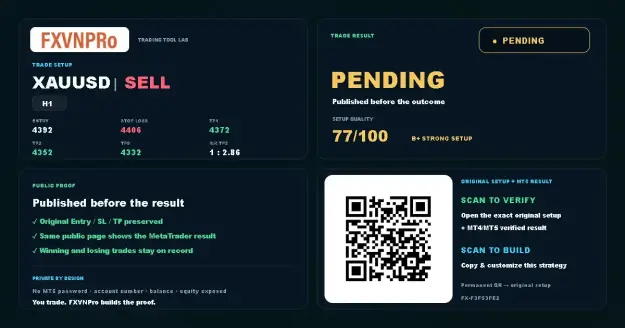 1 · SETUP
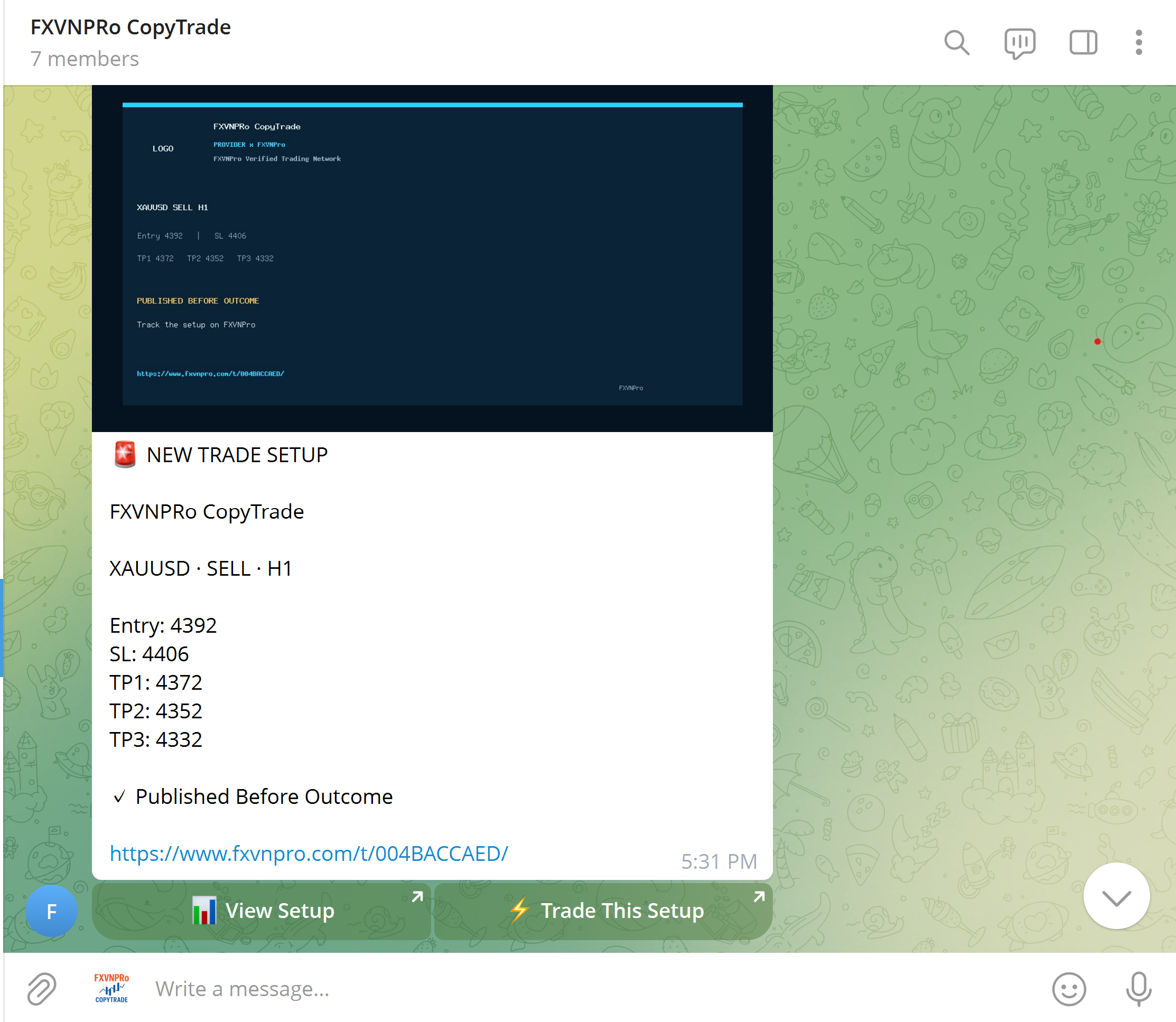 2 · TELEGRAM
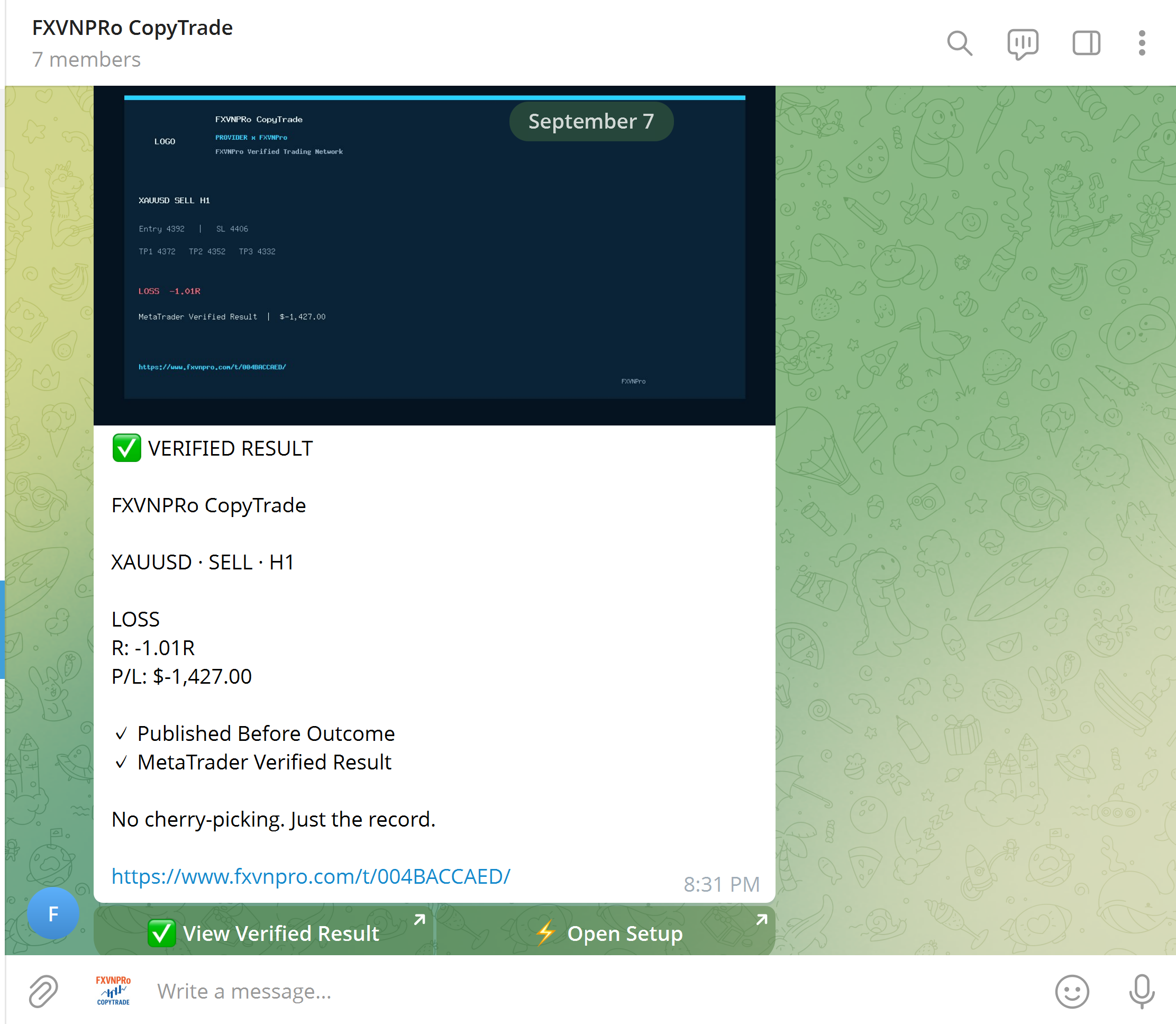 3 · VERIFIED
FXVNPro connects trade plans, Telegram trading communities and verified CopyTrade activity in one practical MT4/MT5 ecosystem.
Turn Entry, Stop Loss and Targets into a trade plan. Publish it before the outcome, then track and verify the result.
Turn Telegram signals into actionable MT4/MT5 setups. Signal Admins create the strategy while Members stay in control of risk.
Discover TRADERs, inspect verified trading history and performance, then decide who you want to follow across MT4 & MT5.
Build your strategy, distribute it to a community, or follow trading activity across MT4 & MT5.
Create Entry, Stop Loss and Targets before the outcome, then build a verified trading record.
Turn Telegram signals into an actionable workflow while followers keep control of their own risk.
Connect Chrome to MT4 or MT5 and open, modify or close trades from your browser.
Explore Masters and copy trading activity to your own MT4 or MT5 terminal with independent risk rules.