

OCTA
FVP Score
6.6/10
OCTA
- Minimum Deposit$25
- RegulationFSC, FSCA, CySEC, MISA
- PlatformsMT4, MT5
- SpreadFrom 0.1 pips
Start with your goal. You do not have to learn the FXVNPro architecture before using the tools.
Build an idea, use Telegram signals, trade from Chrome or follow a trader while technical setup stays in the background.
Technical connection details remain available inside each product when needed.
Compare OCTA and Tickmill by rating, regulation, minimum deposit, platforms, spreads, and overall trading conditions.
Use the FXVNPro Broker Checker Chrome extension to quickly review broker trust signals, ratings, and safety information while browsing broker websites.

| Feature | OCTA | Tickmill |
|---|---|---|
| Rating | 6.6 | 7.2 |
| Minimum Deposit | $25 | $50 |
| Regulation | FSC, FSCA, CySEC, MISA | FCA, FSCA, CySEC |
| Platforms | MT4, MT5 | MT4, MT5 |
| Spread | From 0.1 pips | From 0.0 pips |
Below is a detailed breakdown of fees, spreads, regulation, platforms, and real trading suitability to help you decide which broker fits your trading style better.
If you’ve ever backtested a strategy that looked profitable… then watched it bleed in live trading, you already know the annoying truth: the broker isn’t just a background service. It’s part of your performance. In FX, small differences in spreads, execution quality, and platform friction can turn a clean edge into a grind.
This OCTA vs Tickmill comparison is written for traders who care about trading costs and execution in real market conditions—not marketing slides. If you scalp, day trade news, or run an EA that relies on consistent fills, you’ll want to pay attention to spreads and how they translate into actual fees comparison. If you’re newer, you’ll also want to know whether the whole setup feels manageable when you’re still learning risk control.
Here’s the quick takeaway: OCTA starts with a lower minimum deposit ($25) and lists spreads from 0.1 pips, while Tickmill starts higher ($50) but advertises spreads from 0.0 pips. Both offer MT4 and MT5 and are regulated in multiple jurisdictions, but Tickmill’s higher overall rating (7.2 vs 6.6) suggests a slightly smoother day-to-day experience for many traders.
So which broker is better for your trading style? Let’s break it down properly—fees comparison first, then execution, safety, and where each broker fits depending on your risk and experience.
When traders say “cheap spreads,” they usually mean the headline number. But the price you pay is spread plus whatever the broker effectively charges through commissions (if any), swap/rollover conditions, and—this is the big one—how often you actually get near the displayed spread. In real trading conditions, spreads widen around volatility spikes, and slippage becomes part of the story.
OCTA lists spreads from 0.1 pips. Tickmill lists spreads from 0.0 pips. On paper, Tickmill looks better for cost-sensitive strategies. But here’s the practical question: how often do you see 0.0 in the Connects you trade, during the sessions you trade? Many brokers can print “from” levels during quieter liquidity windows, while your real edge is usually tested during London open, NY overlap, and news events.
Minimum deposits also affect your cost-risk profile. With OCTA, $25 is a lower barrier, so you can start with smaller position sizes. That matters because when you’re learning, you’re often trading smaller, and cost drag can hurt less. Tickmill’s $50 minimum can feel fine for active traders, but beginners sometimes feel constrained when they need to scale position size for risk.
Also watch for hidden friction: inactivity fees (if applicable), withdrawal costs, and the “spread vs commission” structure. Neither dataset here confirms commission models, so you should verify the exact account type you’re using. In my experience, the cheapest broker isn’t the one with the lowest spread headline—it’s the one where your strategy gets consistent fills and your effective cost stays predictable across the week.
In OTC FX, regulation isn’t just a badge—it’s a risk filter. It affects oversight, complaint handling, and the overall framework around client fund protection. Both OCTA and Tickmill show multi-jurisdiction regulation, which is a positive sign compared to offshore-only brokers.
OCTA is regulated by FSC, FSCA, CySEC, and MISA. That’s a broad footprint. CySEC and FSCA are well-known names in the industry, and seeing multiple regulators generally suggests the broker has to meet ongoing compliance requirements. Still, you should understand what each regulator covers in your region and how client funds are handled under those rules.
Tickmill is regulated by FCA, FSCA, and CySEC. FCA is often viewed as stricter and more demanding in terms of governance and conduct. If you’re trading larger size or you’re the type who sleeps better when compliance is tight, that FCA presence can matter.
Here’s the part many traders skip: verification. A regulated broker can still have different account structures, different fee schedules, and different execution policies. Before depositing, confirm the exact entity you’re dealing with, not just the brand. Also check whether the regulatory status matches your country and account currency.
Real-world lesson: if something goes wrong—withdrawal delay, dispute, or unexpected account restriction—you’ll want the regulator framework and the broker’s track record to back you up. Safety isn’t exciting, but it directly impacts your ability to keep trading when the market doesn’t cooperate.
Both brokers offer MT4 and MT5. That means you’re not choosing between platforms as much as you’re choosing how the broker supports them in day-to-day use. In trading, it’s often the small stuff: chart responsiveness, order handling, whether news spikes cause freezing, and how reliable your stop-loss placement feels when volatility hits.
MT4 remains the go-to for many algorithmic traders because of its simplicity and wide EA ecosystem. MT5 tends to appeal to traders who want more built-in features and a different order model. But no matter which platform you use, what matters is how quickly orders are processed and how consistent fills are when price moves fast.
Execution speed and slippage are the practical concerns. Spreads might look great when you place limit orders in calm markets, but when you market in fast moves, your fill quality becomes the real “fee.” This is where traders notice differences—especially scalpers and news traders who rely on predictable order execution.
Tools also matter, but not in a generic way. If you run multi-Connect strategies, you want stable charting and reliable alerts. If you use VPS hosting or EAs, you want the broker to be compatible with your workflow without constant reconnects or server instability. I’ve seen traders blame their strategy when the real issue was inconsistent broker server response during high-impact events.
So which broker feels smoother? Tickmill’s higher rating hints at a more polished overall experience. But don’t take ratings as proof—test with a small deposit, run your typical orders, and watch execution and fill behavior across different sessions. That’s where the truth shows up.
Deposits and withdrawals sound boring until you need them. When you’re trading actively, you’re not just placing trades—you’re managing cash flow, risk, and sometimes funding or withdrawing around monthly patterns or tax considerations. A slow withdrawal process can force you to keep more capital “tied up” longer than you’d like.
OCTA’s minimum deposit is $25. That’s meaningful if you’re testing the waters or if your trading plan starts with small risk. Lower friction at the beginning often means fewer mistakes. Beginners make mistakes—position sizing errors, overtrading, and choosing the wrong session. A broker that lets you start small reduces the damage.
Tickmill’s minimum deposit is $50. For experienced traders, it’s usually fine. For new traders, it can feel like a hurdle when learning to control risk. Still, minimum deposit doesn’t tell you anything about withdrawal speed or fees. Those are separate issues.
Because we don’t have withdrawal fee schedules or processing times in the provided data, the best way to evaluate this is to look at the broker’s typical withdrawal methods, the documentation requirements, and how long it takes in practice. If a broker requests heavy verification immediately, it may slow down your first withdrawal after you win or deposit funds.
In real trading conditions, the “cost” of slow withdrawals isn’t just time—it can be opportunity cost. If you’re moving funds between brokers to compare performance, waiting days to withdraw changes your ability to iterate. For many traders, that’s when the best strategy becomes less useful: they can’t adjust quickly enough.
Beginner suitability isn’t about how many charts or indicators a broker provides. It’s about whether the trading environment helps you avoid costly errors. Lower minimum deposit is one piece of that puzzle, and OCTA’s $25 minimum can be a big deal for brand-new traders who want to learn position sizing and stop-loss discipline without committing too much capital.
Tickmill’s $50 minimum is still accessible, but if you’re starting from a small account, it may encourage larger-than-ideal risk per trade. That’s how beginners blow accounts: not because spreads are huge, but because they size too aggressively under the pressure of “making the account grow.”
Spreads and execution quality matter for beginners too, just in a different way. Beginners often trade market orders out of impatience. If the broker’s effective cost is higher during volatile moments, it can make early lessons harder. You want your first trades to feel “fair,” meaning the market order price behaves roughly as expected and stop-losses are handled consistently.
Also consider the regulatory footprint. Both brokers are regulated across reputable regions. That matters more for beginners because they’re less likely to know how to handle edge cases. Verification steps, account setup clarity, and responsive support are part of safety, even if you don’t notice them until you need help.
So which is better for beginners? If you’re truly starting small and want to reduce the risk of early mistakes, OCTA looks like the more forgiving entry point. But if you value a smoother overall experience and are comfortable with the $50 start, Tickmill is a strong option—just don’t compromise on risk management.
Active traders—scalpers, day traders, and anyone running high frequency—live and die by trading costs and fill quality. The spread headline matters, but only because it influences the effective cost per trade. What you really want is low slippage, stable execution during volatility, and consistent behavior across sessions.
Tickmill advertises spreads from 0.0 pips. In fast markets, that can be meaningful, especially for tight-range scalping strategies. Even a small improvement in average spread can add up over hundreds or thousands of trades per month. That said, the “from” number is not the same as your realized average spread. You’ll want to compare your strategy’s typical execution around London and NY overlap.
OCTA spreads from 0.1 pips. That’s still competitive. But the question for active traders is whether OCTA’s execution holds up when price moves quickly. If slippage tends to widen your effective cost, then 0.1 pips might feel like more than it sounds.
Trading experience also depends on platform stability. MT4/MT5 are both available, but active traders often run multiple charts, EAs, and order management tools. If the broker’s infrastructure is less stable during news releases, your system’s performance can degrade in ways that are hard to diagnose.
For example: suppose you trade GBPUSD around CPI or NFP releases. Your strategy might expect a certain stop distance and target size. If spreads widen and fills slip beyond your stop placement tolerance, the “same” setup becomes a different risk profile. That’s where execution speed and slippage tracking become essential.
Based on the ratings and the spreads positioning, Tickmill is the more obvious fit for scalpers and high-volume traders. But you should still do a short “live test” period and measure realized spread and slippage for your exact Connects.
Now, here’s the part that matters: your strategy’s risk model is built on assumptions. If your effective spread and slippage are worse than expected, your stop-loss and take-profit math stops being accurate. So don’t just pick based on which broker looks cheaper on the website—pick based on which broker produces the most predictable execution for your trading style.
If you’re the kind of trader who keeps a journal and tracks metrics like average spread and slippage, you can actually answer “which broker is better” with data. If not… you’re guessing, and guessing is expensive.
If you force me to give a clear decision, I’d frame it like this: OCTA is the better entry option for smaller accounts and traders who want a lower minimum deposit to begin experimenting. Tickmill is the better choice for active traders focused on trading costs and tighter execution economics.
Choose OCTA if: you’re starting with around $25, you want to minimize early learning mistakes, and you trade in a way where spreads from 0.1 pips are acceptable. It’s also a reasonable pick if you value multi-regulation and you prefer the flexibility of getting started without tying up a larger bankroll.
Choose Tickmill if: you’re day trading or scalping, you care about spreads and trading costs at scale, and you’d rather start with a broker positioned for tighter “from” spread levels (0.0 pips). The FCA presence plus the higher rating also make it easier to justify as your main trading broker once you’re consistently trading.
For both brokers, the smart move is the same: verify the exact account type you’ll use, check the full cost structure (spread vs any commissions, plus swap/rollover where relevant), and test execution on the Connects you actually trade. In the end, the “which broker is better” question is answered by your realized results—not the brochure.
If you want, tell me your typical Connects, your average trade size, and whether you use market orders or limit orders. I can help you estimate which fees comparison and spread profile is likely to matter most for your setup.
One real XAUUSD trade: created before the outcome, sent to Telegram, TRADEd in MT5 and returned as a verified result.
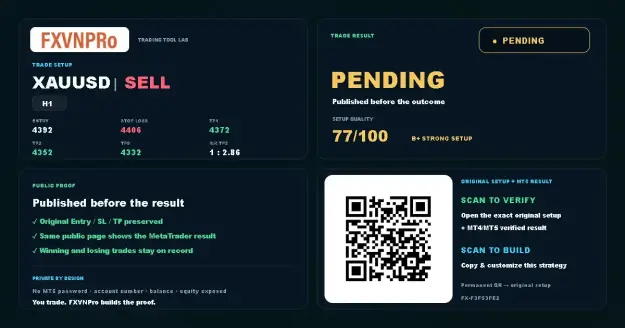 1 · SETUP
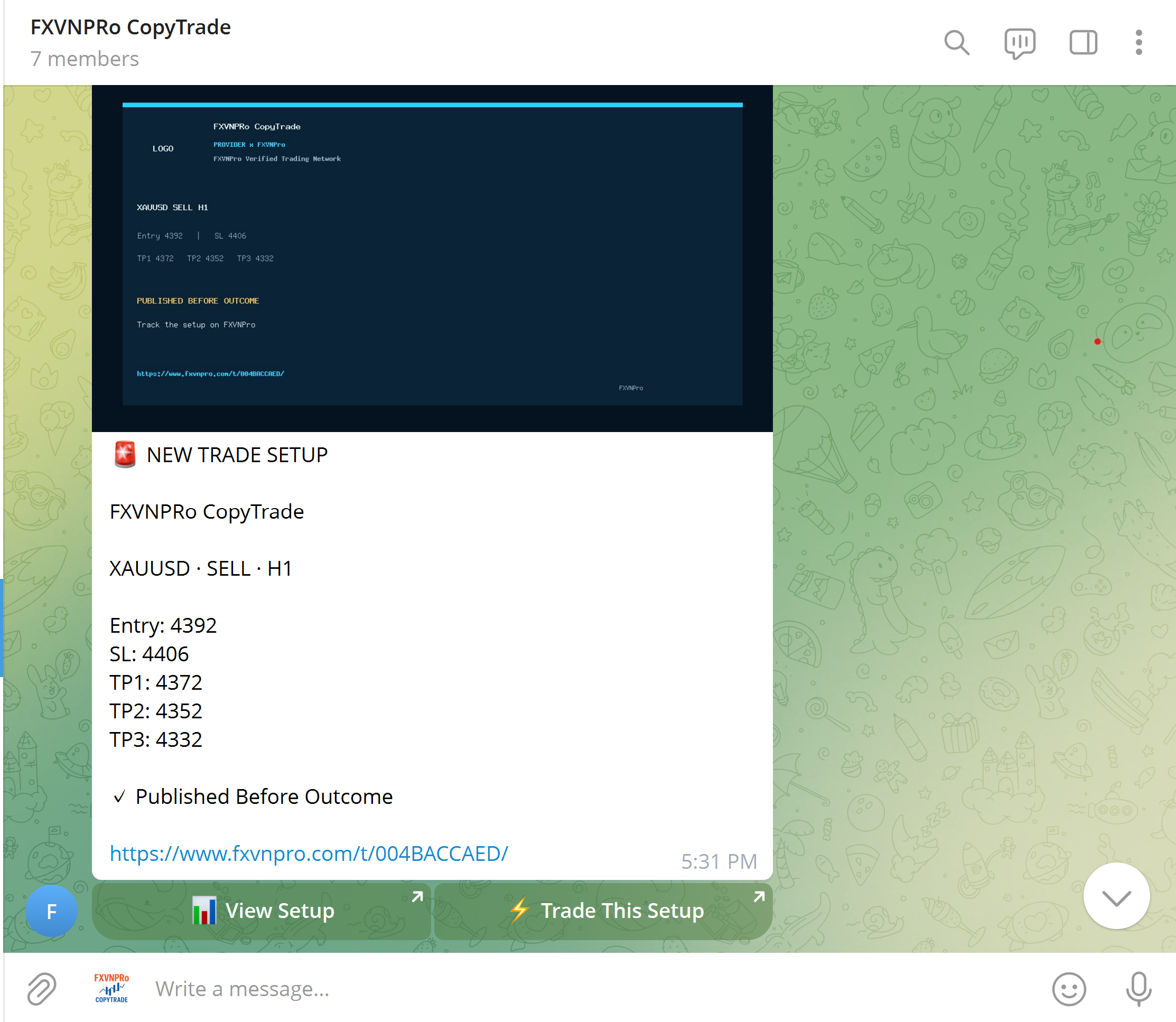 2 · TELEGRAM
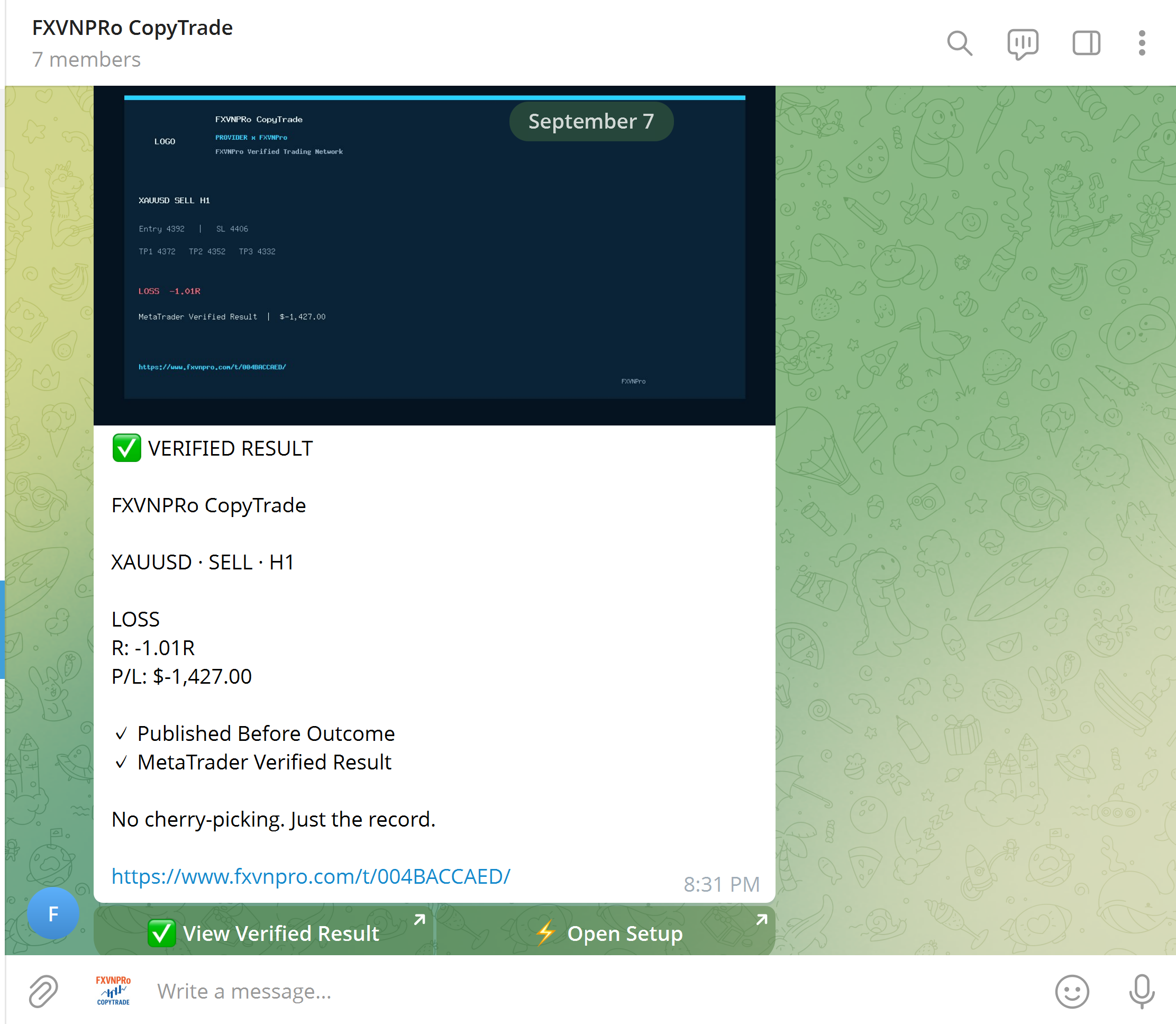 3 · VERIFIED
FXVNPro connects trade plans, Telegram trading communities and verified CopyTrade activity in one practical MT4/MT5 ecosystem.
Turn Entry, Stop Loss and Targets into a trade plan. Publish it before the outcome, then track and verify the result.
Turn Telegram signals into actionable MT4/MT5 setups. Signal Admins create the strategy while Members stay in control of risk.
Discover TRADERs, inspect verified trading history and performance, then decide who you want to follow across MT4 & MT5.
Build your strategy, distribute it to a community, or follow trading activity across MT4 & MT5.
Create Entry, Stop Loss and Targets before the outcome, then build a verified trading record.
Turn Telegram signals into an actionable workflow while followers keep control of their own risk.
Connect Chrome to MT4 or MT5 and open, modify or close trades from your browser.
Explore Masters and copy trading activity to your own MT4 or MT5 terminal with independent risk rules.