

Tickmill
FVP Score
7.2/10
Tickmill
- Minimum Deposit$50
- RegulationFCA, FSCA, CySEC
- PlatformsMT4, MT5
- SpreadFrom 0.0 pips
Start with your goal. You do not have to learn the FXVNPro architecture before using the tools.
Build an idea, use Telegram signals, trade from Chrome or follow a trader while technical setup stays in the background.
Technical connection details remain available inside each product when needed.
Compare Tickmill and Titan FX by rating, regulation, minimum deposit, platforms, spreads, and overall trading conditions.
Use the FXVNPro Broker Checker Chrome extension to quickly review broker trust signals, ratings, and safety information while browsing broker websites.

| Feature | Tickmill | Titan FX |
|---|---|---|
| Rating | 7.2 | 6.3 |
| Minimum Deposit | $50 | $50 |
| Regulation | FCA, FSCA, CySEC | VFSC, FSA, FSC |
| Platforms | MT4, MT5 | MT4, MT5 |
| Spread | From 0.0 pips | From 0.1 pips |
Below is a detailed breakdown of fees, spreads, regulation, platforms, and real trading suitability to help you decide which broker fits your trading style better.
If you’ve traded long enough, you already know the annoying truth: the “best broker” isn’t a label—it shows up in the little things. One spread that’s slightly wider on your session. One execution quirk during a news spike. A withdrawal delay that forces you to keep funds tied up longer than you planned. That’s why the question “which broker is better” between Tickmill vs Titan FX matters far beyond marketing claims.
This comparison is aimed at practical traders—people who care about fees comparison, spreads and trading costs, and how regulation actually affects trust. If you scalp, trade around London/NY overlap, or just want predictable trading conditions, you’ll feel the difference quickly.
Here’s the quick snapshot: Tickmill (rating 7.2) starts from 0.0 pip spreads, runs on MT4 and MT5, and is regulated by FCA, FSCA, and CySEC. Titan FX (rating 6.3) starts from 0.1 pips with MT4 and MT5, and sits under VFSC, FSA, and FSC. Both list a $50 minimum deposit, so the “entry barrier” is similar. The real differences show up in trading costs, execution reality, and the level of regulatory oversight you’re effectively choosing.
Let’s get into it—because when you’re risking money, “close enough” isn’t close enough.
When traders say “spreads don’t matter,” I always think: have you checked your cost per trade over a month? Because spreads and trading costs quietly compound. Even if the spread difference looks tiny on paper, it becomes very real when you run multiple trades a day.
Tickmill advertises spreads “from 0.0 pips.” Titan FX lists spreads “from 0.1 pips.” On paper, that’s not a huge gap. But in real trading conditions—especially during active liquidity windows—0.1 pips can be the difference between a strategy that survives and one that slowly leaks. This matters most if your setup targets small moves, like intraday mean reversion or short-term breakouts where your take profit might be 8–20 pips.
Now, the part people often miss in fees comparison: spreads aren’t the only cost. You can have a tight spread but still pay through commission structure (if applicable) or wider effective costs during volatility. Also, watch for “minimum spread” being advertised while typical spreads vary by Connect and time of day. In other words, the broker’s best-case headline isn’t your average trade cost.
Example scenario: imagine you trade EUR/USD 30 times a week. A 0.1 pip difference doesn’t look dramatic per ticket, but over a month, it becomes a measurable drag—particularly if you’re already paying swap charges for holding trades.
So which is cheaper in real scenarios? Based purely on the spread starts, Tickmill has the edge for cost-sensitive strategies. But the smarter question is: do you trade when spreads tighten, and do you run volume where that extra 0.1 pip becomes noticeable? If yes, Tickmill typically fits better on trading costs.
Regulation isn’t glamorous, but it’s the foundation of broker safety. The regulators listed matter because they influence standards around segregation of client funds, leverage rules, complaint handling, and oversight intensity. When people ignore regulation, they’re basically betting that the broker’s incentives will stay aligned with yours—forever.
Tickmill is regulated by FCA, FSCA, and CySEC. FCA is widely regarded as one of the stricter regimes, and CySEC also has a long track record in Europe. FSCA adds additional supervisory coverage. Why does that matter in real life? Because when something goes wrong—market disruption, unusual order flow, or a dispute—strong regulators tend to enforce clearer processes and compliance expectations.
Titan FX is regulated by VFSC, FSA, and FSC. I won’t pretend these jurisdictions carry the same weight as top-tier EU/UK oversight for many traders. That doesn’t automatically mean Titan FX is unsafe. But it does mean the “regulatory comfort level” can be different depending on where you live, how you prefer to manage risk, and how much you value strict enforcement.
Verification importance is huge here. Traders should verify the broker entity they’re using (not just the brand name), confirm account types, and understand what protections apply. Sometimes a brand lists multiple regulators, but your specific account may be under one entity with specific rules.
If you’re asking “Tickmill vs Titan FX” for safety and trust, Tickmill’s regulatory footprint is the clearer advantage. For risk control minded traders, that matters more than shaving 0.1 pips—because the real nightmare isn’t a few extra pips, it’s operational risk.
Both brokers offer MT4 and MT5. That’s good news because you’re not locked into a single platform ecosystem. If you already have an EA, indicators, or a custom template, you’ll likely be able to move without rebuilding everything from scratch.
Still, “same platform” doesn’t mean “same experience.” The platform is just the interface. Execution speed, order handling behavior, and the quality of liquidity routing are what you feel when the market turns messy. In fast markets—news releases, major index opens, unexpected volatility—execution speed and slippage become the story.
MT4 vs MT5 also changes the trader’s toolkit. MT4 tends to be simpler and still popular for scalping setups and older EAs. MT5 often offers more features and a different indicator environment. But the real question is whether your strategy benefits from MT5’s structure or whether MT4 is your comfort zone.
For example, I’ve seen traders whose backtests look perfect on MT5, then they switch to live and notice differences in fill behavior during high volatility. Sometimes that’s slippage, sometimes it’s how the broker handles market conditions. That’s why execution quality matters, even if spreads look similar.
In day-to-day use, both Tickmill and Titan FX should be workable for technical traders who rely on charting and automation. But if your trading experience depends on tight, consistent fills—especially around session overlaps—Tickmill’s “from 0.0” spread positioning makes it more aligned with cost-sensitive execution expectations.
Let’s talk about the part that’s rarely discussed until it becomes a problem: deposits and withdrawals. Traders don’t just need trading conditions—they need smooth access to their own money. Even with a solid account, withdrawal friction can derail planning, especially if you’re resizing risk based on performance.
Both brokers show a $50 minimum deposit. That means you can start with relatively modest capital and still test your strategy. But minimum deposit is only half the story. What matters more is how fast funds arrive, what fees apply, and how withdrawals behave when you’re withdrawing frequently.
In real-world experience, traders tend to care about three things: processing time, any withdrawal limits, and whether additional verification steps slow everything down. If you’re using a strategy that requires frequent profit-taking or account replenishment, withdrawal timing becomes part of your operational workflow.
Also, watch for edge cases. For instance, some brokers process withdrawals differently depending on whether you’re withdrawing the full amount or partial amounts. Others may require documentation if you’ve changed personal details or if the account was funded via multiple methods.
Since we’re comparing Tickmill and Titan FX with limited published operational details here, the most responsible takeaway is this: both are accessible at the $50 level, but you should still confirm withdrawal processing times for your specific payment method before going “all in.” In practice, the broker with fewer frictions for your region tends to win long-term, even if their trading spreads are close.
If your priority is to stay flexible—testing strategies, moving funds, managing risk—Tickmill’s broader mainstream regulatory presence often correlates with smoother client-handling processes. But don’t assume—verify for your account setup.
Beginners don’t lose money only because they pick wrong strategies. They lose money because of execution reality, spread surprises, and misunderstandings about what “cost” really means. So when you ask which broker is better for beginners, you should focus on how quickly you can learn without getting punished by trading costs.
Both Tickmill and Titan FX offer MT4 and MT5, which is helpful. New traders benefit from familiar platform layouts and the ability to follow tutorials built around MT4/MT5. The bigger difference for a new trader is not platform—it’s the trading environment you’ll be learning in.
Tickmill’s “from 0.0 pips” spread starts are a meaningful advantage for beginners using small take profits or experimenting with tighter risk management. In early stages, your entries might not be perfect. You’ll take more trades than you think. If spreads are consistently tighter, your learning curve improves because your strategy isn’t fighting basic friction.
Also, regulation matters for beginners because they tend to underestimate operational risk. A regulated broker with stronger oversight can provide more predictable complaint resolution and more structured compliance behavior. That reduces stress—stress makes traders overtrade, and overtrading is where accounts bleed.
Beginner real-world scenario: someone starts with $100, trades demo-to-live, and tries a simple EMA crossover with small targets. If their broker’s effective trading costs are higher, they might think the strategy “doesn’t work,” when it actually just can’t overcome consistent costs.
For beginners, Tickmill is the safer, more cost-friendly choice on the numbers provided. Titan FX can still be viable, but if you want fewer surprises while you’re still learning, Tickmill is the better starting point.
Active traders care about one thing more than anything: trading costs and execution quality under pressure. Scalpers don’t have the luxury of “averaging out” a bad fill. Day traders feel spreads when markets get choppy. High-volume traders feel it in their monthly P&L like a recurring invoice.
Tickmill starts spreads “from 0.0 pips,” while Titan FX starts “from 0.1 pips.” On an active trading day, that difference can matter, especially when you’re doing quick in-and-out trades where each spread is a direct hit to your expectancy.
But let’s be honest: scalping success isn’t only about the minimum spread. It’s about whether spreads widen unexpectedly, whether fills happen at the expected price, and whether slippage shows up during the exact moments you’re trying to trade. That’s why execution speed and slippage are key semantic keywords here—not because they’re trendy, but because they show up in your trade history.
Example scenario: a scalper trades GBPJPY around London open. Volatility increases, and the “from 0.0” promise becomes relevant only if it holds during real liquidity. If Tickmill routes execution with better liquidity access, the scalper’s average cost drops. If Titan FX’s typical spreads are slightly wider more often, it adds up fast.
Tools also matter. MT4/MT5 TRADE, charting stability, and the usability of order management are what you feel at 8:45am when you’re not in “learning mode,” you’re in “processing mode.” Both brokers support MT4/MT5, so the practical difference comes down to cost consistency and execution behavior.
For active traders focused on scalping or tight spreads, Tickmill is more aligned. Titan FX isn’t automatically a bad choice, but if you’re optimizing costs and minimizing friction, Tickmill’s spread profile gives it a clearer edge.
Tickmill Pros: Starts from 0.0 pips; strong regulatory presence (FCA, FSCA, CySEC); MT4 and MT5 support; lower friction for cost-sensitive trading styles.
Tickmill Cons: Like any broker, real spreads can vary by Connect and time—so don’t only judge the “from” number; beginners still need to learn about execution and risk, not just costs.
Titan FX Pros: MT4 and MT5 support; $50 minimum deposit keeps entry accessible; competitive spreads “from 0.1 pips” for many traders.
Titan FX Cons: Slightly higher spread starting point can matter for scalpers and short take-profit strategies; regulatory footprint may feel less reassuring depending on where you’re based and how strict you want the oversight to be.
If you’re comparing Tickmill vs Titan FX on fees comparison, the spread start difference is the main cost headline. If you’re comparing on safety and regulation, Tickmill’s oversight story is stronger for most mainstream traders. That’s the core trade-off, and it shows up in how you manage money.
So, which broker is better: Tickmill or Titan FX? Here’s the clean decision, based on what matters most to real traders.
If you’re a cost-sensitive trader—scalper, short-term day trader, or anyone who targets smaller moves—Tickmill is the better fit. The “from 0.0 pips” spread profile is a real advantage, and it aligns with the kind of strategies where spreads and trading costs decide whether your edge survives. Add in the stronger regulation footprint (FCA/FSCA/CySEC), and Tickmill becomes the more confident choice for people who want both lower friction and higher trust.
If you’re considering Titan FX, it can still work for many traders, especially if you trade less frequently, are not ultra-sensitive to small spread differences, and you’re comfortable evaluating execution speed and slippage in your specific market conditions. Titan FX’s $50 minimum deposit also makes it easy to test without risking too much upfront.
My recommendation is direct: Tickmill is the better broker overall for most traders looking at fees comparison, spreads and trading costs, and regulation. Titan FX is the secondary option if your priority is simply getting started on MT4/MT5 with moderate trading costs and you’ll actively verify real-world execution quality.
If you want the best outcome, don’t just choose based on the headline spread. Open both (or use demo), trade your usual Connects during your usual sessions, and compare your actual effective cost per trade. That’s where “Tickmill vs Titan FX” stops being theoretical and becomes your money.
One real XAUUSD trade: created before the outcome, sent to Telegram, TRADEd in MT5 and returned as a verified result.
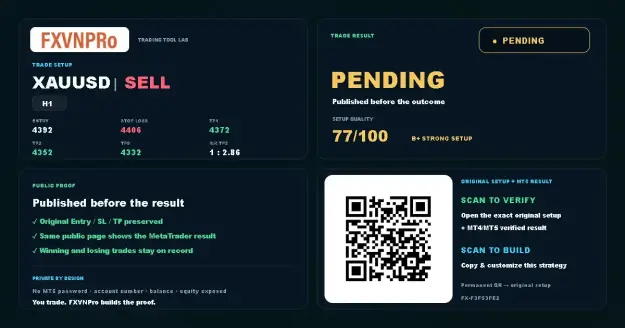 1 · SETUP
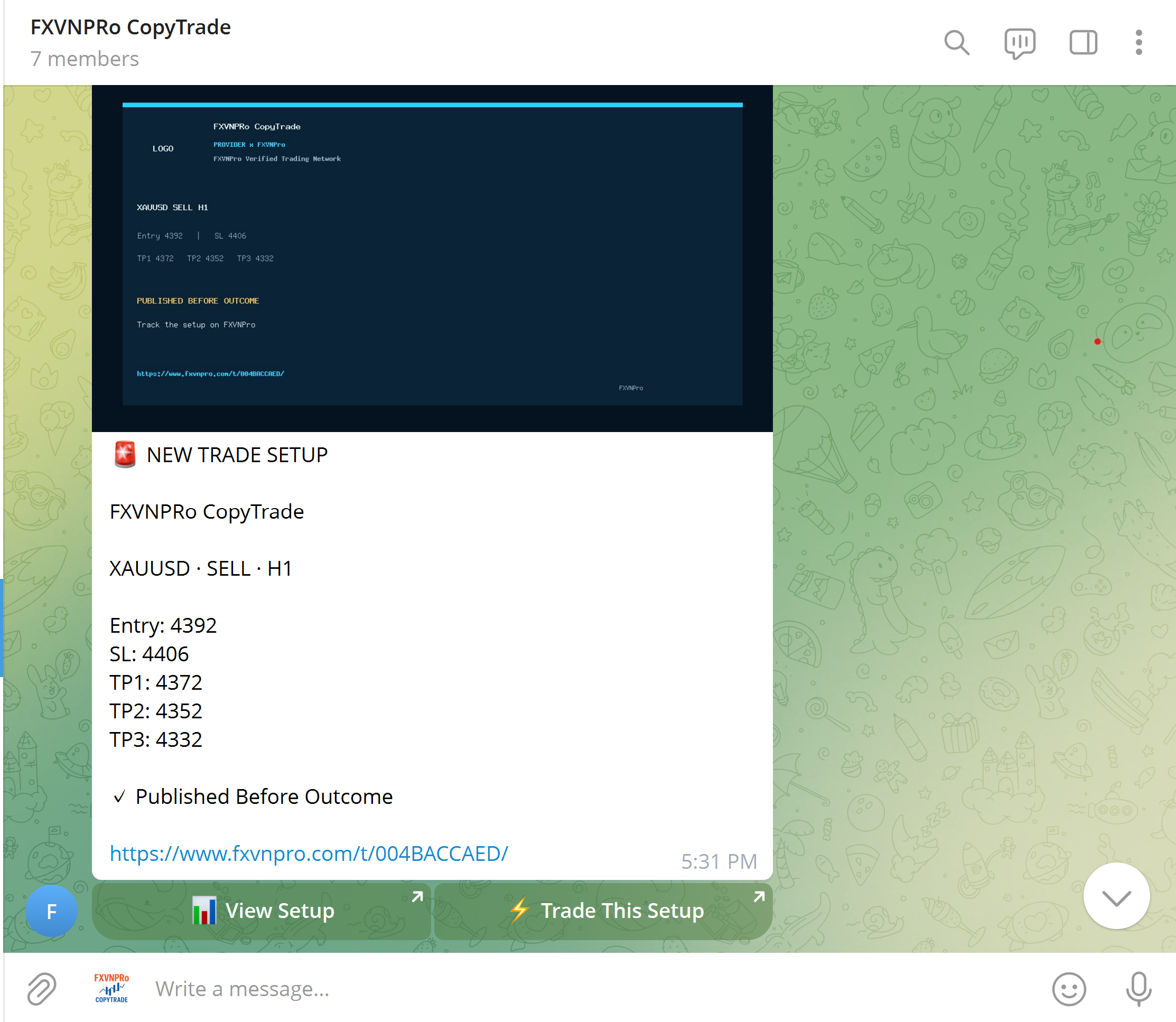 2 · TELEGRAM
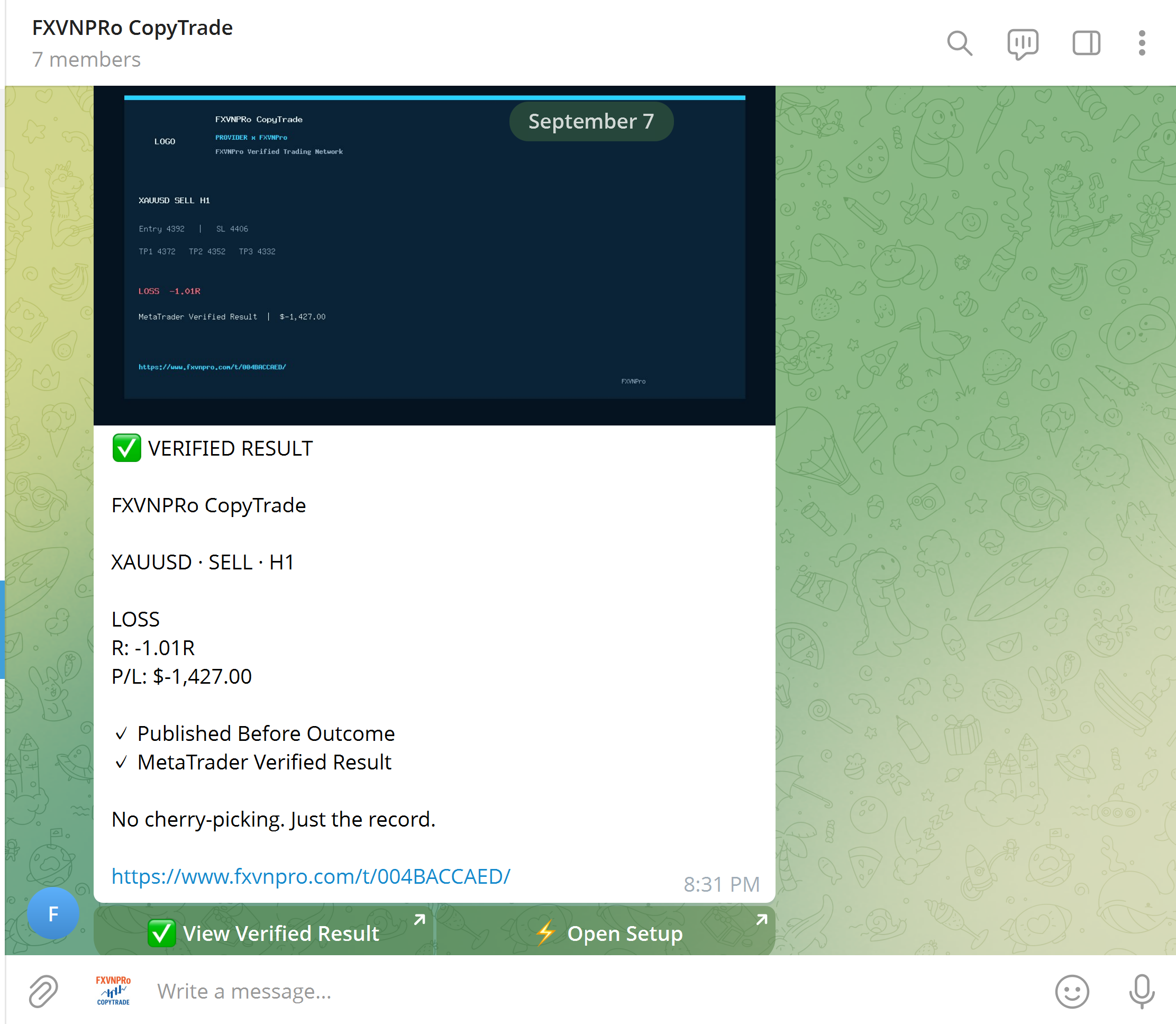 3 · VERIFIED
FXVNPro connects trade plans, Telegram trading communities and verified CopyTrade activity in one practical MT4/MT5 ecosystem.
Turn Entry, Stop Loss and Targets into a trade plan. Publish it before the outcome, then track and verify the result.
Turn Telegram signals into actionable MT4/MT5 setups. Signal Admins create the strategy while Members stay in control of risk.
Discover TRADERs, inspect verified trading history and performance, then decide who you want to follow across MT4 & MT5.
Build your strategy, distribute it to a community, or follow trading activity across MT4 & MT5.
Create Entry, Stop Loss and Targets before the outcome, then build a verified trading record.
Turn Telegram signals into an actionable workflow while followers keep control of their own risk.
Connect Chrome to MT4 or MT5 and open, modify or close trades from your browser.
Explore Masters and copy trading activity to your own MT4 or MT5 terminal with independent risk rules.