

FP Markets
FVP Score
6.7/10
FP Markets
- Minimum Deposit$100 AUD
- RegulationASIC, CySEC
- PlatformsMT4, MT5, cTrader
- SpreadFrom 0.0 pips
Start with your goal. You do not have to learn the FXVNPro architecture before using the tools.
Build an idea, use Telegram signals, trade from Chrome or follow a trader while technical setup stays in the background.
Technical connection details remain available inside each product when needed.
Compare FP Markets and Tickmill by rating, regulation, minimum deposit, platforms, spreads, and overall trading conditions.
Use the FXVNPro Broker Checker Chrome extension to quickly review broker trust signals, ratings, and safety information while browsing broker websites.

| Feature | FP Markets | Tickmill |
|---|---|---|
| Rating | 6.7 | 7.2 |
| Minimum Deposit | $100 AUD | $50 |
| Regulation | ASIC, CySEC | FCA, FSCA, CySEC |
| Platforms | MT4, MT5, cTrader | MT4, MT5 |
| Spread | From 0.0 pips | From 0.0 pips |
Below is a detailed breakdown of fees, spreads, regulation, platforms, and real trading suitability to help you decide which broker fits your trading style better.
If you’ve ever blown a week of gains because your costs were slightly worse than you expected, you already know why broker comparisons matter. On paper, “from 0.0 pips” can look identical. In live trading? That’s where the differences hide—in spreads during news, in how commissions stack up, in how reliably orders fill when price whips around.
This review compares FP Markets (Broker A) and Tickmill (Broker B) from the perspective of a trader who cares about execution quality, total trading costs, and practical day-to-day friction. If you scalp, trade news, run a multi-Connect strategy, or simply want to stop guessing whether your broker is shaving your edge, you’re in the right place.
Quick snapshot: FP Markets has ASIC and CySEC regulation and offers MT4, MT5, and cTrader, with spreads “from 0.0 pips.” Tickmill sits at a higher rating, adds FCA and FSCA alongside CySEC, has a lower minimum deposit, and also offers MT4 and MT5 with spreads “from 0.0 pips.”
So which broker is better? The answer depends on what you trade and how you manage risk. Below, I’ll break down fees comparison, spreads and trading costs, regulation and safety, platform workflow, deposits and withdrawals, and—most importantly—who each broker fits in real life.
Let’s talk costs like a trader would. When people do a fees comparison, they often stop at “spread from 0.0 pips.” But in the real world, your effective spread depends on the Connect, the time of day, volatility, and how the broker routes execution. And then there’s the commission question—because sometimes a broker can advertise razor-thin spreads but recoup the margin elsewhere.
Both FP Markets and Tickmill advertise spreads from 0.0 pips. That’s a useful starting point, but here’s the practical reality: you’ll usually pay more during fast markets (think CPI, NFP, rate decisions) and during low-liquidity sessions. That’s when spreads widen and slippage becomes more visible. For traders, this matters because a strategy that’s profitable on “average spread” can flip negative when the spread regime changes.
In execution terms, your cost is not just the spread—it’s also any commission structure (if applicable), plus the “hidden” cost of delays or partial fills. If you scalp for a few pips repeatedly, even a small difference in effective spread becomes massive over 200–500 trades. For example, if your effective cost is 0.2–0.4 pips worse on one broker, that can erase the edge of a tight mean-reversion setup.
Which is cheaper in real scenarios? If your trading is frequent and spread-sensitive, you’ll want the broker that keeps effective spreads tight during your active hours. Tickmill’s lower minimum deposit suggests it’s built to support active retail participation, but “cheaper” still depends on your instruments and whether commissions apply to your chosen account type. The best move is to test both brokers with the exact Connect and session you trade—then compare your realized spread and slippage, not just the advertised number.
Regulation matters because it shapes enforcement, client protections, and how seriously a broker is monitored. It doesn’t eliminate risk—no regulator can stop every bad outcome—but it changes the likelihood of “surprise” behavior when markets get ugly.
FP Markets is regulated by ASIC and CySEC. That’s a solid base, especially for traders who value oversight and operational discipline. ASIC tends to be strict, particularly around marketing and financial conduct. CySEC also brings a layer of European oversight, which is helpful for transparency and complaint handling.
Tickmill has FCA, FSCA, and CySEC. FCA is widely viewed as one of the toughest regulators in the industry, with strong expectations around governance and client treatment. FSCA adds extra regional oversight, and CySEC rounds it out for European coverage. This matters because the combination can reduce the probability of operational issues and creates more pressure for proper risk management and fair dealing.
Now, here’s the part many traders skip: verification. Always confirm you’re opening an account under the entity that holds the regulation you’re relying on. Brokers sometimes operate through different legal entities depending on your region. If you can’t clearly verify which regulated entity applies to your account, that’s a red flag worth pausing on.
So which broker is safer? Based on the regulator mix alone, Tickmill has the edge for traders who value top-tier supervision. FP Markets is still reputable, but Tickmill’s inclusion of FCA (and FSCA) gives it a slightly stronger trust profile.
Platforms aren’t just “where you place trades.” They shape your execution habits, your ability to backtest properly, and how quickly you can react when price moves against you. If your platform workflow slows you down—even by seconds—you can turn a good setup into a bad trade.
FP Markets offers MT4, MT5, and cTrader. That’s a real advantage for traders who care about platform diversity. MT4 is still beloved for simplicity and ecosystem familiarity. MT5 is useful if you prefer more order types and a different backtesting approach. cTrader is often chosen by traders who like its interface and feel for execution—especially if you’re comparing charting and order management across platforms.
Tickmill offers MT4 and MT5. It’s a more focused offering. For most traders, MT4/MT5 is plenty, and the lack of cTrader won’t matter much unless you specifically prefer it. The bigger question is execution speed and stability. In live trading conditions, platform responsiveness during volatile moments matters. Do charts lag? Does the order ticket behave consistently? Do you get the right price context for the spread you’re seeing?
In practice, I’ve seen traders switch brokers and blame “the strategy” when the actual issue was platform friction—like delayed order placement or confusion around market vs limit orders. So when you compare FP Markets vs Tickmill, treat platforms as part of your system, not a side detail.
If you’re the type of trader who wants more platform choice, FP Markets edges out with cTrader. If you’re comfortable sticking to MT4/MT5 and want a straightforward setup, Tickmill is still very workable.
Deposits and withdrawals sound boring until you’re in the middle of a drawdown and need to top up, or when you’ve hit a target and want your profits back. How fast funds move, what fees appear, and how smooth the process is can make a real difference to your stress level—and your ability to follow your plan.
FP Markets lists a minimum deposit of $100 AUD. Tickmill’s minimum deposit is $50. That lower threshold matters for traders who want to start small and scale as they validate their strategy. It also matters for anyone using the “risk budget” approach—where you allocate a defined amount to test a new Connect, a new timeframe, or a new session.
In real trading life, speed is crucial. If withdrawals are slow or require extensive back-and-forth verification, you might miss the chance to redeploy that capital. Also watch for any hidden friction: extra steps, proof-of-funds requests, or delays due to payment method changes.
One scenario I’ve seen often: a trader runs a short-term strategy, withdraws a portion, then tries to deposit back quickly for another trade cycle. If the process is inconsistent, you end up waiting while the market moves on without you. That’s not a theoretical downside—it affects execution and discipline.
Between these two, Tickmill’s lower minimum deposit is a practical advantage for onboarding. For withdrawal speed and fees, you’ll need to check the current terms for your country and payment method, because that can vary. But from a “start friction” perspective, Tickmill is easier to begin with.
If you’re new, the broker experience can either help you build confidence—or quietly sabotage you. Beginners usually don’t struggle because they can’t read charts. They struggle because they don’t fully understand trading costs, order types, and how spreads behave when volatility spikes.
Tickmill’s minimum deposit of $50 makes it less intimidating to start. That matters because beginners often need multiple attempts to learn execution, stop placement, and position sizing. Starting small reduces emotional pressure. Meanwhile, FP Markets has a $100 AUD minimum deposit, which is still not extreme, but it’s a higher entry point for someone testing the waters.
Platform choice also affects learning. FP Markets offers cTrader in addition to MT4/MT5, which can be appealing if you prefer a clean interface. But more options can also overwhelm a brand-new trader. Tickmill keeping it to MT4/MT5 can feel more straightforward—one ecosystem, fewer decisions.
Here’s the real beginner lesson: spreads and trading costs. Don’t just look at “from 0.0 pips.” Spend a day or two observing your chosen Connect during different sessions. If you’re trading something like EUR/USD, costs can look fine most of the time—until you trade during news and your effective spread widens. Beginners get caught off guard by that change in conditions.
For which broker is better for new traders? I’d lean Tickmill for easier onboarding and lower minimum deposit. If you’re especially curious about cTrader and want that extra platform option, FP Markets is still a strong contender—but Tickmill tends to be the more beginner-friendly entry point.
Active traders care about one thing above all: how consistently the broker delivers your expected price and cost. It’s not enough to have a tight spread sometimes. You need tight spreads when you’re most active—during your normal trading hours, and especially when volatility rises.
Both FP Markets and Tickmill advertise spreads from 0.0 pips, which is encouraging for scalpers and day traders. But in live trading conditions, what matters is the effective spread after market conditions, the frequency of slippage, and the reliability of order execution. When you’re placing dozens of trades a day, a tiny difference in execution quality becomes very real.
Tickmill’s lower minimum deposit is also relevant for active traders who test different strategies and tweak account allocation. You don’t want to tie up too much capital just to try a new intraday model. That’s a practical advantage.
Execution speed and slippage are especially critical around news. Picture this: you’re running a breakout strategy around an economic release, expecting a quick move and planning to exit rapidly. If your fills are consistently worse—widened spreads, delayed execution, or more slippage than expected—you’ll see it in your distribution of trade outcomes. Over time, that can turn a “nearly profitable” system into a losing one.
FP Markets adds cTrader, which some active traders like for its order workflow. That can help when you manage multiple orders and need a clean interface. Still, Tickmill’s broader regulator footprint and simpler platform set can appeal to traders who want fewer variables.
For scalpers and day traders, my bias is slightly toward Tickmill for execution consistency and active-retail focus, but you should validate with a cost test on your exact Connects and session times. Don’t skip that step.
FP Markets Pros: MT4, MT5, and cTrader gives you more platform choice; regulated by ASIC and CySEC; “from 0.0 pips” spreads can work well for cost-sensitive strategies.
FP Markets Cons: Higher minimum deposit ($100 AUD) may be a hurdle for some beginners; if you only trade MT4/MT5, you may not fully benefit from the extra platform option.
Tickmill Pros: Higher overall rating; regulated by FCA, FSCA, and CySEC for a stronger trust profile; lower minimum deposit ($50) makes it easier to start and scale; “from 0.0 pips” supports active strategies.
Tickmill Cons: Only MT4 and MT5 (no cTrader); as always, advertised spreads depend on market conditions—so you still need to watch effective spreads and slippage for your Connects.
One more thing I always remind traders: don’t judge by the best-case spread screenshot. Judge by your realized trading costs during the sessions you actually trade.
If you’re asking “which broker is better” in a simple, one-size-fits-all way, I can’t honestly give you that—because trading style decides what you value most. But I can give you a clear recommendation based on the most common trader profiles.
Choose Tickmill if: you want the stronger regulation mix (FCA/FSCA/CySEC), a lower minimum deposit ($50), and a more beginner-friendly entry while still being suitable for active trading. For many day traders and scalpers, the combination of lower start friction and reputable oversight is hard to ignore.
Choose FP Markets if: you specifically want cTrader alongside MT4/MT5, and you’re comfortable with the $100 AUD minimum deposit. If you trade in a way where platform workflow matters—order management, charting feel, and how you TRADE frequently—that extra platform option can genuinely improve your routine.
For the money part—spreads and trading costs—the safe conclusion is this: don’t assume “from 0.0 pips” equals identical real-world outcomes. Your edge depends on effective spreads and execution quality when the market moves fast. So run a short side-by-side test on your exact instruments, during your typical trading hours, and compare realized costs.
Bottom line: for most traders, especially those weighing safety and onboarding, Tickmill edges out. If platform choice (including cTrader) is a deciding factor for your trading experience, FP Markets becomes the better fit.
One real XAUUSD trade: created before the outcome, sent to Telegram, TRADEd in MT5 and returned as a verified result.
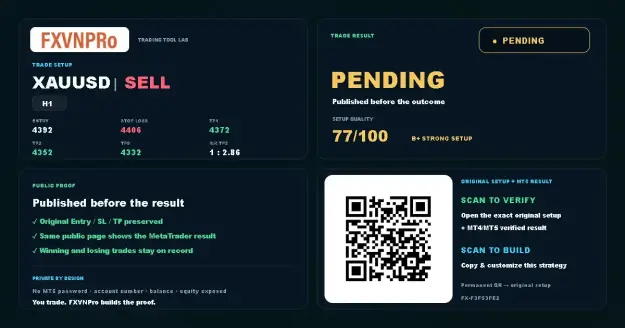 1 · SETUP
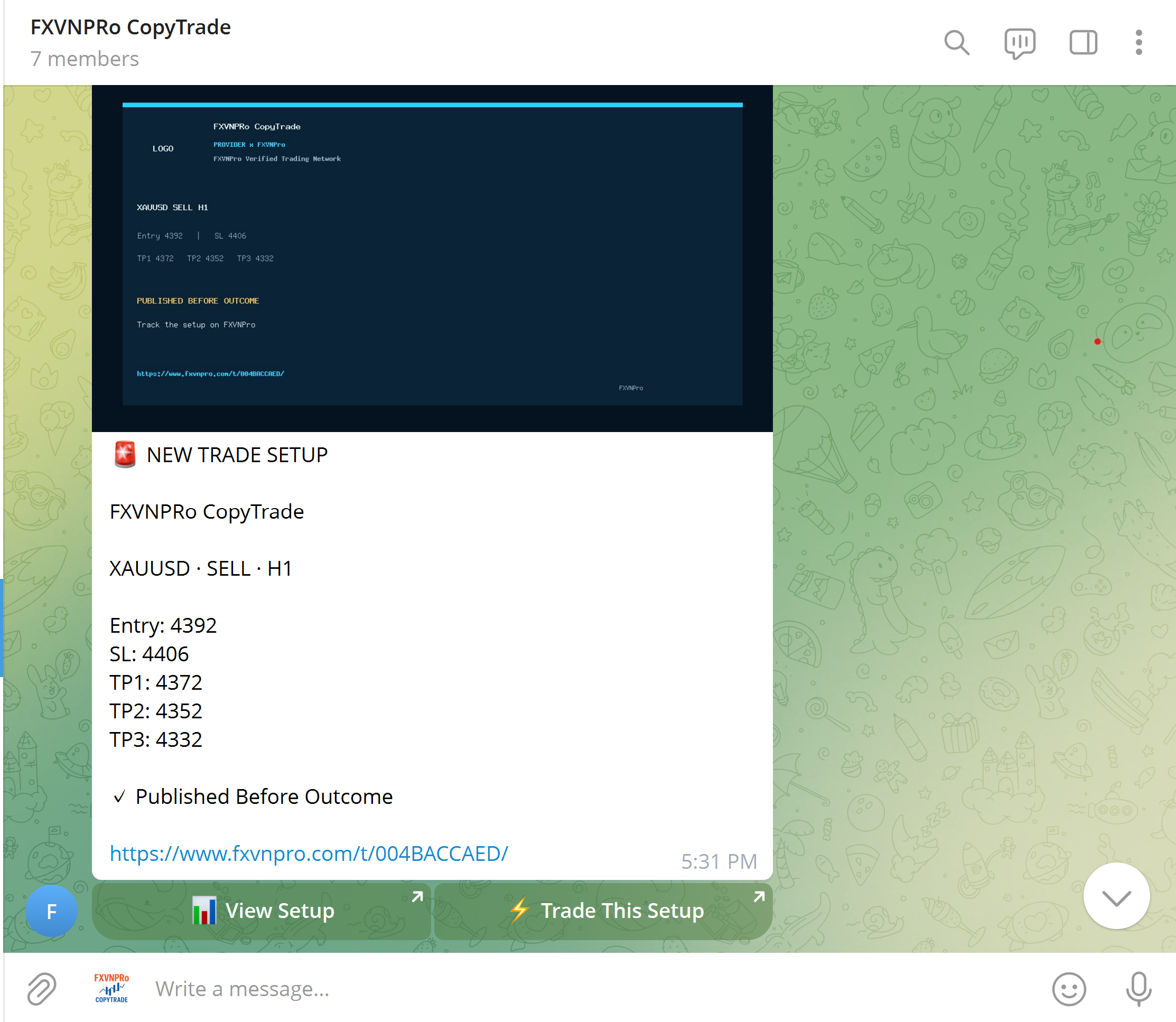 2 · TELEGRAM
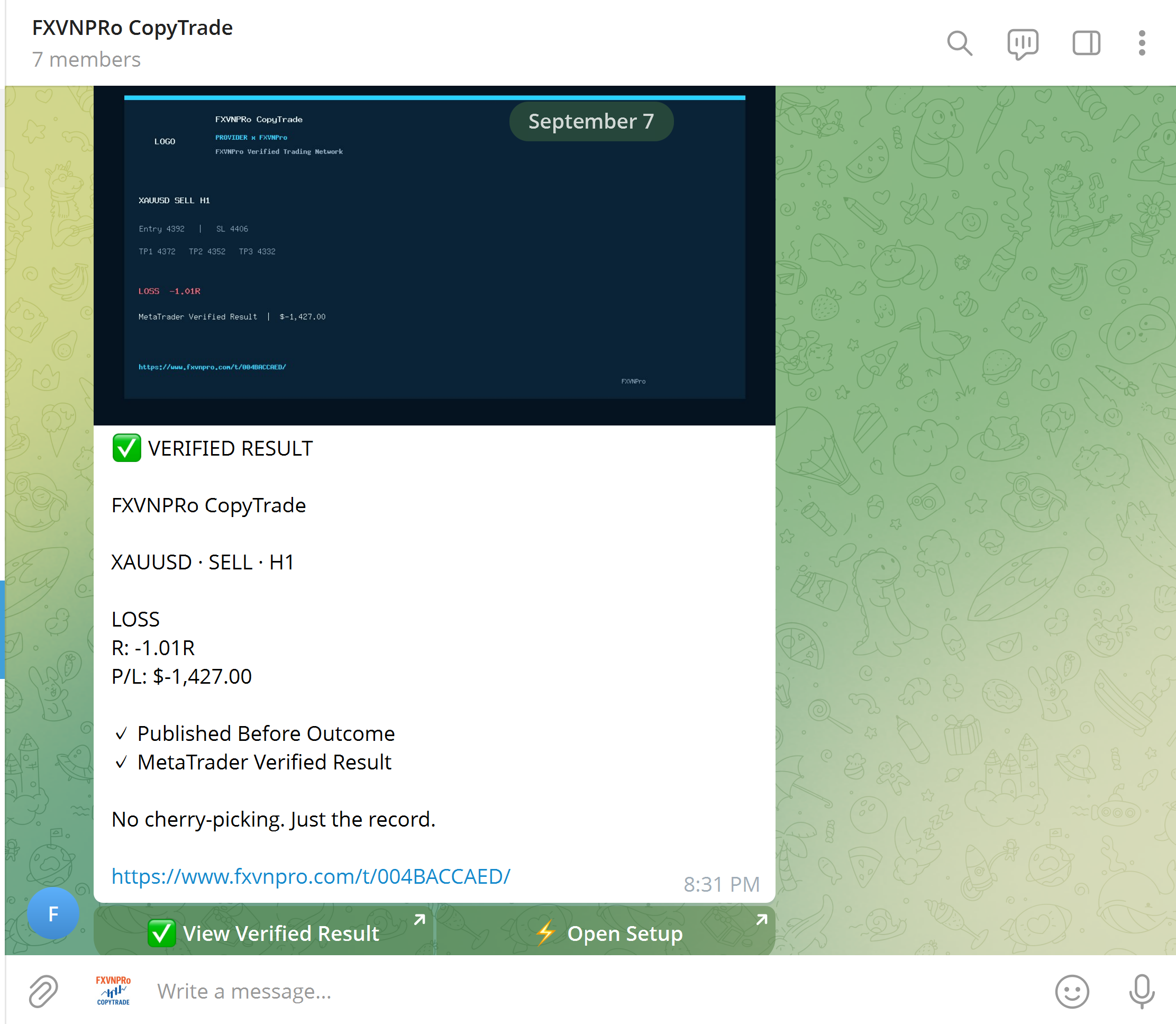 3 · VERIFIED
FXVNPro connects trade plans, Telegram trading communities and verified CopyTrade activity in one practical MT4/MT5 ecosystem.
Turn Entry, Stop Loss and Targets into a trade plan. Publish it before the outcome, then track and verify the result.
Turn Telegram signals into actionable MT4/MT5 setups. Signal Admins create the strategy while Members stay in control of risk.
Discover TRADERs, inspect verified trading history and performance, then decide who you want to follow across MT4 & MT5.
Build your strategy, distribute it to a community, or follow trading activity across MT4 & MT5.
Create Entry, Stop Loss and Targets before the outcome, then build a verified trading record.
Turn Telegram signals into an actionable workflow while followers keep control of their own risk.
Connect Chrome to MT4 or MT5 and open, modify or close trades from your browser.
Explore Masters and copy trading activity to your own MT4 or MT5 terminal with independent risk rules.