

HFM
FVP Score
6.8/10
HFM
- Minimum Deposit$5
- RegulationFCA, DFSA, FSA
- PlatformsMT4, MT5
- SpreadFrom 0.1 pips
Start with your goal. You do not have to learn the FXVNPro architecture before using the tools.
Build an idea, use Telegram signals, trade from Chrome or follow a trader while technical setup stays in the background.
Technical connection details remain available inside each product when needed.
Compare HFM and Tickmill by rating, regulation, minimum deposit, platforms, spreads, and overall trading conditions.
Use the FXVNPro Broker Checker Chrome extension to quickly review broker trust signals, ratings, and safety information while browsing broker websites.

| Feature | HFM | Tickmill |
|---|---|---|
| Rating | 6.8 | 7.2 |
| Minimum Deposit | $5 | $50 |
| Regulation | FCA, DFSA, FSA | FCA, FSCA, CySEC |
| Platforms | MT4, MT5 | MT4, MT5 |
| Spread | From 0.1 pips | From 0.0 pips |
Below is a detailed breakdown of fees, spreads, regulation, platforms, and real trading suitability to help you decide which broker fits your trading style better.
If you’ve ever wondered why one broker “feels” cheaper even when the headline spread looks similar, you’re not imagining things. In forex, the real cost isn’t just the number you see on the platform—it’s spreads plus commissions (if any), execution quality, and how consistently those ultra-low spreads show up during normal market hours.
This HFM vs Tickmill comparison is written for traders who actually place orders. Not for people shopping for features. I’m talking about the kind of costs that show up after a week of scalping, or after you’ve run a few backtests and then go live and realize the live tape doesn’t always behave like your chart.
Quick snapshot: HFM (minimum deposit $5) offers spreads “from 0.1 pips” with MT4/MT5 and is regulated by FCA, DFSA, and FSA. Tickmill (minimum deposit $50) advertises spreads “from 0.0 pips” with MT4/MT5 and regulation via FCA, FSCA, and CySEC. On paper, Tickmill edges the rating (7.2 vs 6.8) and the spread claim. But which broker is better in practice depends on your trading style—especially if you care about scalping, fast entries, or tighter cost control.
Let’s get into fees comparison, spreads and trading costs, and the stuff that matters when you’re risking real money.
Let’s start with the obvious: spreads and trading costs. HFM lists spreads from 0.1 pips. Tickmill lists spreads from 0.0 pips. On a calm chart, that difference might look tiny. In live trading, it often isn’t. Why? Because your total cost isn’t determined by the best spread you can occasionally get—it’s determined by what you get on most trades, and how often you get widened conditions.
Here’s a practical way to think about it. Suppose you trade EUR/USD and average a spread of 0.6 pips with one broker and 0.9 pips with another. If you’re doing 200 trades a month, that’s not “a little difference.” It compounds. Even with the same lot size, the spread gap becomes real dollars fast. This matters because many traders underestimate how many entries they actually make compared to what they planned.
Now, about “hidden fees.” There aren’t always obvious account-level charges, but traders can still pay indirectly through commission structures, swap/overnight financing, and execution-related costs like slippage. If you scalp around news, slippage can erase the benefit of a low spread headline. So when you see “from 0.0 pips,” ask: does that require conditions or account type? And in real trading hours (London open, late US session), how often do you actually see that figure?
In my experience, Tickmill’s tighter spread positioning tends to benefit high-frequency strategies, while HFM’s broader accessibility (especially with a lower minimum deposit) often attracts traders who are less volume-heavy. But cheaper isn’t automatic. Your “true” fees comparison is spread + execution quality + any commission/swap realities for your instrument and holding period.
Regulation matters, but not in the vague “it’s regulated so it’s safe” way. It matters because regulators influence segregation of client funds, risk management rules, reporting requirements, and complaint processes. In other words, regulation affects how seriously a broker has to take both customer protection and operational discipline.
HFM is regulated by FCA, DFSA, and FSA. Tickmill is regulated by FCA, FSCA, and CySEC. The important part is that FCA oversight is typically seen as stricter and more demanding in practice than many other regimes. That doesn’t magically eliminate risk—no broker is risk-free—but it raises the baseline expectations for conduct and compliance.
For a trader, this affects how comfortable you should feel about deposit/withdrawal reliability and how likely you are to get proper support if something goes wrong. Verification also matters: check whether your account region aligns with the entity you’re actually trading with. Traders sometimes assume “the brand” is the regulator, when in reality the legal entity matters.
In real trading conditions, the biggest safety issue usually isn’t a sudden “broker disappears” event. It’s operational friction—delayed withdrawals, unclear policies, or inconsistent execution during volatility. When regulation is strong, those operational issues are generally easier to challenge, because there’s a clear framework for accountability.
So if you’re asking which broker is better for trust level, the answer leans toward the institutions with stronger, more consistently enforced oversight. Both have reputable regulators on the list, but I’d still prioritize the FCA presence and then double-check which local entity governs your account.
Both HFM and Tickmill offer MT4 and MT5. On paper, that means you can run the same indicators, the same Trading Programs (Expert Advisors), and the same charting workflow. But here’s the thing: platform “feel” isn’t only about the platform—it’s about how the broker routes orders, how quickly it updates quotes, and how stable the trading environment is when spreads move.
Execution speed and quote reliability matter most when you’re trading around fast market shifts. If you’re placing limit orders during a range, a few seconds of delay or occasional quote gaps can change fills. If you’re scalping and targeting small edges, you notice slippage immediately. If you’re swing trading, you might not.
MT4 is often still the comfort zone for many discretionary traders and EA users. MT5 is better for certain strategy workflows, multi-asset expansion, and hedging/positioning nuances (depending on your account setup). In real trading, what usually differentiates brokers is not whether MT4/MT5 exists, but whether your order experience stays consistent during volatile sessions.
For example: imagine you’re running a simple breakout EA on MT4 during the first 30 minutes of London. If the feed or execution is inconsistent, the EA might trigger entries at different prices than your backtest expects. That’s where “execution speed, slippage, and trading experience” become more than buzzwords.
Both brokers being on MT4/MT5 is a solid baseline. If your strategy depends on precise fills, you’ll want to test with a small live account (not just demo) and track spread behavior and slippage during your typical trading windows.
Minimum deposit is one thing; the overall deposit and withdrawal experience is another. HFM’s minimum deposit is $5, which is a big deal if you’re testing live execution with limited capital or you’re stepping up from demo. Tickmill’s minimum deposit is $50, which can be completely fine for many traders, but it does raise the “on-ramp cost” if you want to trial the broker first.
Why does this matter? Because many traders don’t realize they need time to validate execution quality. A lower minimum deposit lets you place more test trades, compare average spreads over a week, and see how withdrawals work—without risking your main trading budget.
Withdrawals are where patience gets tested. Even with strong regulation, practical issues like processing times, required verification steps, and funding method compatibility can create friction. In real life, that friction doesn’t have to be dramatic to impact you. If you need funds for another strategy, a delay can force you into bad decisions.
Without making up specifics, I’ll say this: you should always review withdrawal terms in your region, confirm which method you used for deposits, and expect identity verification if you haven’t traded before. The broker’s compliance posture tends to influence how smooth that verification flow is.
So, if you’re comparing HFM vs Tickmill purely on accessibility, HFM wins early-stage flexibility. If you’re comparing the experience after verification and with normal trading volumes, the difference is usually less about the headline minimum and more about operational reliability—something you can only judge by reading policies and testing your first withdrawal process.
Let’s be honest: beginners don’t just need a low minimum deposit. They need a trading environment that doesn’t punish mistakes. When you’re learning position sizing, stop-loss placement, and spread awareness, every extra dollar in unnecessary cost slows you down.
HFM’s $5 minimum deposit is a real advantage for beginners. It lets you open a live position environment sooner, test your order execution, and learn how spreads behave without committing meaningful capital. That matters because beginners often overestimate their confidence and underestimate how quickly small errors compound.
Tickmill’s $50 minimum deposit isn’t “wrong,” but it can discourage experimentation. If your first live week reveals that your strategy struggles with spreads or slippage, you’ve already tied up more money than necessary.
Now, beginner friendliness isn’t just deposit size. It’s also about clarity: how easy it is to understand what you’re paying, whether the account type matches the spread claim, and whether the platform shows you real-time costs without confusion. Since both brokers use MT4/MT5, the learning curve around charts and order types is similar. The difference is what happens when you press buy and sell repeatedly.
In real trading conditions, a beginner’s biggest risk is not market volatility—it’s inconsistency. If your spreads widen unexpectedly or execution quality changes during the times you trade, your learning process becomes noisy. That’s why I’d recommend beginners trial one broker with a small amount, then stick to it long enough to build a consistent trading routine.
For most new traders, HFM’s lower minimum deposit gives a smoother start. If you’re willing to commit more capital up front and you plan to focus on tighter cost strategies, Tickmill becomes more attractive.
Active traders don’t care about “from” numbers in marketing language. They care about what they get when they’re placing dozens of orders and the market is moving. This is where spreads and trading costs stop being theoretical.
Tickmill’s spread claim “from 0.0 pips” makes it the more natural fit for scalpers and high-volume day traders, assuming the low-spread conditions are realistically accessible in your trading hours. Even if you don’t always see 0.0, the broker’s positioning suggests they’re aiming for low average trading costs.
Execution speed and slippage are the other half of the equation. During fast moves—like the minutes around major economic releases—slippage can be the difference between a strategy that looks profitable in backtests and one that bleeds slowly in live trading. If your strategy targets tight ranges, widening spreads can also destroy your edge.
So what does this mean in real trading scenarios? Imagine a day trader executing a momentum scalping plan during London-Open volatility. If the broker’s spreads hold closer to the advertised levels and order execution is stable, you keep your expected value. If execution lags or slippage spikes, you end up “paying twice” (once in spread, once in fill quality).
HFM can still work for active traders—especially if your strategy is less spread-sensitive or you trade with wider stops—but Tickmill’s overall setup is more aligned with high-frequency cost efficiency. That doesn’t guarantee better results. It just means Tickmill is more likely to match what scalpers are optimizing for.
If you’re an active trader, the decision should come down to testing: run a live micro-account, track average spread, measure slippage on market orders, and compare week-to-week.
HFM Pros: Very low minimum deposit ($5) makes live testing easier; regulated by FCA, DFSA, and FSA; MT4/MT5 support is standard for most strategy setups.
HFM Cons: Spread claim starts from 0.1 pips—fine for many traders, but scalpers chasing the tightest costs may feel the difference over time.
Tickmill Pros: Higher rating (7.2) and spread claim from 0.0 pips; regulated by FCA, FSCA, and CySEC; MT4/MT5 support aligns well with automated and discretionary trading.
Tickmill Cons: Minimum deposit is $50, which is a higher barrier if you want to trial execution and withdrawal flow before committing more.
Execution reality check: Both brokers run MT4/MT5, but your experience will depend on slippage and how spreads behave during your trading windows.
If you force me to pick a clear winner for most traders, I’d frame it like this: for cost-focused, active strategies, Tickmill looks like the better match. The “spreads and trading costs” story is more compelling when you’re placing a lot of trades and trying to protect your edge. In particular, for scalpers and day traders, Tickmill’s tighter spread positioning is the reason you’d choose it first—then you validate with your own slippage observations.
For beginners and traders who want to test the waters with minimal risk, HFM is the more practical choice. The $5 minimum deposit changes the whole learning curve. You can run a live trial, observe execution speed and spread behavior, and build confidence without tying up a larger chunk of capital.
So the clean recommendation is:
Choose HFM if you’re starting out, want the lowest minimum deposit, and your strategy isn’t built around squeezing the last fraction of a pip.
Choose Tickmill if you trade actively, care about spreads and fees comparison in a measurable way, and you’re serious about execution quality (especially around volatile periods).
No broker is a magic bullet. The best “which broker is better” answer is the one you confirm with a short live test—track your average spread, watch slippage on market orders, and compare costs over the same week using the same instrument and lot size. That’s the only comparison that really matters once you’re risking money.
One real XAUUSD trade: created before the outcome, sent to Telegram, TRADEd in MT5 and returned as a verified result.
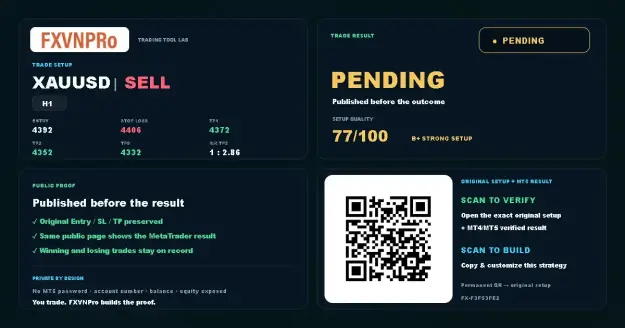 1 · SETUP
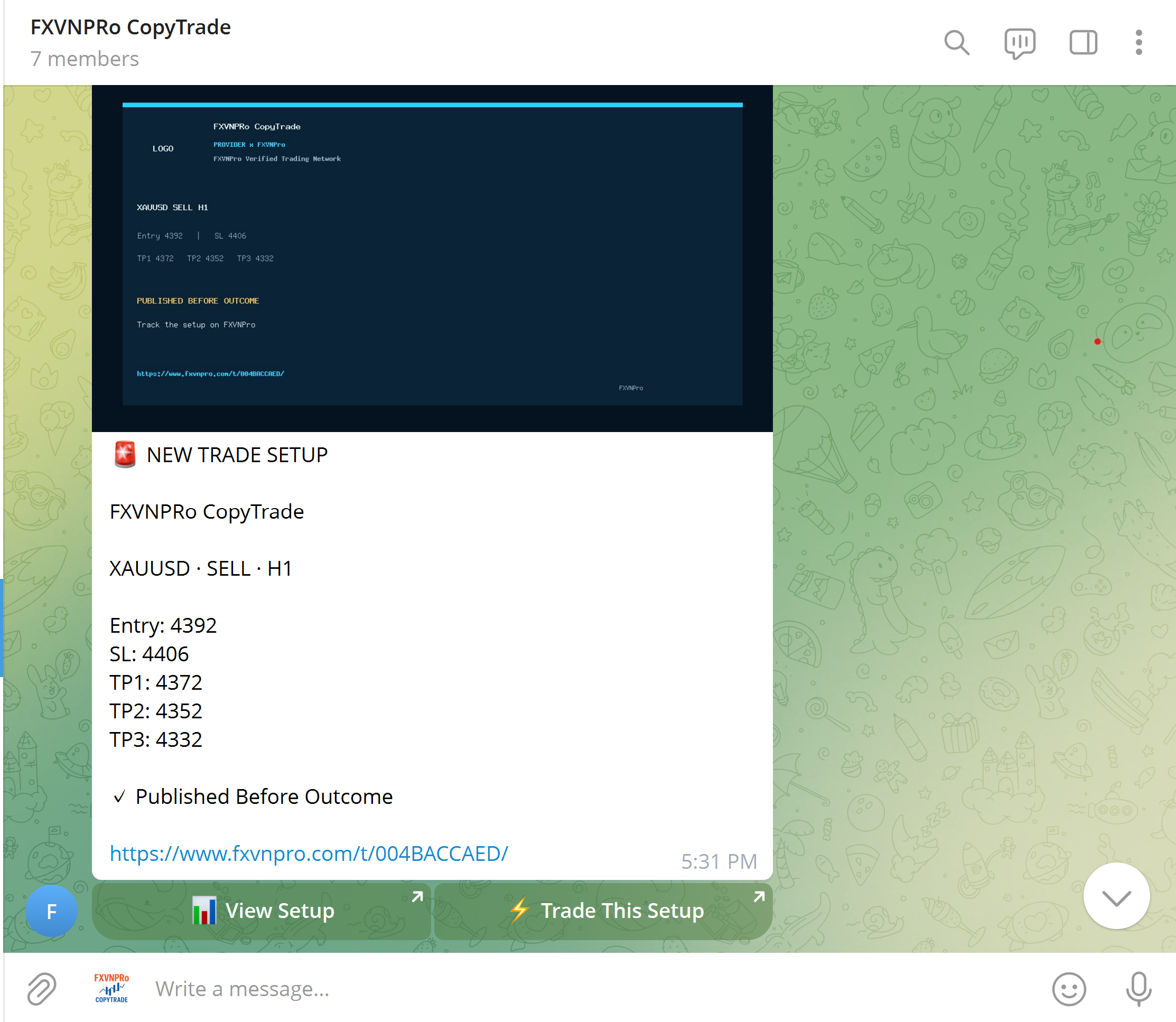 2 · TELEGRAM
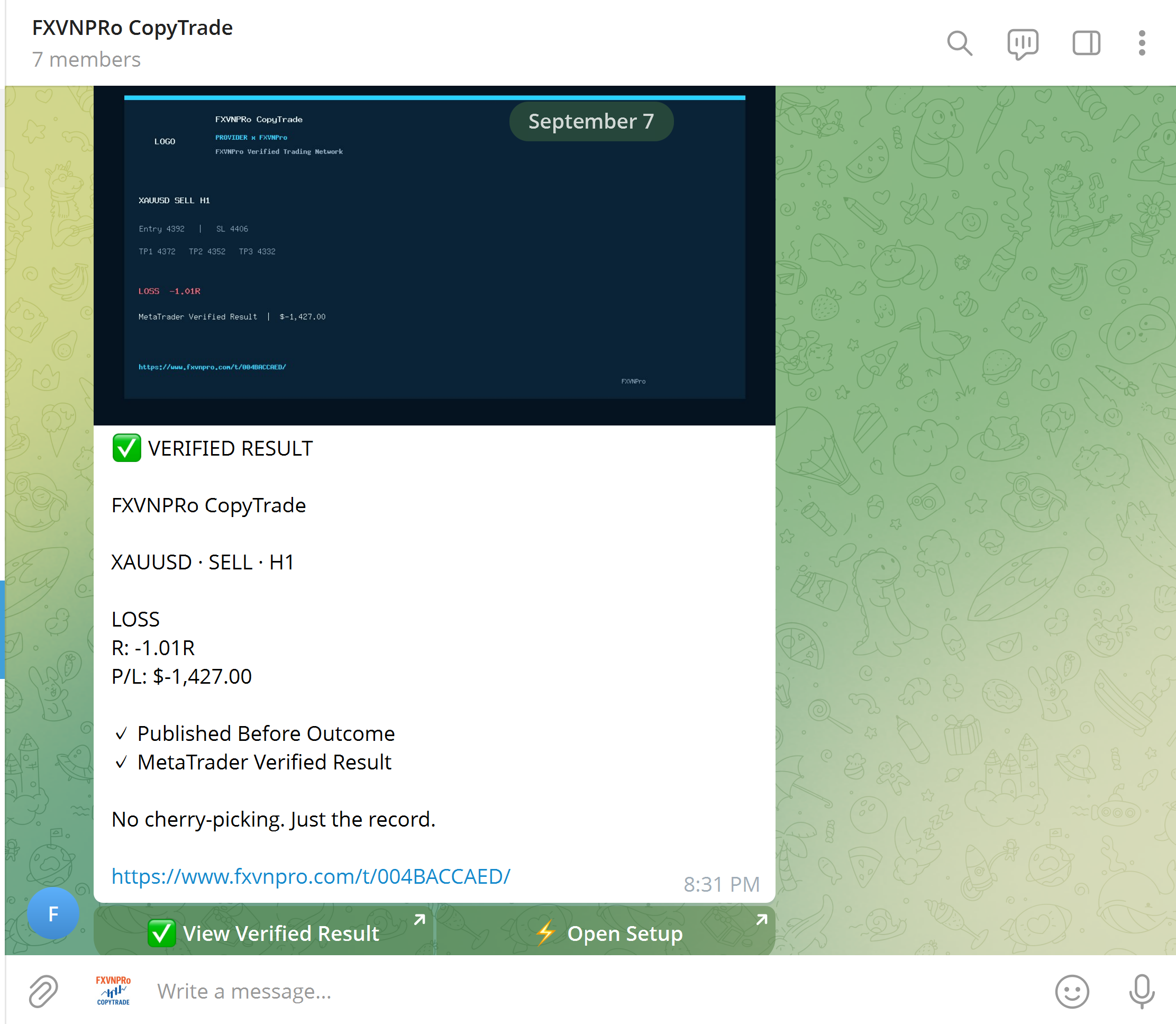 3 · VERIFIED
FXVNPro connects trade plans, Telegram trading communities and verified CopyTrade activity in one practical MT4/MT5 ecosystem.
Turn Entry, Stop Loss and Targets into a trade plan. Publish it before the outcome, then track and verify the result.
Turn Telegram signals into actionable MT4/MT5 setups. Signal Admins create the strategy while Members stay in control of risk.
Discover TRADERs, inspect verified trading history and performance, then decide who you want to follow across MT4 & MT5.
Build your strategy, distribute it to a community, or follow trading activity across MT4 & MT5.
Create Entry, Stop Loss and Targets before the outcome, then build a verified trading record.
Turn Telegram signals into an actionable workflow while followers keep control of their own risk.
Connect Chrome to MT4 or MT5 and open, modify or close trades from your browser.
Explore Masters and copy trading activity to your own MT4 or MT5 terminal with independent risk rules.