Plan a Trade
Build a trade plan and use practical trading tools before you act.
Trade IdeasRisk ToolsCalculators
BUILD A TRADE IDEA →
Start with your goal. You do not have to learn the FXVNPro architecture before using the tools.
Build an idea, use Telegram signals, trade from Chrome or follow a trader while technical setup stays in the background.
Technical connection details remain available inside each product when needed.
Plan trades, connect MT4 & MT5, review verified execution, explore traders and research brokers — without learning the whole platform first.
Build a trade plan and use practical trading tools before you act.
Use Browser Trading or turn supported Telegram signals into a structured trading workflow.
Explore CopyTrade TRADERs, review their records and choose your own risk settings.
Everything is still here — organized by what it helps you do.
Compare HFM and PU PRIME by rating, regulation, minimum deposit, platforms, spreads, and overall trading conditions.
Use the FXVNPro Broker Checker Chrome extension to quickly review broker trust signals, ratings, and safety information while browsing broker websites.


| Feature | HFM | PU PRIME |
|---|---|---|
| Rating | 6.8 | 6.8 |
| Minimum Deposit | $5 | $20 |
| Regulation | FCA, DFSA, FSA | ASIC, FSA |
| Platforms | MT4, MT5 | MT4, MT5 |
| Spread | From 0.1 pips | From 0.1 pips |
Below is a detailed breakdown of fees, spreads, regulation, platforms, and real trading suitability to help you decide which broker fits your trading style better.
If you’ve ever watched your profit vanish after the close, you already know the uncomfortable truth about forex trading: the headline spread rarely tells the full story. It’s execution quality, fee structure, and how costs behave during volatile sessions that decide whether you’re actually trading—or just donating to the market.
In this HFM vs PU PRIME comparison, I’m going to focus on what matters in live conditions: spreads and trading costs, regulation and safety, and how each broker feels when you’re placing real orders with real stress (news spikes, rollover, lunch-time liquidity dips). Not theoretical “features,” but the stuff that hits your P&L.
Here’s the quick take. Both brokers advertise tight pricing (“from 0.1 pips”) and both offer MT4 and MT5. HFM starts with a lower minimum deposit ($5) and is regulated by FCA, DFSA, and FSA. PU PRIME has a higher minimum deposit ($20) and is regulated by ASIC and FSA.
So which broker is better for you? If you’re cost-sensitive and want to test strategies with less initial capital, HFM usually earns the edge. If you’re operating with a slightly larger account and want a clean, familiar setup with solid regulatory oversight, PU PRIME can be a comfortable choice. But the devil is in the fees comparison and—more importantly—the way spreads and execution behave when the market gets noisy. Ready to dig in?
Let’s talk about the classic trap: “Spreads from 0.1 pips.” On paper, both HFM and PU PRIME look similar. In practice, traders don’t trade paper—they trade candles, ticks, and the moment your order fills. That’s where spreads vs commission and slippage (or lack of it) become the deciding factors.
With both brokers, you’ll likely see 0.1 pips during the most liquid hours (think major Connects like EUR/USD during the London session). But the real question is: what happens when liquidity thins—New York open overlap, late Friday, or around economic releases? In those conditions, even a “tight” broker can widen spreads. If your strategy targets small, repeatable edges, widening spreads can wipe out your statistical advantage.
Also watch for fees beyond the spread: commissions (if any), financing/rollover charges, and any platform-related cost differences. Even if both brokers advertise similarly tight starting spreads, one broker can become more expensive if it applies a commission model or has less favorable trade-related costs on your specific instruments.
Here’s a concrete example. Suppose you run a day trading strategy with 30 trades per week on EUR/USD. If one broker averages 0.4 pips more per trade during your active window, that’s 30 × 0.4 = 12 pips of extra cost weekly. Over a year, that becomes the difference between “breakeven with discipline” and “actually profitable.” This matters because it compounds—just like your winners do.
Based on the pricing data you provided (both “from 0.1 pips”), the spread headline is not the differentiator. Instead, the lower minimum deposit at HFM makes it easier to trial the real costs of your strategy before committing more capital. For many traders, that reduces the risk of paying hidden costs the hard way—by losing money during the learning phase.
Regulation isn’t a marketing line—it’s your first line of defense. When brokers cut corners, traders usually only notice after damage is done. That’s why you should treat regulation as part of your risk management, not just a checkbox.
HFM is regulated by FCA, DFSA, and FSA. PU PRIME is regulated by ASIC and FSA. The important nuance is not just “they have regulators,” but what those regulators imply for oversight and operational standards: segregation expectations, conduct rules, and supervisory enforcement. In real trading terms, stricter oversight often correlates with more reliable processes around order handling, client fund handling, and complaint resolution.
Verification matters too. When you open an account, make sure your jurisdiction and entity match the regulator you expect. Some brokers operate through different entities in different regions. If you’re not careful, you might think you’re trading under one regulatory umbrella while onboarding under another.
Now, a practical point traders sometimes ignore: even with regulation, execution quality and liquidity conditions are still market realities. Regulation can’t stop a spread from widening during a news spike. It can, however, reduce the odds of extreme unfair dealing, and it gives you a clearer path if something goes wrong.
Between HFM and PU PRIME, both have credible regulators listed. However, HFM’s broader regulatory footprint (FCA plus DFSA plus FSA) tends to feel more robust to many experienced traders, especially those who have lived through the “mystery broker” era. If your priority is maximum comfort on safety and governance, HFM has a slight edge in how it’s positioned—at least based on the regulators shown.
Both brokers offer MT4 and MT5. That’s a big deal because it removes the “platform lock-in” problem. If you already know MT4 for indicators and EA development—or you prefer MT5’s market depth and netting/hedging behavior depending on your setup—you’re not starting from scratch.
Where the differences can matter is in how the platform connects to the broker’s execution environment. On busy days, traders experience delays, partial fills, and—most commonly—slippage that doesn’t match what they expected from the spread quote. You can’t fix that with better indicators. It’s execution speed and order routing.
In real-world use, I look at three things. First: how quickly charts update during fast markets. Second: whether the trade ticket shows consistent pricing when I hit “confirm.” Third: how stable the connection is when my internet is a bit shaky. These sound mundane until you’re trying to manage risk through a news candle and your platform lags.
MT4 is still the trader favorite for simplicity and EA ecosystem. MT5 can be cleaner for some workflows, but it depends on your indicator set and whether your strategy was built for MT5 specifically. If your strategy uses custom indicators, you’ll want to confirm they behave the same on both brokers’ feeds.
Tools beyond the platform can also influence your experience: economic calendars, VPS options, and research access. You didn’t list those details for either broker, so I won’t pretend they’re identical. Still, if you’re primarily an execution-and-risk manager, the platform choice alone won’t make or break you—execution consistency will.
Given both brokers support the same platforms, the better “which broker is better” answer often comes down to trading costs and account friction, not the software. In that sense, HFM’s lower minimum deposit makes it easier to test the platform + execution feel with less upfront pressure.
Deposits and withdrawals are one of those topics that only becomes “real” once you’re actually in profit and want your money out. Until then, most people ignore it. But when you’re managing risk, withdrawal friction matters because it affects how you scale.
From your data, HFM has a minimum deposit of $5, while PU PRIME’s minimum is $20. That difference sounds small, but it changes behavior. With $5, you can run a more realistic trial phase: test your EA, confirm your lot sizing rules, and stress-check your spread assumptions without tying up meaningful capital. With $20, you still can test, but it’s slightly harder to experiment aggressively.
Now, beyond minimum deposits, real traders care about speed and fees. Some brokers make withdrawals fast but include deposit charges. Others do the opposite. Even if both are reputable, the “total friction” can tilt your experience. For example, if your preferred method has a withdrawal fee at PU PRIME that HFM doesn’t, your profit-taking becomes less efficient.
I also pay attention to how withdrawals behave during weekends and bank holidays. Markets don’t close the way banks do. If your strategy runs through Friday and you want to withdraw immediately, you’ll learn quickly whether a broker’s processing delays match your lifestyle.
Because you didn’t provide specific deposit/withdrawal processing times or fee schedules, I can’t claim one is faster than the other. What I can say is this: HFM’s lower minimum deposit reduces the “entry cost” of learning the full deposit/withdraw workflow. That matters because a broker that’s fine in theory can become irritating if you hit friction right when you want to scale.
So, for many traders—especially newer ones—HFM’s lower minimum deposit is a practical advantage. You can get to the part where you actually test withdrawals sooner.
If you’re new, your biggest enemy isn’t only market volatility—it’s decision fatigue. You’re learning spreads, leverage, position sizing, stop-loss placement, and platform behavior all at once. So the broker that feels easier to “set up and learn on” often wins.
On that front, HFM has a clear advantage in minimum deposit: $5 versus $20. Why does that matter? Because beginners typically make mistakes. Everyone does. If your first week includes a couple of over-sized trades, a too-tight stop, or a strategy that doesn’t account for spread widening, you’ll feel it immediately. A smaller initial deposit lets you build experience without getting punished as hard before you find your rhythm.
Both brokers offer MT4 and MT5, which helps because you can follow common tutorials and indicator setups without jumping into an unfamiliar ecosystem. That reduces the learning curve.
But don’t confuse “easy start” with “easy profits.” The broker still needs to provide stable execution, predictable pricing, and reasonable trade conditions. For beginners, the cost of being wrong is higher when spreads widen unexpectedly. That’s why the “from 0.1 pips” claim is relevant—but only if those spreads hold during the hours you actually trade.
Practical beginner scenario: you start a demo-to-live transition on GBP/USD. You place trades during your local evening, not during peak London liquidity. If your broker’s spreads widen more in your trading window, your trade history will look worse than it should. This matters because beginners often interpret that as “my strategy is bad,” when it’s actually “my trading session is expensive.”
Between HFM vs PU PRIME, which broker is better for beginners? Based on the minimum deposit alone (and assuming standard execution quality expected from regulated brokers), HFM is the more forgiving starting point. Lower entry friction means you can learn without draining capital immediately.
Active traders don’t just care about spreads—they care about how reliably the broker delivers those spreads at the exact moments they trade. Scalpers and day traders live and die by micro-costs: spread, slippage, and the consistency of fills.
Both brokers list spreads from 0.1 pips and both provide MT4 and MT5. That’s enough to run scalping and short-term strategies, in theory. But in real trading conditions, the biggest differentiators are execution speed during bursts and how often you see price gaps on fast markets.
Imagine a scalper trading EUR/USD around a rate decision. You’re not waiting for a “good candle.” You’re placing and closing quickly, sometimes within seconds. If execution is slightly slower, you might enter at a worse price than expected. If slippage happens frequently, your edge can shrink even if the average spread looks fine.
For day traders, I’m also interested in spread behavior around rollover and transitions between sessions. These are times when liquidity thins and spreads can widen even for major Connects. If you trade across multiple sessions, you want a broker whose pricing doesn’t get erratic.
What about tools? Active traders often use VPS setups, EAs, multi-chart monitoring, and strict order management. MT4/MT5 compatibility is important, but stability matters too: the platform shouldn’t disconnect under load, and order modification should be responsive.
Given the information you provided, I’d choose based on costs and account friction. Since both have similar advertised spreads and both support MT4/MT5, HFM’s lower minimum deposit makes it easier to fine-tune your risk model with smaller drawdowns while you validate execution under real conditions. PU PRIME might still be a great platform for active trading, but with a higher minimum, you’re committing more capital sooner.
So for active traders who want to test and optimize aggressively, HFM is the more practical starting point. For traders who already have capital and prefer PU PRIME’s specific regulatory footprint, PU PRIME can be equally workable—but cost validation becomes crucial.
Let’s be honest: if your broker’s total trading costs are even slightly higher during your typical trading hours, it will show up in your results. That’s why the fees comparison can matter more than the platform choice.
So, which broker is better—HFM or PU PRIME? I’m going to give you a clear decision based on the information provided and how traders actually operate.
Best overall for most traders (especially testing and learning): HFM. The main reason is practical: the minimum deposit is $5 instead of $20. When you’re validating spreads and slippage in real trading conditions, a lower entry cost reduces the punishment for mistakes. HFM also shows broader regulatory coverage (FCA, DFSA, FSA), which many traders find reassuring for long-term trust.
Best for traders who already have capital and want a straightforward MT4/MT5 setup: PU PRIME. If $20 minimum doesn’t matter to you and you’re comfortable focusing on execution during your specific session hours, PU PRIME can be a solid option. Its listed regulation (ASIC and FSA) is credible too.
Here’s the decision rule I’d use if I were setting up a new trading account today: pick the broker where you can test your strategy with the least friction, then measure real spreads and execution behavior during the hours you actually trade. Based on minimum deposit and the similar “from 0.1 pips” positioning, HFM is the more efficient place to start.
If you want to be picky (and you should be), do one thing before funding big: run a short live test or micro-lot trial, track your average spread and any slippage, and compare your total trading costs. That’s the fastest way to confirm which broker wins your personal “fees comparison” rather than a generic one.
One real XAUUSD trade: created before the outcome, sent to Telegram, TRADEd in MT5 and returned as a verified result.
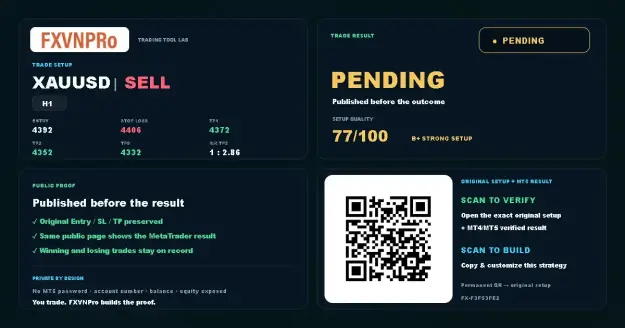 1 · SETUP
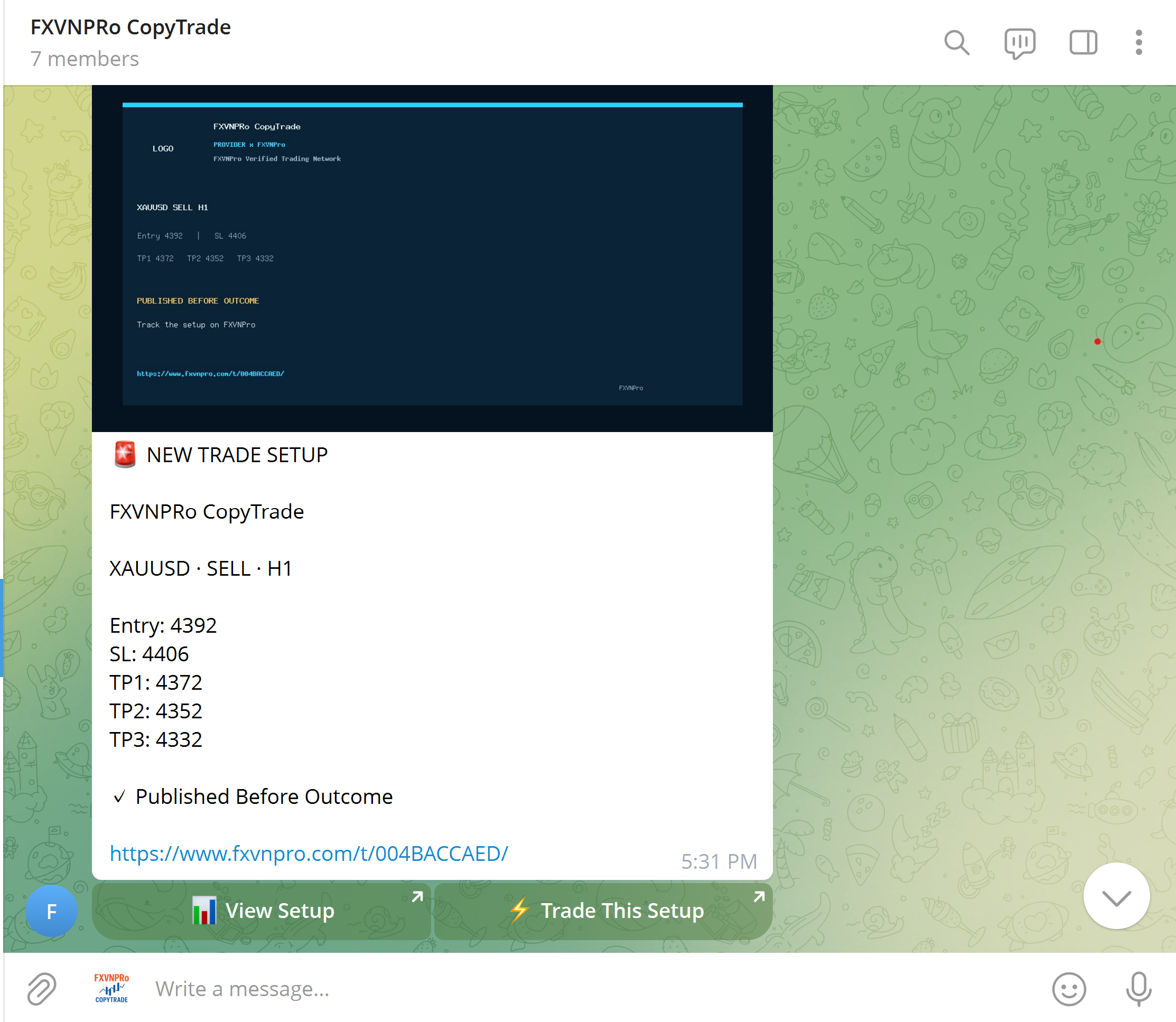 2 · TELEGRAM
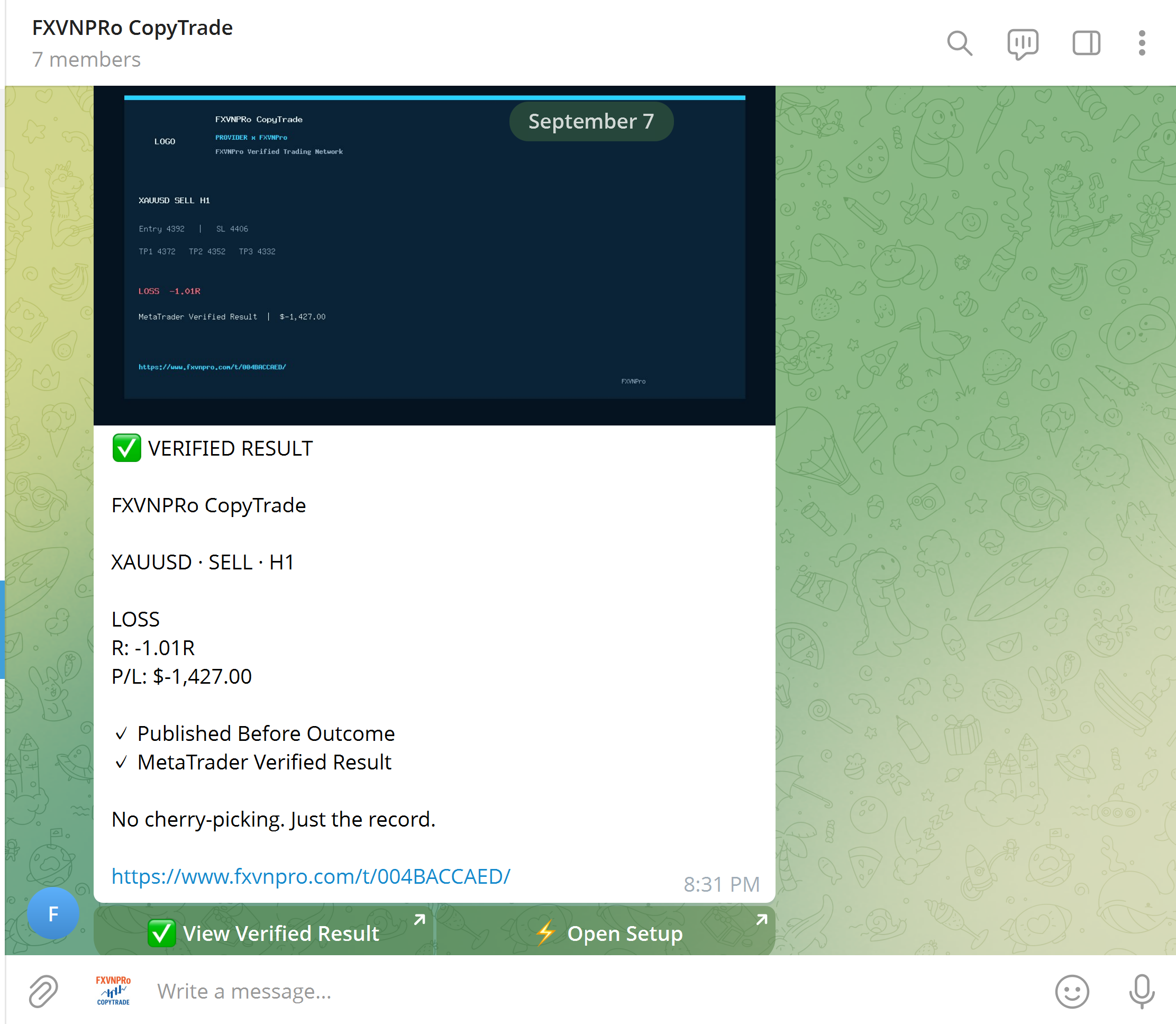 3 · VERIFIED
FXVNPro connects trade plans, Telegram trading communities and verified CopyTrade activity in one practical MT4/MT5 ecosystem.
Turn Entry, Stop Loss and Targets into a trade plan. Publish it before the outcome, then track and verify the result.
Turn Telegram signals into actionable MT4/MT5 setups. Signal Admins create the strategy while Members stay in control of risk.
Discover TRADERs, inspect verified trading history and performance, then decide who you want to follow across MT4 & MT5.
Build your strategy, distribute it to a community, or follow trading activity across MT4 & MT5.
Create Entry, Stop Loss and Targets before the outcome, then build a verified trading record.
Turn Telegram signals into an actionable workflow while followers keep control of their own risk.
Connect Chrome to MT4 or MT5 and open, modify or close trades from your browser.
Explore Masters and copy trading activity to your own MT4 or MT5 terminal with independent risk rules.