

Exness
FVP Score
7/10
Exness
- Minimum Deposit$10
- Regulation-
- PlatformsMT4, MT5
- SpreadFrom 0.0 pips
Start with your goal. You do not have to learn the FXVNPro architecture before using the tools.
Build an idea, use Telegram signals, trade from Chrome or follow a trader while technical setup stays in the background.
Technical connection details remain available inside each product when needed.
Compare Exness and Tickmill by rating, regulation, minimum deposit, platforms, spreads, and overall trading conditions.
Use the FXVNPro Broker Checker Chrome extension to quickly review broker trust signals, ratings, and safety information while browsing broker websites.

| Feature | Exness | Tickmill |
|---|---|---|
| Rating | 7 | 7.2 |
| Minimum Deposit | $10 | $50 |
| Regulation | - | FCA, FSCA, CySEC |
| Platforms | MT4, MT5 | MT4, MT5 |
| Spread | From 0.0 pips | From 0.0 pips |
Below is a detailed breakdown of fees, spreads, regulation, platforms, and real trading suitability to help you decide which broker fits your trading style better.
If you’ve ever sat through a live session where your stop didn’t get filled the way you expected, you already know this isn’t a theoretical game. Forex brokers can look similar on paper—same MT4/MT5, similar “from X pips” marketing—but the moment you’re placing real trades, the details start charging you. The big one? Trading costs and execution quality. That’s why this Exness vs Tickmill comparison matters.
In this review, I’m comparing Exness (minimum deposit $10, platforms MT4/MT5, spreads from 0.0 pips, regulation not listed in the provided data) with Tickmill (minimum deposit $50, platforms MT4/MT5, spreads from 0.0 pips, regulated by FCA, FSCA, and CySEC in the provided data). Both are popular names, both serve active traders, but they don’t feel the same once you’re trading frequently.
Who should care? Honestly, anyone running a strategy with tight risk control—scalpers, day traders, and even swing traders who still get hit by bad fills during news. If you’re newer, the minimum deposit and “how frictionless it feels” matters more than you think. If you’re experienced, the fees comparison and execution speed/slippage become your daily reality.
Quick snapshot: Tickmill has a clear regulation footprint and typically attracts traders who care about compliance and consistency. Exness may be easier to start with due to the lower minimum deposit, but the safety angle is less clear from the data you gave. Let’s break down the parts that actually move your P&L.
When traders ask for a fees comparison, they usually focus on the headline spread: “from 0.0 pips.” Both Exness and Tickmill show spreads from 0.0 pips in your data, which sounds great. But spreads don’t trade in a vacuum. In real trading conditions, you’ll experience widening around rollover, during high-impact news, and sometimes during liquidity shifts. So the question becomes: what’s your average cost over many trades, not your best-case screenshot?
Here’s how this typically plays out for cost-sensitive traders. Suppose you scalp EUR/USD and target small moves. If your broker’s spread is often 0.2–0.8 pips instead of near zero during your trading window, that cost compounds. Now add commission (if applicable) and potential slippage. Even “tight spreads” can become expensive if fills are inconsistent.
With both brokers advertising “from 0.0 pips,” the practical difference usually shows up in execution quality (slippage) and whether any commission structure exists on the account type you’re using. Your data doesn’t include commission details, so I can’t claim one is always cheaper. What I can say as a trader: the cheapest broker on paper becomes the most expensive if your strategy relies on precision and you repeatedly get worse fills.
Scenario: you trade London open and enter 40–60 trades in a week. If one broker consistently gives you slightly tighter average spreads and less slippage, you’ll feel it in your equity curve. If the other broker’s spreads widen more during the same session, you’ll feel it in your drawdown. That’s why “spreads and trading costs” need to be judged together: spread + execution + commission (if any) = true cost.
Bottom line for this section: based on the limited info, both can be competitive on spreads, but you should evaluate actual trading costs via testing on your chosen account type and instruments, especially if you’re scalping or trading news.
Let’s talk regulation, because it’s not just a checkbox. In forex, safety isn’t about feeling good; it’s about how your broker is supervised when things get messy—market volatility, operational hiccups, or disputes. From your provided data, Exness shows “Regulation: -” (not specified), while Tickmill lists FCA, FSCA, and CySEC.
What does that mean in practice? FCA (UK), FSCA (South Africa), and CySEC (Cyprus) are well-known regulatory bodies. When a broker is regulated by multiple reputable authorities, it generally signals stronger oversight around client money handling, reporting, and compliance processes. It doesn’t eliminate risk—nothing does—but it changes the likelihood that you’ll run into “gray area” outcomes.
For example, imagine you’re trading a medium-term strategy and you need a withdrawal quickly. In a regulated environment, the process tends to be more standardized and auditable. Again, I’m not promising smooth withdrawals—nobody should. But regulation affects how brokers are expected to behave.
Verification matters too. Even with regulation listed, traders should confirm the broker’s registration details on the regulator’s site and ensure the entity you’re trading with matches what’s shown in your account area. This is where real-world due diligence pays off.
So which broker is “safer” based on your data? Tickmill has the clearer regulatory footprint. Exness may still be widely used, but with regulation not provided here, you’re asking yourself a basic risk question: do you want to base your trading life on information that’s incomplete?
If you’re serious about protecting capital, regulation isn’t optional reading. It’s part of your risk management.
Both Exness and Tickmill offer MT4 and MT5. That’s important because it means you can use the same ecosystem—EAs, indicators, charting, and multi-asset watchlists. If you’ve already standardized your workflow on MT4 or MT5, switching brokers shouldn’t feel like switching languages.
But “same platform” doesn’t mean “same experience.” Execution speed, how price updates feel, and how quickly your orders respond under stress can vary. In real trading conditions—especially during fast markets—small differences show up. Your stop-loss might be placed correctly, but the platform’s interaction with the broker’s execution system determines how close you get to your intended entry and exit.
Also, consider trading experience. MT4 is still loved for automation and simplicity. MT5 adds more features and a different structure for some tools, plus improved market depth features depending on the broker setup. If you run an EA and you’ve ever had it reject trades due to “off quotes” or requotes, you know why this matters. It’s not the chart that costs you—it’s the trade execution.
In practice, traders often evaluate tools in three areas: order types available (market, limit, stop), ability to manage trades quickly, and the reliability of the platform during news spikes. Do you see delays? Do your pending orders trigger as expected? Does the platform freeze when volatility rises? Those aren’t “nice to haves” for active traders.
Both brokers have MT4/MT5, so your platform choice can be based on your strategy and familiarity. The deciding factors are execution behavior and the account types behind those platforms—things you’ll only fully judge by testing during your typical sessions.
Minimum deposit is often the first number traders notice, and rightfully so. Exness has a minimum deposit of $10. Tickmill’s minimum deposit is $50. On paper, that’s a straightforward difference. In real trading, though, it influences what you can realistically do: how quickly you can scale your testing, and whether you can keep enough free margin to avoid forced adjustments.
Let’s take a trader who wants to trial two strategies—one for mean reversion and another for breakouts. With a $10 entry point, you can run smaller experiments and iterate faster. With $50, you still can test, but you may feel more pressure to commit to one plan sooner. That can affect your trading experience, especially if you’re learning position sizing and risk management.
Deposits and withdrawals aren’t just about speed; they’re also about friction. Does the process require extra steps? Are there fees? Are certain methods limited? Your provided data doesn’t include withdrawal timelines or fee schedules, so I won’t invent details. But I will say this: when you’re actively trading, withdrawal uncertainty creates stress. And stress causes mistakes—overtrading, widening stops, or breaking rules.
Scenario: you hit a good week, want to withdraw part of profits to “de-risk,” and the process takes longer than expected. If you’re used to prompt withdrawals, that delay can change your psychology for the next sessions. That’s not a small issue for many traders.
So, which broker is easier to start with? Based purely on minimum deposit, Exness is clearly more accessible. Tickmill’s $50 threshold is still not high, but it’s less friendly for absolute beginners or for those who want to test with smaller capital.
If deposits/withdrawals matter most to you, treat this as a practical checklist item: confirm your funding method options, withdrawal rules, and any conditions before you scale up.
For beginners, the “which broker is better” question often hides the real issue: how easy is it to make mistakes and still recover? With Exness vs Tickmill, the minimum deposit difference is the first thing you feel. Exness at $10 lowers the barrier to starting. Tickmill at $50 is still reasonable, but it’s more capital at risk while you’re still learning spreads, pip value, and proper lot sizing.
Second, beginners should care about regulation and trust. You don’t need to be a compliance expert to understand that a regulated broker is more likely to follow predictable operational standards. Tickmill’s FCA/FSCA/CySEC listing (per your data) gives you a clearer safety baseline than Exness where regulation isn’t specified.
Third, beginners get hit by trading costs more than they realize. When you’re learning, you’ll take more trades than you should. If your strategy is losing while you’re calibrating, every extra spread or slippage incident makes the learning curve steeper. That’s why “spreads and trading costs” matter even for new traders, not just scalpers.
Scenario: a new trader places multiple small trades during volatile sessions, not understanding that spreads widen around news. They might think the broker is “moving their price” when really it’s market liquidity and execution. If the broker’s execution is smooth, the learning is clearer. If it’s inconsistent, you’ll struggle to separate your trading errors from broker effects.
So which broker is better for beginners? If your priority is a lower starting minimum and faster experimentation, Exness has an edge. If your priority is starting with a clearer regulatory framework and potentially more structured operational expectations, Tickmill is the safer bet.
If you’re truly new, I’d lean toward Tickmill for trust and structure, but I’d only recommend Exness if you’re comfortable verifying account details and you plan to test execution with disciplined sizing.
Active traders live and die by the details: spreads, slippage, and how quickly the broker TRADEs during momentum. Both Exness and Tickmill advertise spreads from 0.0 pips, which is attractive for high-frequency strategies. But here’s the truth: the “from” number is not your average trading cost.
Let’s talk about scalping. If you hold positions for seconds to minutes, you’re constantly exposed to microstructure changes—liquidity gaps, spread widening, and delays. Even a small difference in execution quality can flip a strategy from profitable to marginal. That’s why slippage matters as much as spreads and trading costs.
Day traders care about session consistency. Suppose you trade the first 2 hours of London and you frequently use stop orders and limit entries. If one broker fills closer to your requested price and triggers orders reliably, your backtest becomes more realistic. If another broker widens spreads and requotes more often, your risk assumptions don’t hold.
Now add the account reality. Your data doesn’t specify commission structures or execution model (market vs dealing desk vs ECN/STP-style). Without that, we can’t declare one is objectively cheaper for scalpers. What we can do is set the right evaluation approach: test in your exact symbols, at your exact times, with your actual order sizes, and track three numbers—average spread, average slippage, and rejected/off-quote frequency.
For active traders, regulation also matters because operational issues tend to show up when trading activity rises. Tickmill’s listed regulators reduce the “unknown unknowns” risk. Exness might still be fine, but from your provided data, the safety narrative is less clear.
My take: Tickmill looks more aligned with professional execution expectations due to regulation clarity. Exness may offer better accessibility, but for active traders I’d be more cautious and verify execution behavior before scaling up.
So, which broker has the more complete “trader-ready” profile from the information given? Tickmill edges it on regulation clarity. Exness edges it on entry cost and accessibility.
If you want a clear decision, here it is—based on the data provided and how traders typically feel the differences in real trading.
Tickmill is the better choice for most traders who prioritize safety and consistency. The regulation listing (FCA, FSCA, CySEC) gives you a stronger foundation for risk management beyond spreads and trading costs. For day traders and active traders, that matters because execution and operational reliability are part of the same risk equation. If you’re building a routine around specific sessions, you want fewer unknowns.
Exness is the better choice if your priority is low-cost entry and rapid testing. With a $10 minimum deposit, it’s easier to start smaller, learn faster, and run multiple strategy experiments without draining your account. That’s especially relevant for beginners who are still figuring out lot sizing, pip value, and how spreads behave during different market hours. Just don’t skip due diligence—verify the entity details and test execution costs yourself.
For the question you actually came here for—Exness vs Tickmill, which broker is better—my recommendation is:
Either way, remember this: the best broker isn’t the one with the best headline spread. It’s the one that delivers consistent fills at the cost level your strategy needs. Test it like a professional, not like a browser.
One real XAUUSD trade: created before the outcome, sent to Telegram, TRADEd in MT5 and returned as a verified result.
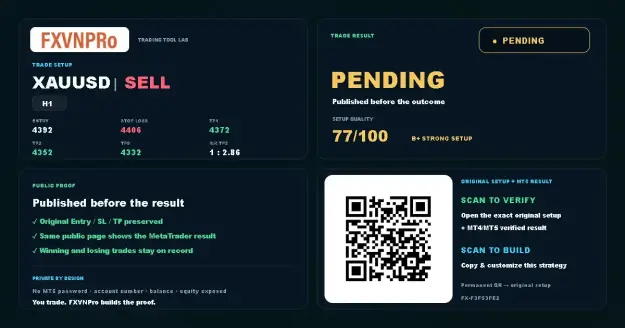 1 · SETUP
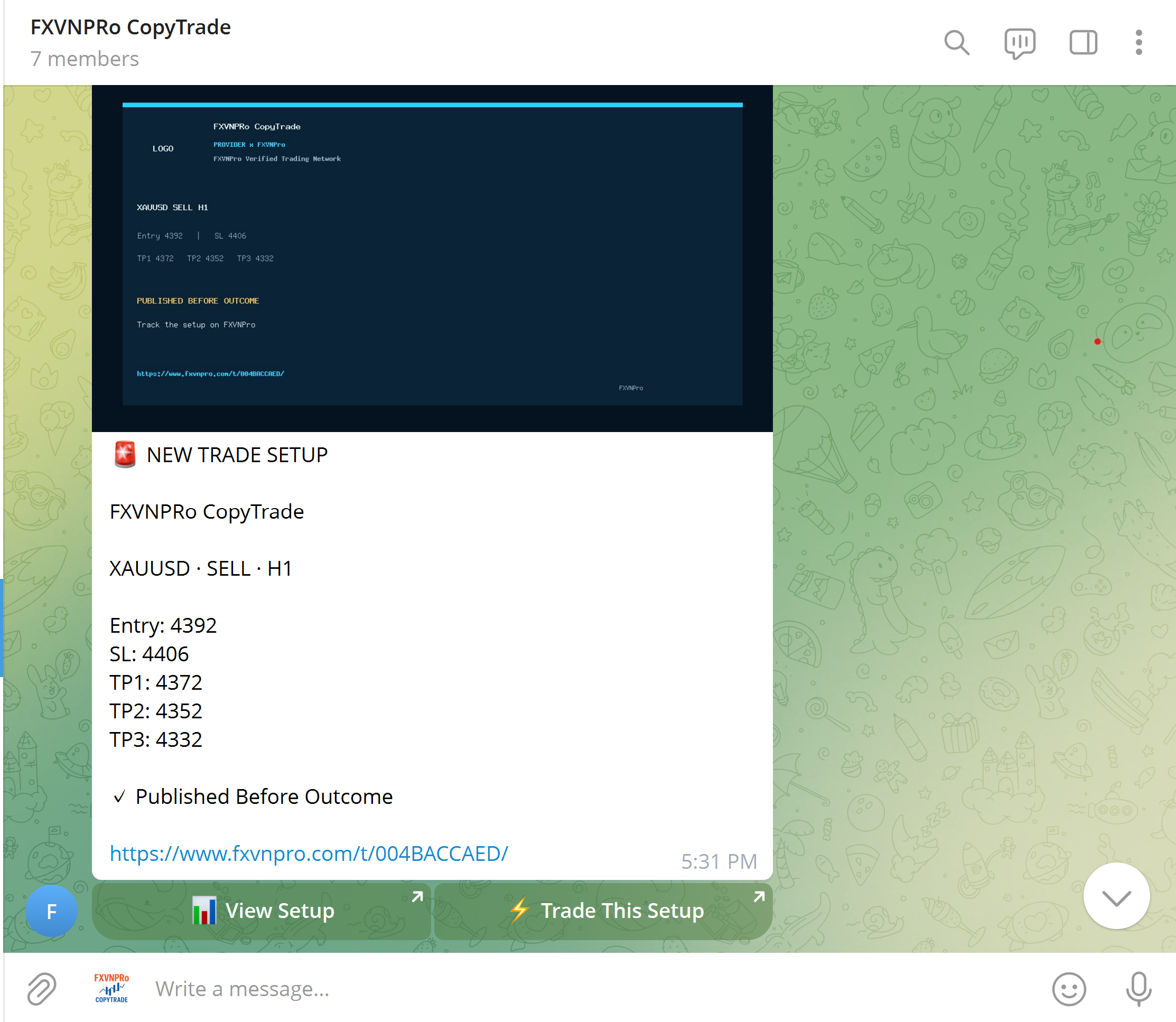 2 · TELEGRAM
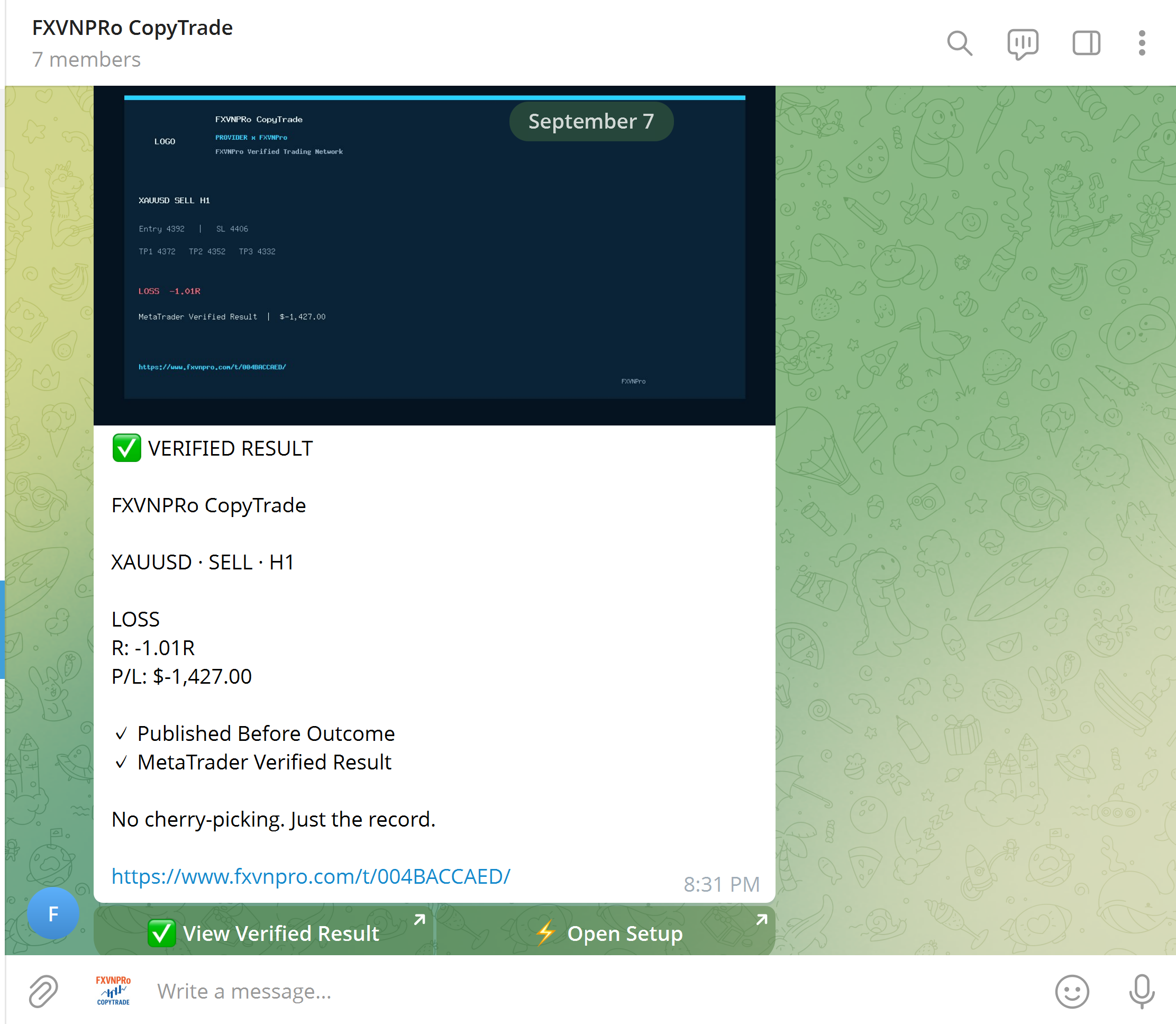 3 · VERIFIED
FXVNPro connects trade plans, Telegram trading communities and verified CopyTrade activity in one practical MT4/MT5 ecosystem.
Turn Entry, Stop Loss and Targets into a trade plan. Publish it before the outcome, then track and verify the result.
Turn Telegram signals into actionable MT4/MT5 setups. Signal Admins create the strategy while Members stay in control of risk.
Discover TRADERs, inspect verified trading history and performance, then decide who you want to follow across MT4 & MT5.
Build your strategy, distribute it to a community, or follow trading activity across MT4 & MT5.
Create Entry, Stop Loss and Targets before the outcome, then build a verified trading record.
Turn Telegram signals into an actionable workflow while followers keep control of their own risk.
Connect Chrome to MT4 or MT5 and open, modify or close trades from your browser.
Explore Masters and copy trading activity to your own MT4 or MT5 terminal with independent risk rules.