

Exness
FVP Score
7/10
Exness
- Minimum Deposit$10
- Regulation-
- PlatformsMT4, MT5
- SpreadFrom 0.0 pips
Start with your goal. You do not have to learn the FXVNPro architecture before using the tools.
Build an idea, use Telegram signals, trade from Chrome or follow a trader while technical setup stays in the background.
Technical connection details remain available inside each product when needed.
Compare Exness and XM by rating, regulation, minimum deposit, platforms, spreads, and overall trading conditions.
Use the FXVNPro Broker Checker Chrome extension to quickly review broker trust signals, ratings, and safety information while browsing broker websites.

| Feature | Exness | XM |
|---|---|---|
| Rating | 7 | 7.1 |
| Minimum Deposit | $10 | $5 |
| Regulation | - | CySEC, ASIC, IFSC |
| Platforms | MT4, MT5 | MT4, MT5 |
| Spread | From 0.0 pips | From 0.6 pips |
Below is a detailed breakdown of fees, spreads, regulation, platforms, and real trading suitability to help you decide which broker fits your trading style better.
If you’ve ever stared at a backtest that looked amazing, then watched your live P&L crawl—there’s a good chance the culprit wasn’t your strategy. It was trading conditions. In the “Exness vs XM” debate, the headline numbers matter, but the part that hits your account is usually the stuff that doesn’t show up on a marketing page: spreads and trading costs in different market moments, how execution behaves when volatility spikes, and whether your deposits/withdrawals feel smooth or annoying.
This comparison is aimed at traders who actually place trades—scalpers checking execution quality, day traders watching cost per round trip, and beginners who don’t want friction when they’re trying to build consistency. If you’re more of a passive investor and just want long-term holds, some details still matter, but costs and platform behavior become less dramatic.
Quick snapshot: Exness (min deposit $10, MT4/MT5, spreads from 0.0 pips) vs XM (min deposit $5, regulated by CySEC/ASIC/IFSC, MT4/MT5, spreads from 0.6 pips). On paper, Exness can look cheaper thanks to “from 0.0.” XM’s edge is regulation coverage and a lower entry barrier for getting started.
So which broker is better for you? Keep reading—because the “right” choice changes depending on whether you’re paying for tight spreads every day or prioritizing safety and straightforward onboarding.
Let’s talk money the way it shows up in real trading: your spread at entry and exit, plus anything else that quietly taxes your edge. Exness lists spreads from 0.0 pips. XM lists spreads from 0.6 pips. That difference sounds simple, but here’s the catch: “from” is not the same as “most of the time.” In live markets, spreads widen during news, around rollover, and when liquidity thins out.
Imagine a EUR/USD scalping strategy where you target, say, 6–10 pips per trade and you do it frequently. If your typical spread on XM is closer to 0.6–1.2 pips during your trading window, you’re adding a meaningful portion to your effective cost. On Exness, if you truly see near-zero spreads on your account for much of the session, your round-trip cost can be lower. This matters because scalping is brutally sensitive—one or two extra pips per trade can turn a strategy that “works” into one that grinds you down.
Now consider a swing trader holding positions for days. The spread matters too, but it’s often less dominant than swap/rollover costs, overnight financing, and how prices move against you. Since the data you provided doesn’t include commission schedules or swap rates, I won’t invent numbers. What I can say practically: if you’re not paying commission and you’re relying on raw spreads, the difference between 0.0 and 0.6 pips can be significant for high trade counts, less so for low-frequency trading.
Hidden fees are where traders get burned—especially when they confuse “spread-only” brokers with “always cheap” conditions. In real trading, the cheapest broker is usually the one that keeps spreads tight during the exact time you trade, not just when the market is calm.
Safety is one of those topics traders debate until something goes wrong. Then it becomes the only topic. XM is regulated by CySEC, ASIC, and IFSC. Exness, based on your data, shows “Regulation: -”, which is a red flag for due diligence. Does that mean Exness is unregulated in every jurisdiction? I can’t responsibly claim that from the provided dataset. But as a trader making a decision right now, you have to treat “no regulation listed” as a gap you should investigate.
Why does regulation matter in day-to-day trading? It affects the framework around dispute handling, client money protections (in some models), oversight of conduct, and how seriously the broker is expected to behave under stressful conditions. Even if you personally never file a complaint, regulation is a proxy for operational discipline.
Here’s a real-world scenario: you’re trading actively, and one day you notice withdrawals take longer than usual. You don’t need to panic, but you do need leverage. Traders in regulated environments often have clearer escalation paths. With an unlisted/unclear regulatory status, you might still get paid normally—yet your “comfort factor” drops, and that changes how comfortable you should feel scaling up.
Verification importance is another angle. Before you commit, confirm the broker’s entity that matches your country, check licensing details, and verify whether your account is held under the regulated entity you think it is. Sounds boring, but it’s exactly the kind of detail that separates informed traders from people who learn the hard way.
If your priority is maximum regulatory coverage, XM has the clearer advantage in the information provided.
Both brokers offer MT4 and MT5. That matters because it reduces the “learning curve tax.” If you already trade with MT4/MT5, you’re not forced into a new ecosystem. For automation, MT4 and MT5 are also familiar territories—EAs, custom indicators, and the whole MetaTrader ecosystem are there.
But platforms aren’t just about availability—they’re about how the broker supports them in practice. Execution speed, order handling, and how cleanly the platform reflects your fills in fast markets can make a difference. In real trading conditions, the difference between a good and a great broker often shows up when the market moves quickly: spreads can widen, slippage can appear, and your stop-loss behavior becomes a question of reliability.
Exness shows spreads from 0.0 pips, which suggests the broker may be offering very competitive pricing (depending on account type and liquidity). If you’re running a strategy that triggers frequently—like a momentum system with tight stops—your experience will depend on whether those tight pricing moments actually translate into consistent fills.
XM’s platform offering is the same family (MT4/MT5), but its regulatory profile can be a part of the “overall feel” for execution reliability. Traders often describe it like this: not just “does it fill,” but “does it fill fairly when it matters?”
Tools also include things like economic calendar quality, charting usability, and how easy it is to manage positions. Both MT4 and MT5 can handle these, but the broker’s integration and responsiveness still matters. If you’re day trading and watching multiple charts, you’ll care about smoothness and order modification behavior more than you expected.
Bottom line: you won’t be switching learning systems. You’ll be choosing the trading conditions behind the same platform.
Deposits and withdrawals sound “administrative,” but for many traders they’re actually part of the cost equation. Time is money—especially if you’re actively managing risk and want to pull profits without delays.
Exness has a minimum deposit of $10. XM’s minimum deposit is $5. That difference is small, but it can matter for beginners testing live conditions with smaller risk. If you’re trying to prove to yourself that your strategy survives real execution and not just a demo environment, being able to start with less capital lowers pressure.
What about speed and fees? Your provided data doesn’t include specifics about withdrawal times or transaction charges. I won’t make up numbers. Still, here’s how this plays out in practice: brokers can differ in how quickly they process requests, how often they ask for verification, and whether certain payment methods are smooth or occasionally glitchy. If you’ve ever had to wait days for a withdrawal while your market exposure changes, you know why this matters.
Verification is a big part of withdrawal friction. Even when the broker is fast, you may need to submit documents to unlock full withdrawal capability. Beginners sometimes underestimate how annoying that can be when they don’t plan ahead.
Real-world example: you fund an account, trade for a week, and then want to withdraw. If verification is delayed until you request funds, you may feel trapped. Traders who plan ahead—deposit with the payment method they intend to withdraw with, and complete verification early—often avoid that stress.
Given XM’s regulated status in your data, you may find the compliance workflow more structured. For Exness, you should still check the exact entity and withdrawal policies applicable to your region.
For beginners, the “which broker is better” question is often simpler than it sounds: you want a broker that’s easy to fund, easy to understand, and not filled with surprises. Both brokers use MT4/MT5, so the platform learning curve is familiar. That’s a strong point for both.
Where the difference shows up is regulation clarity and minimum deposit. XM has a $5 minimum deposit and is regulated by CySEC, ASIC, and IFSC. That combination tends to reduce stress for new traders. When you’re learning risk management and trying to avoid overtrading, you don’t want uncertainty about the broker’s legitimacy.
Exness has a $10 minimum deposit and claims spreads from 0.0 pips. Tight spreads can help beginners because they reduce the “random” effect of costs on early performance. But beginners also need stability and clarity—especially around withdrawals and account terms. With regulation not listed in the provided data, a cautious beginner should verify the broker’s regulatory status and the exact legal entity before committing.
Here’s a scenario: you deposit, place a couple of demo-to-live transfers, then realize your strategy is too aggressive. You want to reduce risk, maybe withdraw some funds, maybe change account sizing. If the broker workflow is smooth, you learn faster. If it’s a hassle, you start making emotional decisions.
So which is easier to start with? Based on the information you gave, XM has the cleaner beginner story: lower minimum deposit and clearer regulation coverage. Exness can still be workable, but you should do a bit more homework first.
Active traders live and die by trading costs and execution behavior. This is where “from” spreads become relevant—because over dozens or hundreds of trades, small differences compound.
Exness lists spreads from 0.0 pips. If your account consistently gets tight spreads during your trading hours, you can reduce effective cost per round trip. That helps day traders who scalp intraday moves, and it helps high-volume traders who care about cost efficiency more than anything else.
XM lists spreads from 0.6 pips. That doesn’t automatically make XM expensive—it depends on whether XM uses commission structures (not provided here), how often spreads approach the minimum, and how execution quality affects slippage. In real trading conditions, a broker with slightly wider spreads can still be competitive if execution is clean and slippage is consistently low.
Let’s put it into a practical scenario: you trade London session. Liquidity is strong, spreads tend to tighten. A scalper on Exness might see spreads compress near the minimum more often, which directly improves expectancy. On XM, you may still get good pricing, but the baseline spread is higher, so you need either a better signal edge or a slightly wider target/stop logic.
Execution speed matters too. When news hits—CPI, NFP, central bank surprises—spreads can widen and price can jump. You’ll feel it most if your strategy depends on precise entries. Traders often notice whether stop-losses are respected as expected and how often orders fill at unpleasant levels.
With the limited data about commissions and slippage, the safest conclusion is this: Exness looks more tailored for cost-sensitive trading due to the “from 0.0” pricing, while XM’s advantage is more about regulated operating standards. For high-frequency traders, pricing consistency during your exact session matters more than the minimum number.
Those tradeoffs are not theoretical. They show up the moment you start placing frequent orders or when you want to scale up after a few weeks. If you’re paying a higher baseline cost, your strategy needs to overcome it every day. If you’re on a broker with unclear regulatory listing, your strategy might be perfect but your peace of mind might not be.
So before you choose, ask yourself: are you optimizing for cost efficiency or for verified oversight? That one question usually narrows the decision quickly.
Here’s the clear split, based on the information provided. If you’re asking “Exness vs XM, which broker is better” in a practical sense, the answer depends on what you value most.
Choose XM if: you want a smoother, lower-barrier start ($5 minimum), and you care about having regulation coverage shown upfront (CySEC/ASIC/IFSC). For beginners and many day traders, that reduces uncertainty. XM also makes sense if you’re not running ultra-tight scalping where every fraction of a pip matters.
Choose Exness if: your strategy is cost-sensitive—scalping, frequent intraday trading, or high-volume execution—and you benefit from very tight spreads (from 0.0 pips). In a world where costs compound, lower spreads can be a real edge. The catch is that you should verify the regulatory situation yourself since your dataset lists regulation as “-”.
If you’re still undecided, use this rule of thumb: calculate your approximate round-trip trades per week. If you trade a lot, spreads and trading costs will dominate your results. If you trade less and prioritize safety and clarity, XM’s regulated positioning makes it the more comfortable choice.
My recommendation as a trader who’s watched small cost differences wreck good strategies: XM is the better pick for cautious beginners and risk-aware traders. Exness can be the better pick for active traders hunting tighter spreads—but only after you confirm the regulatory details that aren’t included in the data you provided.
One real XAUUSD trade: created before the outcome, sent to Telegram, TRADEd in MT5 and returned as a verified result.
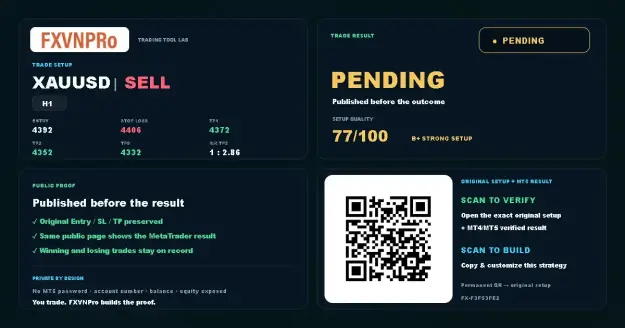 1 · SETUP
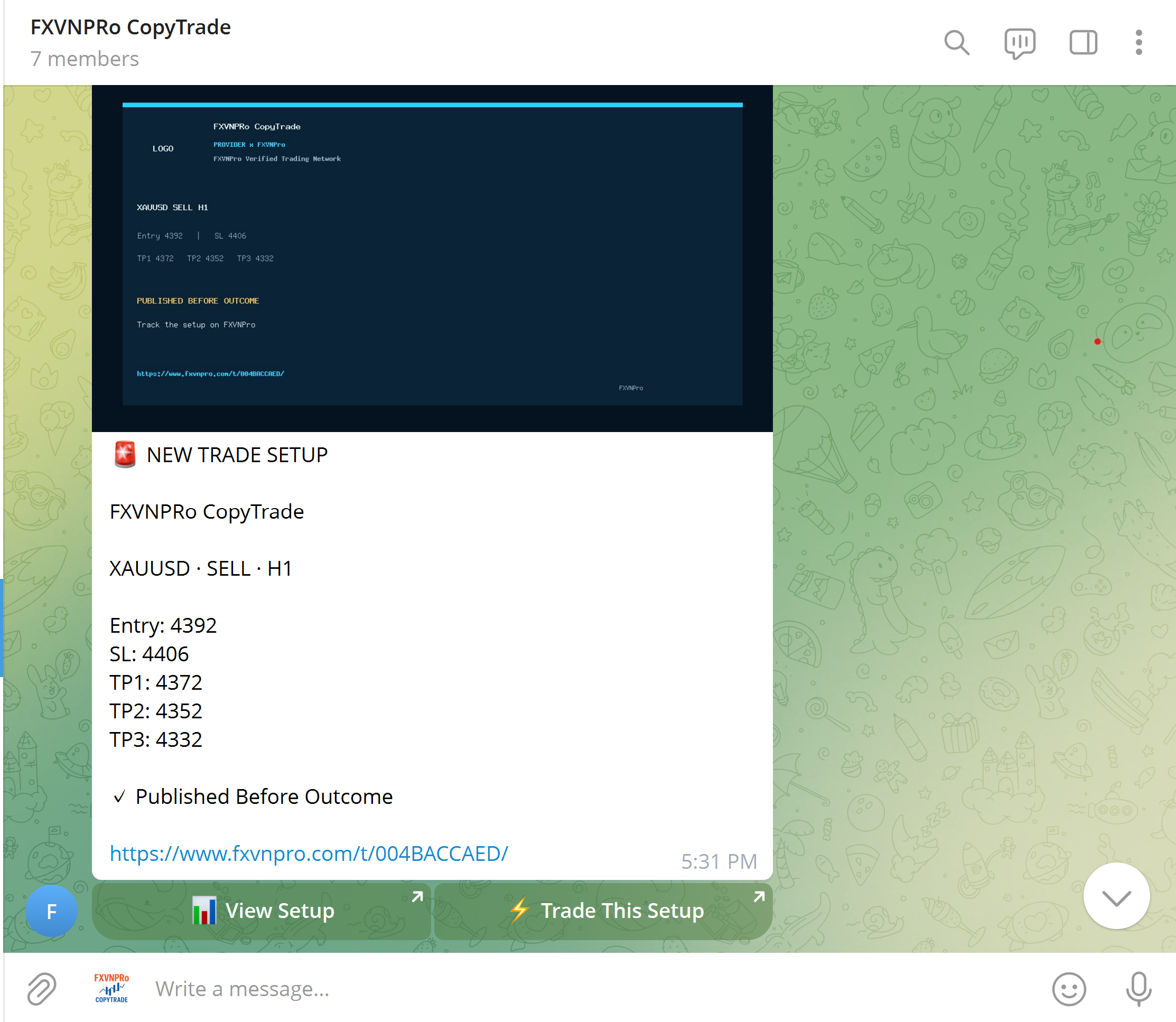 2 · TELEGRAM
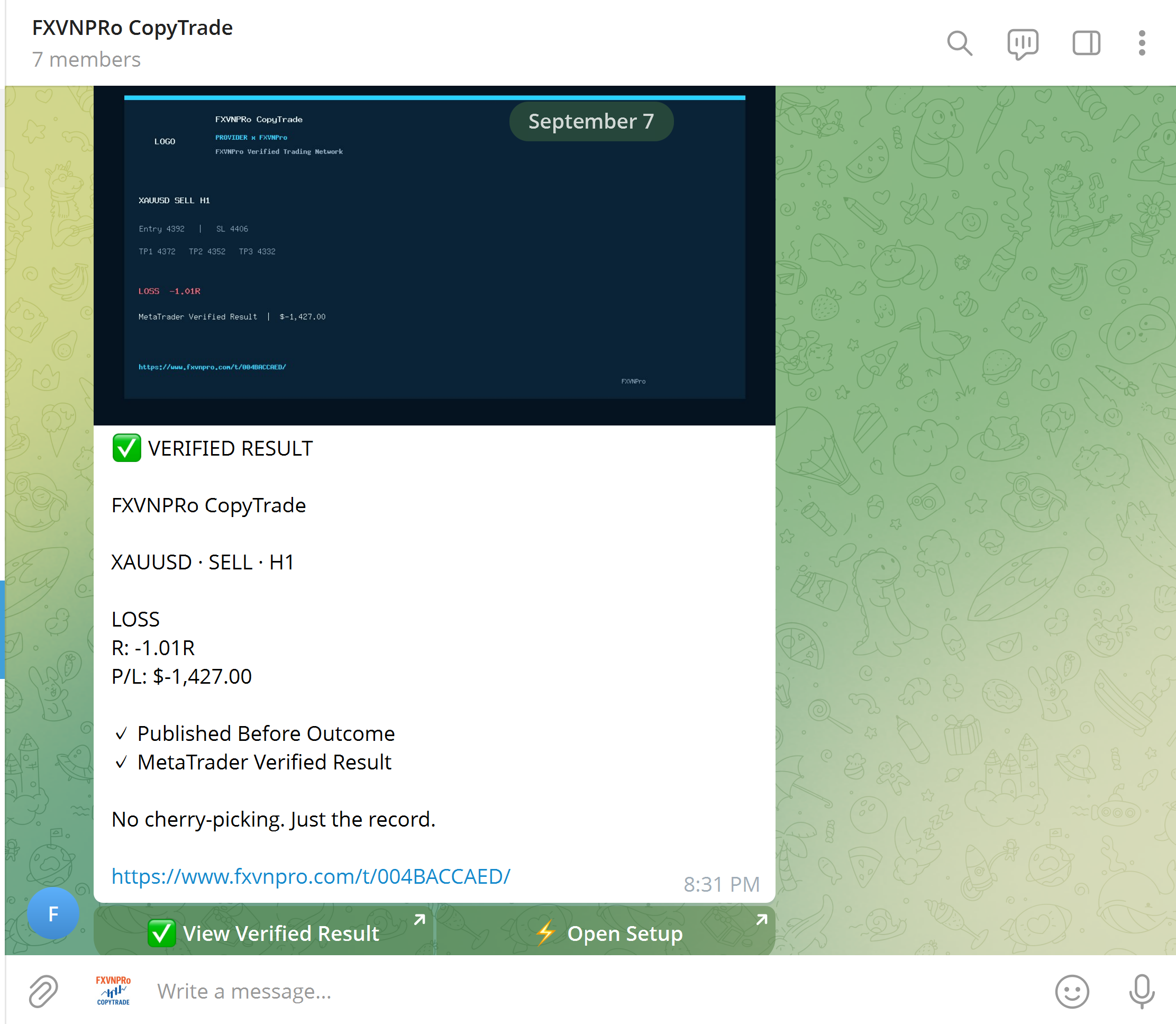 3 · VERIFIED
FXVNPro connects trade plans, Telegram trading communities and verified CopyTrade activity in one practical MT4/MT5 ecosystem.
Turn Entry, Stop Loss and Targets into a trade plan. Publish it before the outcome, then track and verify the result.
Turn Telegram signals into actionable MT4/MT5 setups. Signal Admins create the strategy while Members stay in control of risk.
Discover TRADERs, inspect verified trading history and performance, then decide who you want to follow across MT4 & MT5.
Build your strategy, distribute it to a community, or follow trading activity across MT4 & MT5.
Create Entry, Stop Loss and Targets before the outcome, then build a verified trading record.
Turn Telegram signals into an actionable workflow while followers keep control of their own risk.
Connect Chrome to MT4 or MT5 and open, modify or close trades from your browser.
Explore Masters and copy trading activity to your own MT4 or MT5 terminal with independent risk rules.