

BlackBull
FVP Score
6.4/10
BlackBull
- Minimum Deposit$1
- RegulationFSP
- PlatformsMT4, MT5,cTrader,TradingView
- SpreadFrom 0.0 pips
Start with your goal. You do not have to learn the FXVNPro architecture before using the tools.
Build an idea, use Telegram signals, trade from Chrome or follow a trader while technical setup stays in the background.
Technical connection details remain available inside each product when needed.
Compare BlackBull and Exness by rating, regulation, minimum deposit, platforms, spreads, and overall trading conditions.
Use the FXVNPro Broker Checker Chrome extension to quickly review broker trust signals, ratings, and safety information while browsing broker websites.

| Feature | BlackBull | Exness |
|---|---|---|
| Rating | 6.4 | 7 |
| Minimum Deposit | $1 | $10 |
| Regulation | FSP | - |
| Platforms | MT4, MT5,cTrader,TradingView | MT4, MT5 |
| Spread | From 0.0 pips | From 0.0 pips |
Below is a detailed breakdown of fees, spreads, regulation, platforms, and real trading suitability to help you decide which broker fits your trading style better.
If you’ve ever looked at a broker’s website and thought, “Great—zero spreads, easy,” then you already know the catch. In live FX trading, the headline spread is only one piece of the puzzle. Execution quality, commissions (if any), platform reliability, and even how regulation is handled can quietly decide whether a strategy survives or gets chopped up by costs.
This BlackBull vs Exness comparison is for traders who don’t just want features—they want to understand how fees comparison and spreads and trading costs translate into real P&L. I’m talking about the stuff you feel on your statement after a week of fast markets, rollovers, and news spikes.
Quick snapshot: BlackBull starts with a lower minimum deposit (often a big deal when you’re testing), offers MT4/MT5 plus cTrader and TradingView, and lists spreads from 0.0 pips. Exness also advertises spreads from 0.0 pips, but the minimum deposit is higher and the regulation data provided here isn’t specified.
So which broker is better? If you care about platform choice and want to start small with a clearer regulatory label, BlackBull typically fits more situations. If you’re already comfortable with the higher starting capital and you’re focused mostly on core MT4/MT5 TRADE, Exness may feel efficient. But the “which broker is better” answer changes depending on your trading style and how you pay for liquidity.
Let’s start with the part everyone scans: “from 0.0 pips.” On paper, both BlackBull and Exness can show extremely tight spreads. But in real trading conditions, “from” matters because most traders don’t live on the best-case tick. Liquidity thins during sessions transitions, spreads widen around rollover, and news can turn tight spreads into ugly ones fast.
Here’s the practical way I think about fees comparison: you’re not paying for “the spread” in isolation—you’re paying for the total cost of entering and exiting. That includes the spread itself, plus any commission (if applicable), plus the slippage you experience when price moves faster than your platform can fill you. Even if the spread is near-zero most of the day, slippage on market orders can still be your hidden bill.
With BlackBull, the minimum deposit is $1 and spreads are shown “from 0.0 pips.” That suggests they’re comfortable competing on raw trading conditions. With Exness, the minimum deposit is $10 and spreads are also “from 0.0 pips.” The minimum deposit won’t change your per-trade costs directly, but it changes how easily you can run multiple test trades and measure your real-world spreads and slippage behavior.
In real scenarios, the cheaper broker isn’t always the one with the tightest headline spread—it’s the one that TRADEs consistently during your typical trading window. If you trade during London and overlap with New York, you’ll see different behavior than someone trading Asia. So the right question is: in your style, does either broker widen more than the other when it matters?
Regulation is one of those topics people love to compress into a single line, but that’s exactly how traders get burned. What matters is not just the regulator name—it’s what that regulator covers in practice: client money protection, oversight standards, and how robust enforcement tends to be when things go wrong.
For BlackBull, the data provided lists regulation as “FSP.” That label gives at least a reference point, but as a trader I’d still want to verify the exact entity and scope before depositing significant capital. You should check whether the broker is authorized for the specific instruments you trade (FX, indices, commodities), and whether segregation of client funds is explicitly stated.
For Exness, the regulation field is shown as “-” in the data you provided. That’s a problem for safety-minded traders—not necessarily because Exness is automatically unsafe, but because the comparison here can’t support a confidence level. When you can’t clearly see regulatory coverage, it’s harder to judge risk. And risk management isn’t just about your stop-loss—it’s also about counterparty risk.
Verification importance is real. I’ve seen traders focus so hard on spreads that they forget the boring question: “What happens if withdrawal processing slows or the broker changes terms?” In high-stress moments, you want the comfort of clear oversight.
If you’re deciding which broker is better primarily on safety, this section pushes the decision toward the broker with clearer regulatory labeling in the provided data—BlackBull. If you’re already comfortable with Exness from prior experience, you can still evaluate it, but you shouldn’t ignore the missing regulation detail.
Platforms sound like a “preferences” topic until you’ve tried to manage risk during fast moves. Then you realize platform usability affects execution speed, order handling, and even your ability to stay calm. That’s why platforms and tools matter in a BlackBull vs Exness decision.
BlackBull offers MT4, MT5, cTrader, and TradingView. That’s a wide toolkit. If you’re a trader who likes different charting styles or wants more control over order types, having cTrader in the mix can be a real advantage. TradingView integration can also help if you build workflows around charting first and execution second. In real trading, fewer workarounds usually means fewer mistakes.
Exness offers MT4 and MT5 only. MT4 is still the workhorse for many systematic traders—especially those using older EAs or specific community tools. MT5 can be better for netting/hedging preferences and certain order capabilities, but it depends on what you run.
Execution speed and slippage don’t only depend on the server; they depend on how the platform handles data, how your VPS setup performs, and how stable the connection is during volatile periods. In practice, if you switch platforms often, you might improve flexibility but increase the chance of inconsistent behavior (different order execution mechanics, different display latency, different hedging logic).
So which broker is better for trading experience? If you want platform variety and a smoother workflow for charting and execution, BlackBull has an edge. If your strategy is tightly tied to MT4/MT5 and you don’t care about cTrader or TradingView, Exness stays competitive.
Deposits and withdrawals aren’t glamorous, but they’re where trading plans either stay consistent or start falling apart. You can have great spreads and still lose money if withdrawals are slow when you’re trying to manage risk or scale down after a losing run.
In the data you provided, BlackBull has a minimum deposit of $1. That usually means lower friction for testing. For example: if you’re building a strategy and want to run 20–50 demo-like micro tests on a live environment (without pretending it’s a demo), a $1 start is psychologically easier. You can also fund and refund more flexibly as you tune position sizing.
Exness has a $10 minimum deposit. That’s still not expensive, but it can matter if you’re the type of trader who likes to trial multiple approaches quickly. With a higher minimum, you’re more likely to commit a bit more capital per “experiment,” which can slow iteration if your strategy needs rapid changes.
Speed matters too—especially withdrawals. In real trading, you don’t always withdraw when markets are calm. Sometimes you’re pulling funds right after a streak, or before a high-impact news window. The best execution in the world won’t comfort you if withdrawal processing becomes a hassle.
Because the provided information doesn’t specify withdrawal times, fees, or supported payment methods for either broker, I can’t claim “faster withdrawals” as a fact. But the minimum deposit difference is still meaningful: it changes how quickly you can start, how often you can test, and how small your first operational risk is.
For traders who hate friction and want to begin with minimal commitment, BlackBull is easier to enter with based on the $1 minimum deposit.
If you’re new, you’re not just learning charts—you’re learning broker behavior. That includes how spreads actually look at your trading time, how order execution feels, and whether the platform confuses you when you place stops or adjust positions.
BlackBull’s $1 minimum deposit is a big deal for beginners. It reduces the emotional pressure. When you can start tiny, you can focus on learning market mechanics and platform navigation instead of worrying that one mistake costs a meaningful chunk of your capital. Beginners often overtrade when they feel “stuck” financially, and a lower minimum helps avoid that trap.
Platform variety also helps. Having MT4 and MT5 is great, but adding cTrader and TradingView can give beginners a more intuitive charting and order workflow. Sometimes the “best” platform is the one that matches your learning style. If you’re coming from TradingView, jumping into TradingView charts and then executing can feel less like switching worlds.
Exness has MT4/MT5 and a $10 minimum deposit. That’s not a deal-breaker, but it’s more commitment at the beginning. If you’re practicing with small lot sizes, you may still be fine. But beginners generally benefit from the freedom to make mistakes without turning them into expensive lessons.
Also, regulation visibility matters for beginners too. If you can clearly identify regulatory oversight, you’ll sleep better and make fewer emotional decisions. In this comparison dataset, BlackBull has a stated regulation label, while Exness regulation is not provided (“-”). For a first-time trader, that clarity is valuable.
For beginner suitability, the safer recommendation based on the information given is BlackBull—mainly because of the lower minimum deposit and broader platform options.
Active traders don’t just want tight spreads—they want reliable fills. Scalping is where tiny costs become huge. A strategy that looks profitable on a spreadsheet can get wrecked by slippage, inconsistent spreads, or platform quirks during fast order flow.
Both brokers advertise spreads “from 0.0 pips,” which is promising for scalpers. But here’s the thing: in active trading, the “from” number is less important than what you consistently experience during your trade window. If you trade the open of London or the US session, your fills are tested. If you trade quieter hours, spreads might behave differently and you may not notice execution issues until later.
BlackBull’s platform options matter for day traders and scalpers. cTrader can be attractive for traders who like its interface and order handling. TradingView can also be helpful if you use alerts and plan entries visually, while MT4/MT5 can support EAs and fast execution routines. More importantly, having multiple platforms gives you redundancy: if one workflow feels sluggish or you don’t like its order management, you can adjust.
Exness is MT4/MT5 only. That can still be totally fine for active traders—especially those already built around MT4 EAs or MT5 systems. But you’re less flexible if you later decide you want a different execution experience.
Minimum deposit also affects active traders indirectly. With Exness at $10, you can still start, but active traders usually move quickly toward meaningful lot sizes. The ability to test execution with smaller capital can help you validate your slippage assumptions before you scale.
So, which broker is better for active traders in this dataset? If you care about execution workflow flexibility and you want more platform choices to optimize your trading experience, BlackBull holds the edge.
BlackBull pros: Lower minimum deposit ($1) for rapid testing; multiple platforms (MT4, MT5, cTrader, TradingView); spreads listed from 0.0 pips; clearer regulatory label in provided data (FSP).
BlackBull cons: As always, “from 0.0 pips” depends on market conditions—expect variation during news or low-liquidity periods; you still need to verify the exact regulatory entity and client fund protections.
Exness pros: Spreads listed from 0.0 pips; MT4 and MT5 support; solid option if your trading setup is already built around those platforms.
Exness cons: Higher minimum deposit ($10); regulation detail is missing in the provided data, which reduces confidence for safety-focused traders; fewer platform choices than BlackBull.
What should you check before committing? Don’t just look at spreads in marketing screenshots. Run a small live test during your usual session and log: average spread, worst-case spread during volatility, and perceived slippage on your order type. That’s the “fees comparison” that actually matters to your strategy.
If you want a clear decision based on the information provided, I’d summarize it like this: BlackBull vs Exness comes down to cost-testing flexibility, platform variety, and the clarity of regulatory labeling.
My recommendation for most traders (especially newer ones): BlackBull. The $1 minimum deposit makes it easier to validate spreads and execution speed without risking too much early. Plus, the platform lineup (MT4, MT5, cTrader, TradingView) gives you options as your trading experience grows. If you’re trying to learn how costs and execution really behave, that flexibility helps.
When Exness makes more sense: If you’re already an MT4 or MT5-focused trader and you’re comfortable starting with a $10 minimum deposit, Exness can be a workable choice—particularly if your priority is sticking to one ecosystem and you already know how their execution behaves in your markets.
But here’s the boundary: if regulation clarity is a major part of your risk management, the missing regulation detail in the provided Exness data makes it harder to justify choosing Exness over BlackBull purely from a safety standpoint.
So which broker is better? For beginners and traders who value platform flexibility and clearer regulatory labeling in this comparison, BlackBull is the better pick. For experienced traders who already trade MT4/MT5 and don’t need extra platform tools, Exness can still fit—just make sure you’ve done your own verification on safety and real trading costs.
One real XAUUSD trade: created before the outcome, sent to Telegram, TRADEd in MT5 and returned as a verified result.
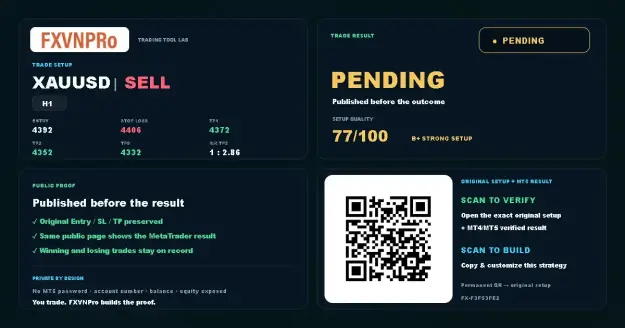 1 · SETUP
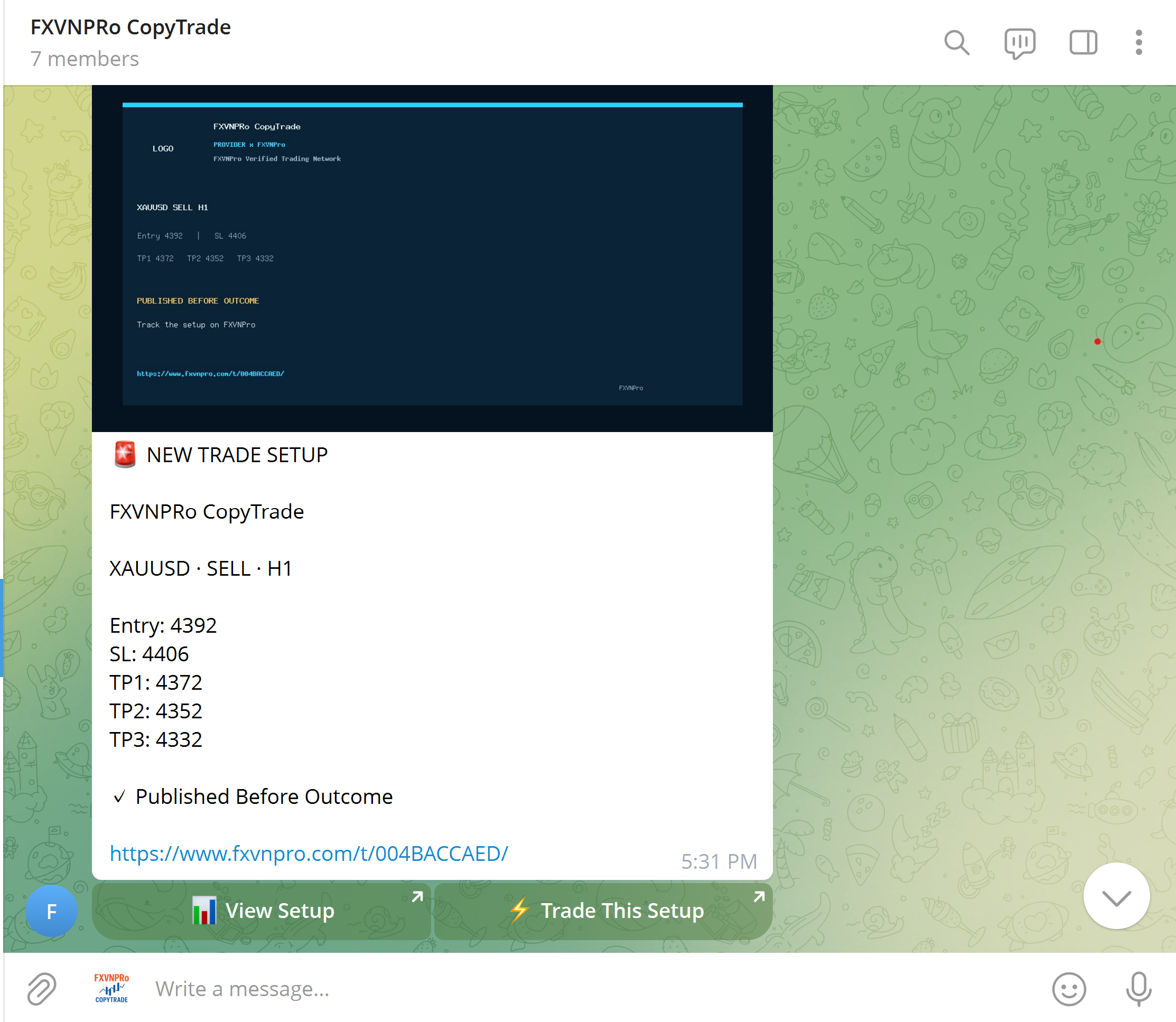 2 · TELEGRAM
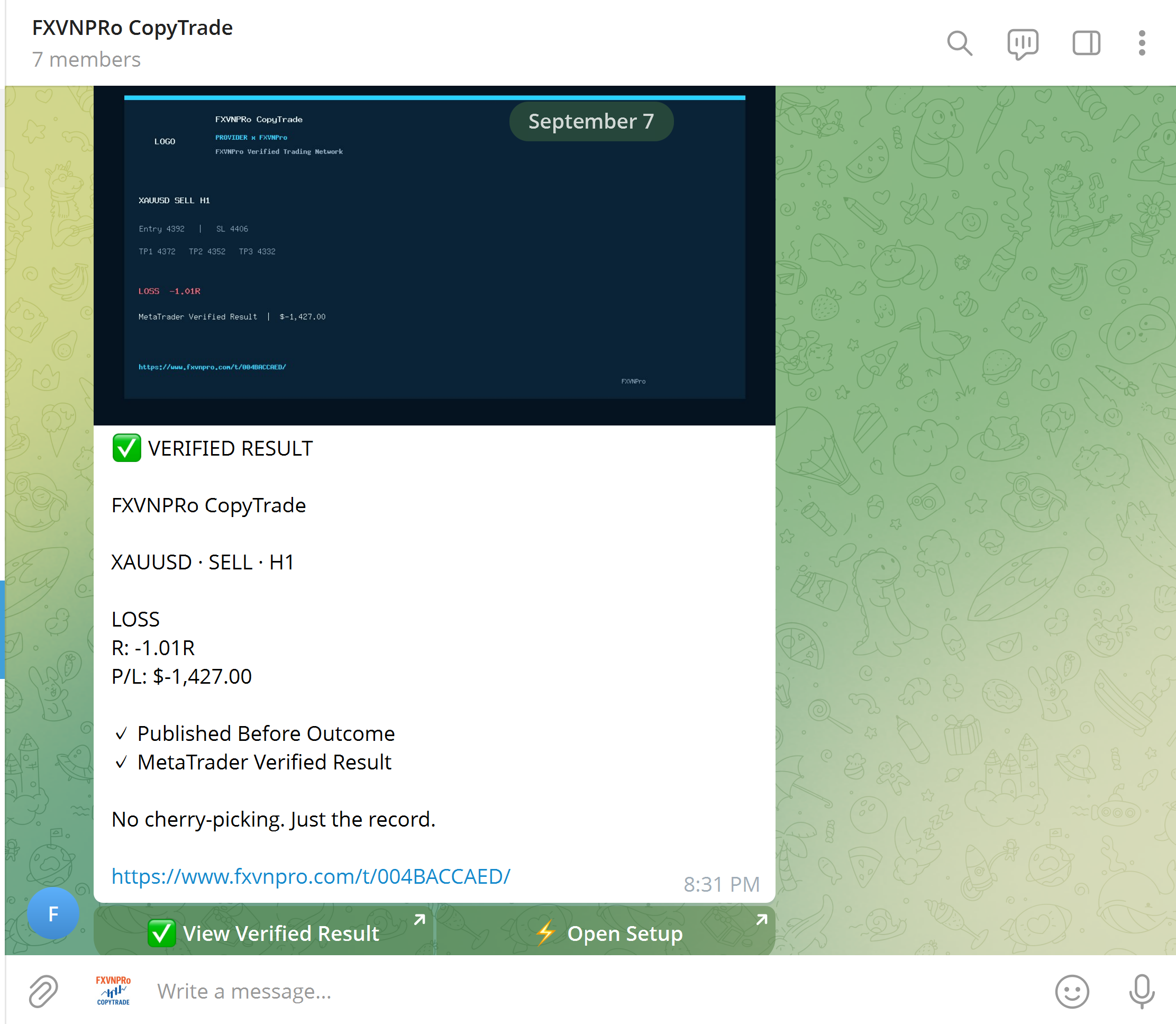 3 · VERIFIED
FXVNPro connects trade plans, Telegram trading communities and verified CopyTrade activity in one practical MT4/MT5 ecosystem.
Turn Entry, Stop Loss and Targets into a trade plan. Publish it before the outcome, then track and verify the result.
Turn Telegram signals into actionable MT4/MT5 setups. Signal Admins create the strategy while Members stay in control of risk.
Discover TRADERs, inspect verified trading history and performance, then decide who you want to follow across MT4 & MT5.
Build your strategy, distribute it to a community, or follow trading activity across MT4 & MT5.
Create Entry, Stop Loss and Targets before the outcome, then build a verified trading record.
Turn Telegram signals into an actionable workflow while followers keep control of their own risk.
Connect Chrome to MT4 or MT5 and open, modify or close trades from your browser.
Explore Masters and copy trading activity to your own MT4 or MT5 terminal with independent risk rules.