

Exness
FVP Score
7/10
Exness
- Minimum Deposit$10
- Regulation-
- PlatformsMT4, MT5
- SpreadFrom 0.0 pips
Start with your goal. You do not have to learn the FXVNPro architecture before using the tools.
Build an idea, use Telegram signals, trade from Chrome or follow a trader while technical setup stays in the background.
Technical connection details remain available inside each product when needed.
Compare Exness and Titan FX by rating, regulation, minimum deposit, platforms, spreads, and overall trading conditions.
Use the FXVNPro Broker Checker Chrome extension to quickly review broker trust signals, ratings, and safety information while browsing broker websites.

| Feature | Exness | Titan FX |
|---|---|---|
| Rating | 7 | 6.3 |
| Minimum Deposit | $10 | $50 |
| Regulation | - | VFSC, FSA, FSC |
| Platforms | MT4, MT5 | MT4, MT5 |
| Spread | From 0.0 pips | From 0.1 pips |
Below is a detailed breakdown of fees, spreads, regulation, platforms, and real trading suitability to help you decide which broker fits your trading style better.
If you’ve ever been up on a trade, then watched the numbers quietly slip the wrong way at the open—spread, slippage, execution delay—that feeling is why “cheap broker” debates aren’t just online drama. They’re about survival. Exness vs Titan FX isn’t simply about which platform looks nicer. It’s about which one helps you keep more of your edge after real trading conditions show up: news spikes, thin liquidity hours, fast scalps, and the kind of entries you take because the chart says so—not because the market is cooperating.
This comparison is for traders who actually place orders often enough to feel costs, not just test once a week. If you’re running a day plan or scalping around session changes, fees and spreads and execution speed stop being “details.” They become part of your P&L.
Quick headline differences: Exness has a lower minimum deposit ($10) and spreads “from 0.0 pips,” but we don’t have a clear regulation listing in the provided data. Titan FX has a $50 minimum deposit, regulation noted as VFSC, FSA, and FSC, and spreads “from 0.1 pips.” Both offer MT4 and MT5, so the platform isn’t the deciding factor. The deciding factor is the whole package: trading costs, trust/risk, and how you’ll experience execution in practice.
So which broker is better for you? Let’s break it down properly—fees comparison included, because that’s where the real money lives.
When traders say “spreads matter,” they usually mean it in a general way. But in real trading, spreads matter differently depending on your style. A swing trader can tolerate wider quotes for a moment. A scalper can’t. If you’re trying to capture small moves, spreads and trading costs are the gatekeeper to whether your strategy even has a chance.
Exness lists spreads “from 0.0 pips.” That sounds great on paper, especially if you’re trading during liquid hours. But “from” matters. In practice, the spread you see depends on instrument, volatility, and broker feed conditions. During calmer markets, you may indeed get ultra-tight pricing. During news releases, spreads tend to widen for everyone—what changes is how quickly the broker adapts and how stable the execution feels.
Titan FX shows spreads “from 0.1 pips,” which is still competitive for many strategies. The key question becomes: does Titan’s pricing stay consistent when the market speeds up? Also, spreads aren’t the only cost. Some brokers have commission structures that aren’t included in a simple “spread from X” line. With the data provided, we can’t claim commission specifics, so you should verify whether spreads are raw or effectively “built-in.” This is part of the fees comparison you shouldn’t skip.
Real-world scenario: Suppose you scalp EUR/USD and plan 30 round trips in a session. If Exness averages 0.2 pips tighter than Titan during your active window, that’s 0.2 pips * 30 round trips = 6 pips of cost difference. Convert that to dollars using your position size and suddenly it’s not “small.” It’s a meaningful chunk of risk budget.
This matters because the winner isn’t always the broker with the best headline spread. The winner is the one that keeps trading costs predictable during the exact moments you’re placing orders.
Let’s talk regulation like a trader, not like a brochure. Regulation affects your risk of operational issues: account access problems, dispute handling, and the credibility of the broker’s business model. Even if you never have a “problem,” the regulatory framework shapes how seriously the broker handles compliance and customer protection.
In the provided data for Exness, regulation is listed as “-”. That doesn’t automatically mean “unsafe,” but it does mean we don’t have the safety signal here. For a professional-minded trader, missing or unclear regulation info is a red flag worth investigating before you size up. Why? Because capital protection is not only about price execution—it’s also about whether you can reliably withdraw and whether your account is handled under a clear rulebook.
Titan FX lists regulation as VFSC, FSA, and FSC. Regulators can differ in strength, but having named oversight at least tells you there’s a framework. That matters for trust level and risk. It also affects how you approach verification importance: you should still verify the broker’s exact entity name in your account and confirm the regulator details for that entity, not just the marketing list.
Here’s a practical way to think: if you’re deploying a strategy with a multi-month horizon, you’ll feel the pain of bad execution. But if you’re placing larger capital and relying on consistent withdrawals, regulatory clarity becomes non-negotiable. You don’t want to discover late that your account falls under a less robust jurisdiction than you assumed.
In real trading conditions, safety isn’t only theoretical. It shows up when you need to manage risk fast—during drawdowns, after wins, or when you hit your monthly withdrawal plan.
Both Exness and Titan FX offer MT4 and MT5. On the surface, that means similar charting, order types, and ecosystem support (EAs, indicators, VPS workflows). If you’ve already built your routine around MT4/MT5, you won’t feel forced to change your platform. That’s a real advantage.
But here’s the nuance: “platform supported” doesn’t automatically mean “platform feels identical.” Execution speed, how quickly price updates, order handling under volatility, and even the reliability of trading during high-load periods can differ. A trader can have the same EA on both brokers and still see different performance because fills and slippage behave differently.
MT4 is still a favorite for many scalpers and automated traders because it’s lightweight and widely used for custom EAs. MT5 adds more features for market depth and order types, plus a different trading environment for indicators and backtesting. In actual use, the question is whether the broker’s bridge between your terminal and the market is smooth when spreads widen.
For example: during a session transition (London to New York), spreads can widen and price can jump. If you run a stop-entry system, you care about execution speed and whether your stop behaves as expected. You also care about slippage—especially with market orders. If your strategy is “limit-first,” you might reduce slippage risk, but you’ll still feel it when your limits don’t get filled at your targeted level.
So which broker has the better platform experience? Based purely on the data you provided, it’s impossible to prove. Both support the same platforms. The differentiator becomes execution quality in real trading conditions, which you should test with a small live account and a repeatable routine.
Because if your EA is making money on backtests but losing during live deployment, the first suspect isn’t your strategy—it’s usually execution and trading costs.
Minimum deposit is one of those numbers people glance at and then forget. But it changes the kind of testing you’ll actually do. Exness has a $10 minimum deposit. That makes it easier to start small, test execution, and learn how spreads behave on your instruments without risking too much early. For new traders, that matters because the first week is often about mistakes—wrong lot size, poor session selection, and impulsive entries.
Titan FX has a $50 minimum deposit. That’s still not huge, but it’s higher. Practically, it can push beginners into starting with more pressure: “I paid more, so I need to make it work.” That’s not always healthy, but it happens. On the other hand, higher minimums can sometimes correlate with a more stable onboarding experience—again, it depends on process, not just math.
For deposits and withdrawals, we’d need more specifics to claim exact speeds or fee schedules. The data provided doesn’t include withdrawal timeframes or third-party payment costs. What we can say is this: deposits and withdrawals are where traders feel friction. If a broker has unclear policies, slow withdrawals, or hidden processing fees, your stress level rises—especially when you’re drawing down and want to manage your exposure externally.
Real-world scenario: You run a short-term strategy and hit a good week. You want to pull part of the profit to reduce psychological pressure. If withdrawals are simple and reasonably fast, you stay consistent. If not, you start second-guessing every trade because your money isn’t where you expect it to be.
So for “which broker is better,” deposits/withdrawals become personal. Titan’s regulation list may add confidence for some traders, but you still need to check payment methods and withdrawal behavior for your region.
Before you size up, do a full cycle: deposit small, place a few trades during your usual session, then attempt withdrawal when you’re in profit. That’s the only real test.
Beginner suitability isn’t about whether a broker offers MT4/MT5. Almost every broker does. It’s about how forgiving the broker is when you’re learning. That includes minimum deposit, the stability of spreads, and whether the trading environment punishes you for common beginner mistakes.
Exness starts with a $10 minimum deposit. That’s low enough to let a beginner practice position sizing and order placement without immediately putting big money at risk. If you’re experimenting with micro-lots and learning how spreads look on different Connects, a low entry cost keeps your learning process intact. Combine that with spreads “from 0.0 pips,” and you might get genuinely tight pricing—at least at times—so your demo-to-live transition doesn’t feel like a wall.
Titan FX’s $50 minimum deposit is still accessible, but it’s a different mindset. You’ll likely start with fewer “try” trades and more “commit” trades. Beginners often need repetition to build discipline. Higher minimums can indirectly reduce that repetition.
Now the other side: regulation visibility. Titan lists VFSC, FSA, and FSC. For a beginner, that can reduce anxiety. You want a learning environment where the broker is transparent about oversight. Verification importance is also higher here—new traders are more likely to overlook entity names and account types.
So which broker is easier to start with? If we focus purely on cost to begin, Exness is more beginner-friendly because of the $10 minimum. If we focus on trust signals and the comfort of named regulation, Titan FX has an advantage. In practice, most beginners need both: a low barrier and a clear safety framework.
My suggestion: if you’re brand new, start with the broker that lets you trade small while you learn execution and trading costs. Then, confirm withdrawal behavior before you increase lot size.
Active traders don’t just “like tight spreads.” They build their entire risk model around them. When you’re placing many orders, the difference between 0.0 and 0.1 pips becomes less theoretical and more like daily rent. Execution speed and slippage are equally important because even a small delay can move your entry from “good” to “chasing.”
Exness lists spreads “from 0.0 pips” and supports MT4/MT5. For day traders and scalpers, that headline number suggests potential cost efficiency. But again, the real question is consistency. During fast markets—index news, FX rate announcements, or sudden momentum spikes—spreads widen. What matters is how often you get the tight end of the range when you’re actually trading and how stable order execution remains when volatility hits.
Titan FX shows spreads “from 0.1 pips,” slightly wider on paper. However, regulation is listed (VFSC, FSA, FSC). For active traders, that can matter because you’re more likely to scale up and hold meaningful balances for longer periods. You want confidence that operational processes—especially withdrawals—won’t become a bottleneck.
Let’s put it into a scenario. Imagine you run a simple day strategy: trade the first 90 minutes after a session opens, take 1–3 setups, and cut losers quickly. Your edge depends on getting filled at intended levels. If Exness provides tighter spreads but occasionally shows higher slippage on stop orders, your P&L might flatten. If Titan’s spreads are slightly wider but fills are cleaner and more consistent, Titan could outperform for that strategy—even with the “from 0.1 pips” headline.
So which broker is better for active trading? It depends on your order style. If you use limit orders and your strategy tolerates small execution variance, Exness could shine. If you rely more on market fills and stop execution during volatility, you should test both brokers under your real session and instrument list.
If you’re wondering why this matters: pros and cons aren’t about comfort—they’re about what can break your strategy when the market gets noisy.
Let’s be decisive, because “which broker is better” shouldn’t stay vague. Based on the data provided, I’d recommend Exness more for traders who prioritize low-cost experimentation and can verify the missing regulation details themselves. The $10 minimum deposit plus spreads “from 0.0 pips” makes Exness appealing if you’re actively testing a strategy, trading smaller size, or you’re building confidence in live execution without putting too much capital at first.
But if you’re the type of trader who will sleep better with clear regulation signals on day one, Titan FX is the clearer pick from a safety/oversight standpoint. The spreads “from 0.1 pips” are not a deal-breaker for most day trading and many scalping approaches, and the listed regulation (VFSC, FSA, FSC) gives a stronger trust foundation. For traders who plan to scale up balances and keep funds at the broker, Titan’s transparency here is meaningful.
My practical recommendation by trader type:
Whichever you choose, don’t skip the “real decision” checklist: run a small live test, monitor spreads and slippage for your instruments, and confirm deposits/withdrawals work smoothly. That’s how you turn Exness vs Titan FX from a forum debate into a trading advantage.
One real XAUUSD trade: created before the outcome, sent to Telegram, TRADEd in MT5 and returned as a verified result.
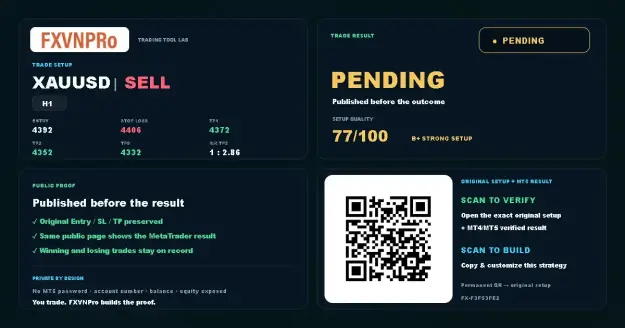 1 · SETUP
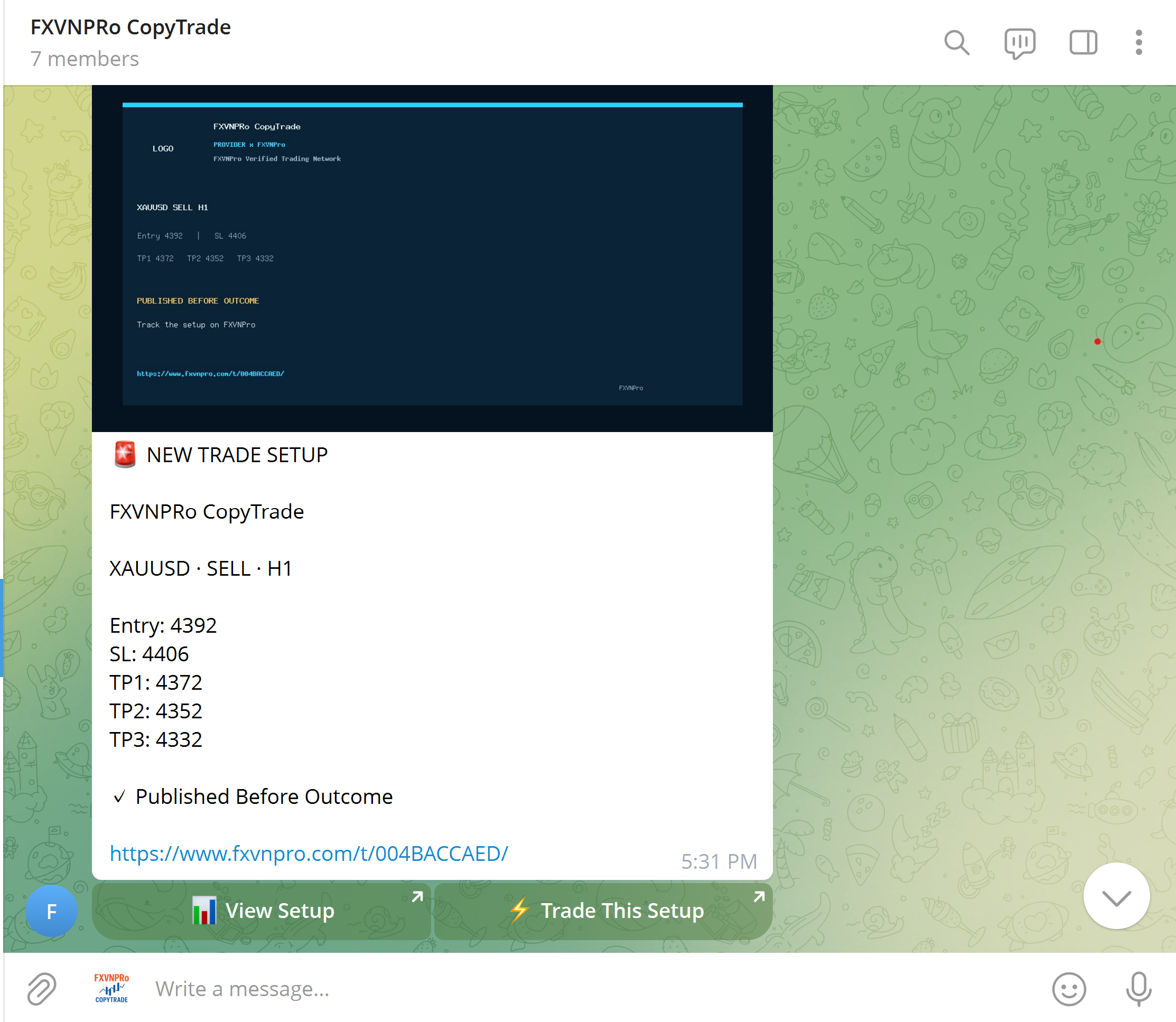 2 · TELEGRAM
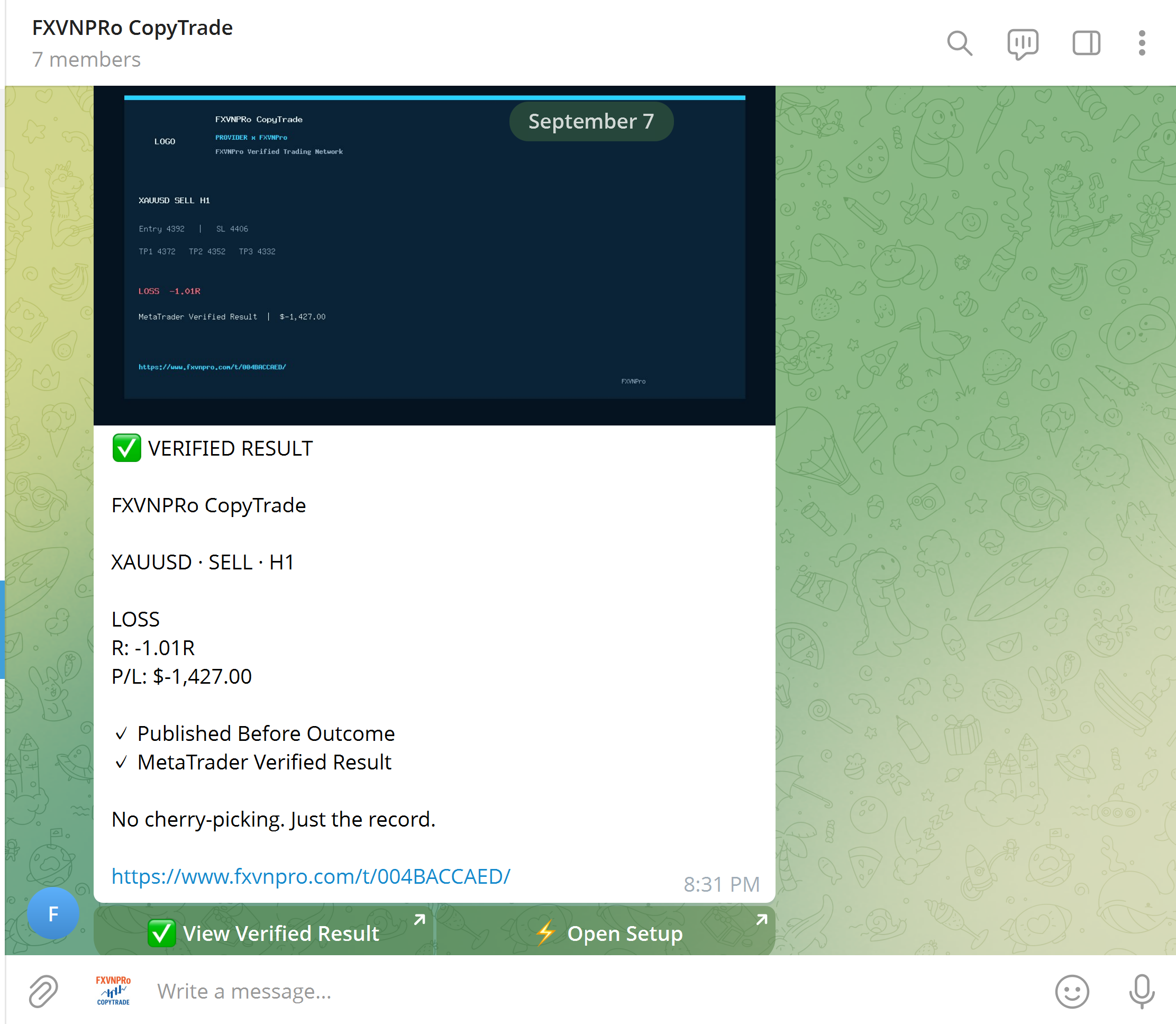 3 · VERIFIED
FXVNPro connects trade plans, Telegram trading communities and verified CopyTrade activity in one practical MT4/MT5 ecosystem.
Turn Entry, Stop Loss and Targets into a trade plan. Publish it before the outcome, then track and verify the result.
Turn Telegram signals into actionable MT4/MT5 setups. Signal Admins create the strategy while Members stay in control of risk.
Discover TRADERs, inspect verified trading history and performance, then decide who you want to follow across MT4 & MT5.
Build your strategy, distribute it to a community, or follow trading activity across MT4 & MT5.
Create Entry, Stop Loss and Targets before the outcome, then build a verified trading record.
Turn Telegram signals into an actionable workflow while followers keep control of their own risk.
Connect Chrome to MT4 or MT5 and open, modify or close trades from your browser.
Explore Masters and copy trading activity to your own MT4 or MT5 terminal with independent risk rules.