

Exness
FVP Score
7/10
Exness
- Minimum Deposit$10
- Regulation-
- PlatformsMT4, MT5
- SpreadFrom 0.0 pips
Start with your goal. You do not have to learn the FXVNPro architecture before using the tools.
Build an idea, use Telegram signals, trade from Chrome or follow a trader while technical setup stays in the background.
Technical connection details remain available inside each product when needed.
Compare Exness and HFM by rating, regulation, minimum deposit, platforms, spreads, and overall trading conditions.
Use the FXVNPro Broker Checker Chrome extension to quickly review broker trust signals, ratings, and safety information while browsing broker websites.

| Feature | Exness | HFM |
|---|---|---|
| Rating | 7 | 6.8 |
| Minimum Deposit | $10 | $5 |
| Regulation | - | FCA, DFSA, FSA |
| Platforms | MT4, MT5 | MT4, MT5 |
| Spread | From 0.0 pips | From 0.1 pips |
Below is a detailed breakdown of fees, spreads, regulation, platforms, and real trading suitability to help you decide which broker fits your trading style better.
If you’ve ever placed a trade during a fast news candle and watched your P/L swing before your brain even caught up, you already know this isn’t a “which platform looks nicer” game. It’s about costs, execution, and how much friction you feel when you’re trying to manage risk in real time. That’s exactly why the question “Exness vs HFM— which broker is better?” matters.
This comparison is for traders who care about spreads and trading costs, who want to understand execution speed and potential slippage, and who don’t want to discover limitations after they’ve already funded an account. If you’re a scalper, a day trader, or even a swing trader who still checks spreads like a hawk, you’ll feel the differences.
Quick snapshot: Exness (Broker A) shows spreads “from 0.0 pips,” has a low minimum deposit ($10), and offers MT4/MT5. The catch? The provided regulation field is “-”, meaning we can’t confidently place it under a named top-tier regulator based on the data you gave. HFM (Broker B) lists regulation under FCA, DFSA, and FSA, has a smaller minimum deposit ($5), and spreads “from 0.1 pips.” On paper, HFM looks safer; on pure headline spreads, Exness looks more aggressive.
But here’s the real question: when prices move quickly and your strategy is cost-sensitive, do those “from” numbers actually translate into better fills for your style? Keep reading—this is where the trading experience gets practical.
Let’s talk money, because spreads and trading costs are where most traders accidentally bleed performance. Exness advertises spreads from 0.0 pips. HFM advertises spreads from 0.1 pips. Sounds close, right? In calm markets, it often is. But in real trading conditions—especially around session overlap and economic releases—spreads widen and execution quality becomes a bigger part of your total cost than you might expect.
Here’s how it tends to play out for a practical trader. Imagine you run a short-term mean reversion strategy and you’re targeting, say, 8–15 pips per trade, but you close quickly. If your broker’s typical spread is consistently 0.8–1.4 pips during your trading window, the difference between “from 0.0” and “from 0.1” won’t matter much. What matters is average spread and whether your fills degrade when volatility hits.
Now consider a scalper. That trader might do 30–100 trades in a week. A seemingly tiny spread disadvantage can compound into meaningful P/L drag. For HFM, “from 0.1 pips” could still be very competitive depending on liquidity and execution model, but it’s not as visually attractive as “0.0.” On the flip side, if Exness has less transparent regulation in the provided data, traders who care about long-term risk management may decide that paying an extra fraction of a pip is worth it.
Also watch for hidden fees: swaps/rollover rates, any commission structure (if applicable), and withdrawal-related charges. Your provided data lists spreads but doesn’t confirm commissions. So the honest takeaway is this: compare your total cost on your specific instrument, during your usual trading hours, with your lot sizes. In real scenarios, that’s what decides which broker is cheaper for you—not a marketing line.
If you want a simple test: run the same strategy on both brokers for at least a couple of weeks using identical time windows. Then compare net results after spread costs. That’s the fees comparison that actually counts.
Regulation isn’t a badge you wear—it’s a safety net. And when people skip this part, it usually comes back during stress, not during calm. Based on the data you provided, Exness regulation is listed as “-”. That means we don’t have a named regulator to anchor trust to. HFM lists FCA, DFSA, and FSA. Even without pretending regulators eliminate all risk, having recognized oversight matters for dispute handling, client protections, and overall legitimacy.
Why does this matter for traders? Because trading is already risky—leverage, volatility, and strategy failure are built-in. When a broker’s regulatory status is unclear, the risk shifts from “market risk” toward “counterparty risk.” And counterparty risk is the kind you don’t model well in backtests.
Verification importance is also real. Traders who operate long-term care about whether their account setup and identity checks are consistent, whether compliance is handled professionally, and whether the broker’s processes are stable across deposits/withdrawals. In practice, a well-regulated broker tends to have more standardized procedures. That can reduce the chance of delays exactly when you need funds.
Let’s put this into a scenario. Suppose you have a good month, decide to withdraw, and your bank transfer gets stuck. If your broker is under a clear regulator, you have a clearer path for escalation. If regulation is unclear, you may still resolve it, but the stress level is higher.
So in the “Exness vs HFM” question, HFM gets a clear safety advantage based on the information given. Execution and spreads matter—but regulation changes how confident you can be that the broker environment will remain stable when things get messy.
Both brokers offer MT4 and MT5. That’s a big deal because it means you’re not locked into a proprietary interface. For many professional traders, MT4/MT5 compatibility is non-negotiable—especially if you rely on specific indicators, custom EAs, or trade automation workflows.
However, “same platform” doesn’t always mean “same trading experience.” Execution speed, order handling behavior, and how consistently the broker feeds liquidity into the platform can still differ. Even within MT4/MT5, the broker’s underlying execution quality is what you feel when you’re trying to enter on a specific level or when you’re managing trades during fast price movement.
Think about a typical day. You’re trading EURUSD during London open. You place limit orders around support, then switch to trailing stop management when price breaks. If the broker’s execution is slightly slower, you don’t just get worse entries—you also get worse risk control. That matters more than most traders realize. Slippage doesn’t always show up in the “spread from” line, but it hits your stops and profit targets.
Tooling also matters. MT4/MT5 can be used for automation, but the quality of your fills still determines whether an EA performs as expected. If your strategy assumes tight spreads and low slippage, you need real data from the broker in your instrument and timeframe. Otherwise, your backtest becomes a fantasy.
In real-world usage, beginners also benefit from familiar platform controls and charting. MT4/MT5 aren’t perfect, but they’re widely understood. If you already have a routine—watchlists, alerts, copy-trade habits, EA templates—switching between brokers is less painful.
Bottom line: both brokers support the platforms most traders want. The difference is how that platform “behaves” when you’re actually trading, not just what it looks like.
Deposits and withdrawals are one of those topics traders only care about after something goes wrong. But the truth is, friction affects your trading more than people think. If funding is slow or withdrawals are inconsistent, you either delay trading or you get forced into suboptimal risk decisions.
From the data: Exness has a minimum deposit of $10. HFM’s minimum deposit is $5. That alone can matter if you’re testing the waters or if you’re running smaller accounts. For beginners, lower minimums can reduce the psychological pressure of overfunding before you understand costs. For experienced traders, minimum deposit is less important than reliability—especially if you withdraw profits regularly.
Here’s the real-world scenario I see often: a trader starts with a small account, runs two weeks of testing, then hits a profitable streak and wants to withdraw. If the process is smooth, it reinforces discipline. If it’s slow, it can tempt the trader to keep trading beyond their risk plan “just to make it worth the wait.” That’s how good traders turn into impulsive ones.
We also need to acknowledge that your provided data doesn’t list specific withdrawal fees, processing times, or supported payment methods. That means we can’t claim one broker is faster purely from the minimum deposit number. What we can say is this: with HFM showing clearer regulation (FCA, DFSA, FSA in your data), you generally expect more standardized compliance and account handling. That can reduce withdrawal friction in practice.
So which broker is better for deposits and withdrawals? If you’re optimizing for low entry cost, HFM wins by minimum deposit. If you’re optimizing for long-term confidence and smoother handling, HFM has the edge on regulatory clarity. Exness may still be fine operationally, but with regulation data missing here, traders who prioritize safety usually lean toward the broker with named oversight.
For beginners, the biggest risk isn’t just losing money. It’s losing momentum. A confusing account setup, unclear trading conditions, or unexpected costs can make you question your strategy when the real problem is the broker environment. So in “Exness vs HFM,” beginner suitability comes down to how predictable trading costs and account processes feel.
HFM stands out immediately on minimum deposit ($5). That lowers the barrier to learning. You can practice position sizing, explore instruments, and test whether your chosen strategy survives spread costs. Exness has a $10 minimum deposit, which is still low, but HFM is more beginner-friendly on that specific entry point.
Regulation also matters for new traders. When you’re learning, you’re already vulnerable to bad trades and over-leverage mistakes. Adding counterparty uncertainty is not a good mix. With HFM listed as regulated by FCA, DFSA, and FSA, beginners typically feel more comfortable sticking with one broker while they build a routine.
Now let’s talk about trading experience. Both MT4 and MT5 are familiar ecosystems. A beginner can learn charting, basic order types, and risk controls without switching platforms. But the broker’s spreads and trading costs will directly affect your early “proof” that your strategy works. If your method is sensitive to costs, you might think you’re doing everything right while actually getting quietly taxed by wider spreads.
So which broker is easier to start with? If you want the lowest entry friction and clearer regulatory oversight, HFM is the safer onboarding choice. Exness can still be workable, especially if you’re drawn to the “from 0.0 pips” headline spread, but beginners should be extra careful to verify average spreads and overall execution costs on their chosen instrument.
Ask yourself: do you want to learn trading, or do you want to also learn broker variability?
Active traders live in the details. It’s rarely one trade that makes or breaks you—it’s the 200 tiny decisions inside a month. That’s why execution speed, slippage, and spreads and trading costs matter far more than platform features.
Exness advertises spreads from 0.0 pips, which is exactly what scalpers like to see. If your strategy depends on frequent entries—like breakout scalping or momentum reversion—tight spreads can help you maintain a favorable expectancy. But “from” is not the same as “most of the time.” In real markets, spreads widen during volatility and liquidity gaps.
HFM’s spread from 0.1 pips is slightly less sexy on paper. Yet active traders should care about consistency and overall net cost. If HFM provides stable execution speed and minimizes slippage during your trading hours, that 0.1-pip difference might be irrelevant, especially after you account for actual fill quality.
Let’s run a realistic example. You trade XAUUSD or US30 around major session overlap. In those windows, you’re fighting spread expansion and fast reversals. If one broker’s fills are slightly better and the other is slightly worse, the better execution can outperform the broker with the lower advertised spread. This is why traders track not only spreads but also their average effective spread (how far the fill is from expected price).
For high-volume traders, the withdrawal and account handling experience also becomes important. Small operational delays can interrupt daily workflows. Regulation clarity also affects risk tolerance. If you’re moving size and withdrawing profits frequently, you want confidence that compliance processes are predictable.
Given your data, Exness looks more aggressive on headline spreads, while HFM looks more trustworthy on regulation. For most serious active traders, the decision often becomes: do you want the lowest advertised spread, or do you want the lower-regret trading environment with recognized oversight?
If you’re wondering “which broker is better,” the honest answer is: it depends on what you value most—lowest advertised spread versus regulatory clarity. Traders don’t blow up because a platform has nicer charts. They blow up because costs, execution, or trust breaks down when it matters.
Here’s the decision framework I’d use if I were placing capital based on the information provided. Exness vs HFM isn’t just a comparison of spreads—it’s a comparison of risk posture and trading cost realities.
Choose HFM if: you care about regulation and safety clarity (FCA, DFSA, FSA in your data); you want a slightly easier start with a $5 minimum deposit; you’re a beginner or intermediate trader who values a predictable environment while learning execution and risk management. For many retail traders, this is the “lower regret” path.
Choose Exness if: you’re highly focused on cost-sensitive trading and you believe the “from 0.0 pips” environment translates into your typical market conditions; you can verify average effective spreads and slippage on your specific instruments and time windows. If you’re an active trader running many trades where every pip matters, Exness may feel better—but you should treat regulation uncertainty (as shown in the provided data) as a real factor, not a footnote.
In a strict “which broker is better” sense: based on regulation clarity alone, HFM has the edge. Based on headline spreads alone, Exness looks more aggressive. But professional traders don’t pick brokers by headlines—they pick by net execution outcomes and comfort with the counterparty risk.
If you want the most practical next step: paper trade or run a small live test on both brokers for 10–20 trading sessions, same instruments, same time of day, same risk per trade. Then compare your net results after spreads and trading costs. That will tell you the real winner for your strategy—fast.
One real XAUUSD trade: created before the outcome, sent to Telegram, TRADEd in MT5 and returned as a verified result.
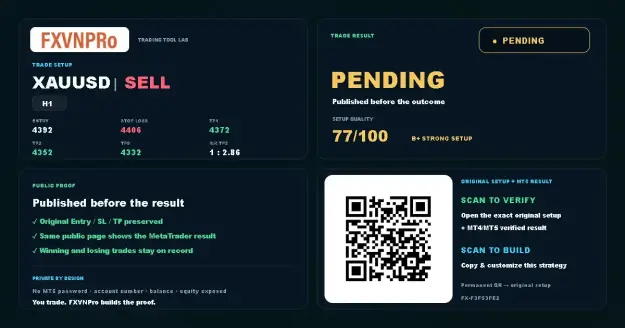 1 · SETUP
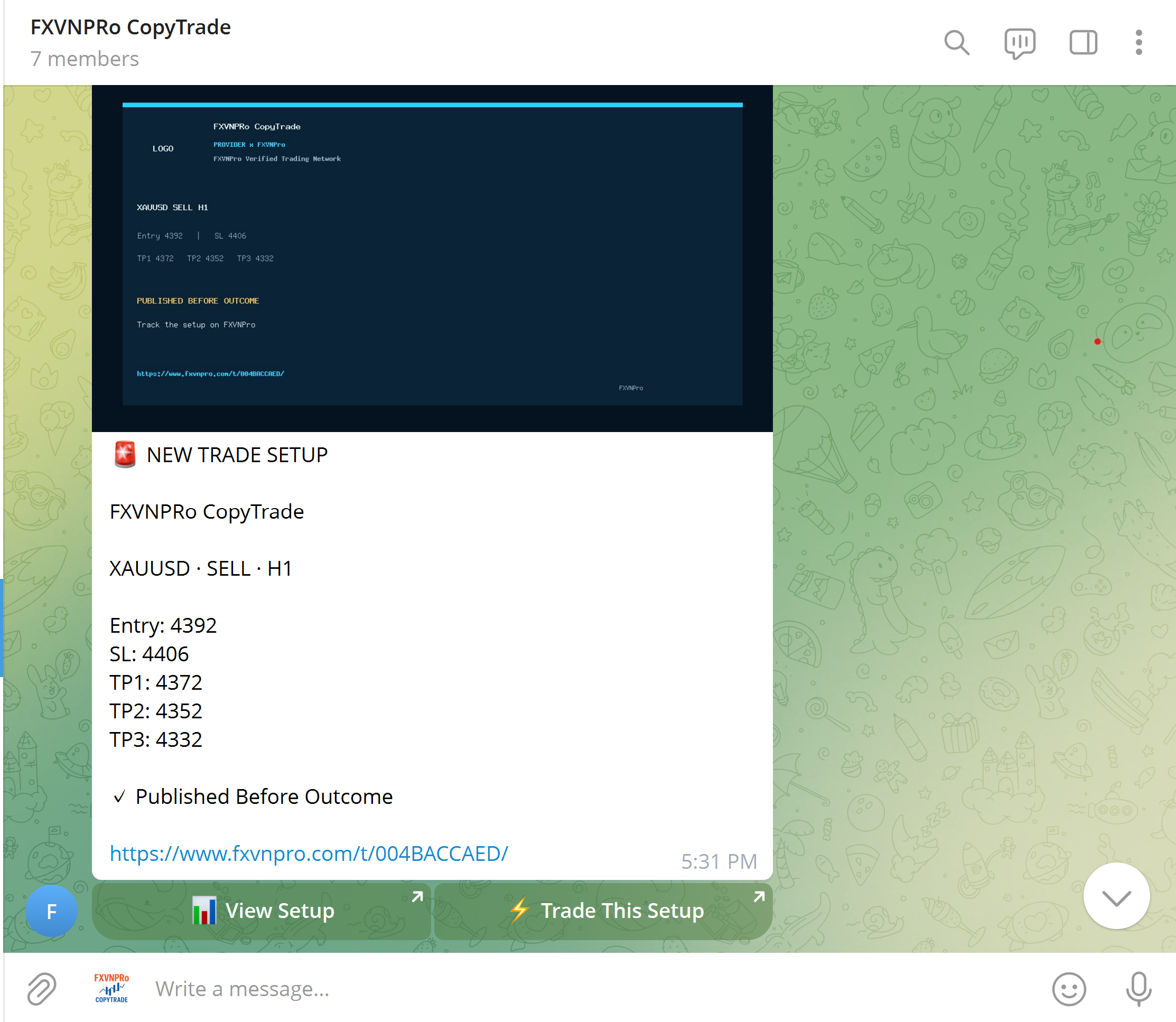 2 · TELEGRAM
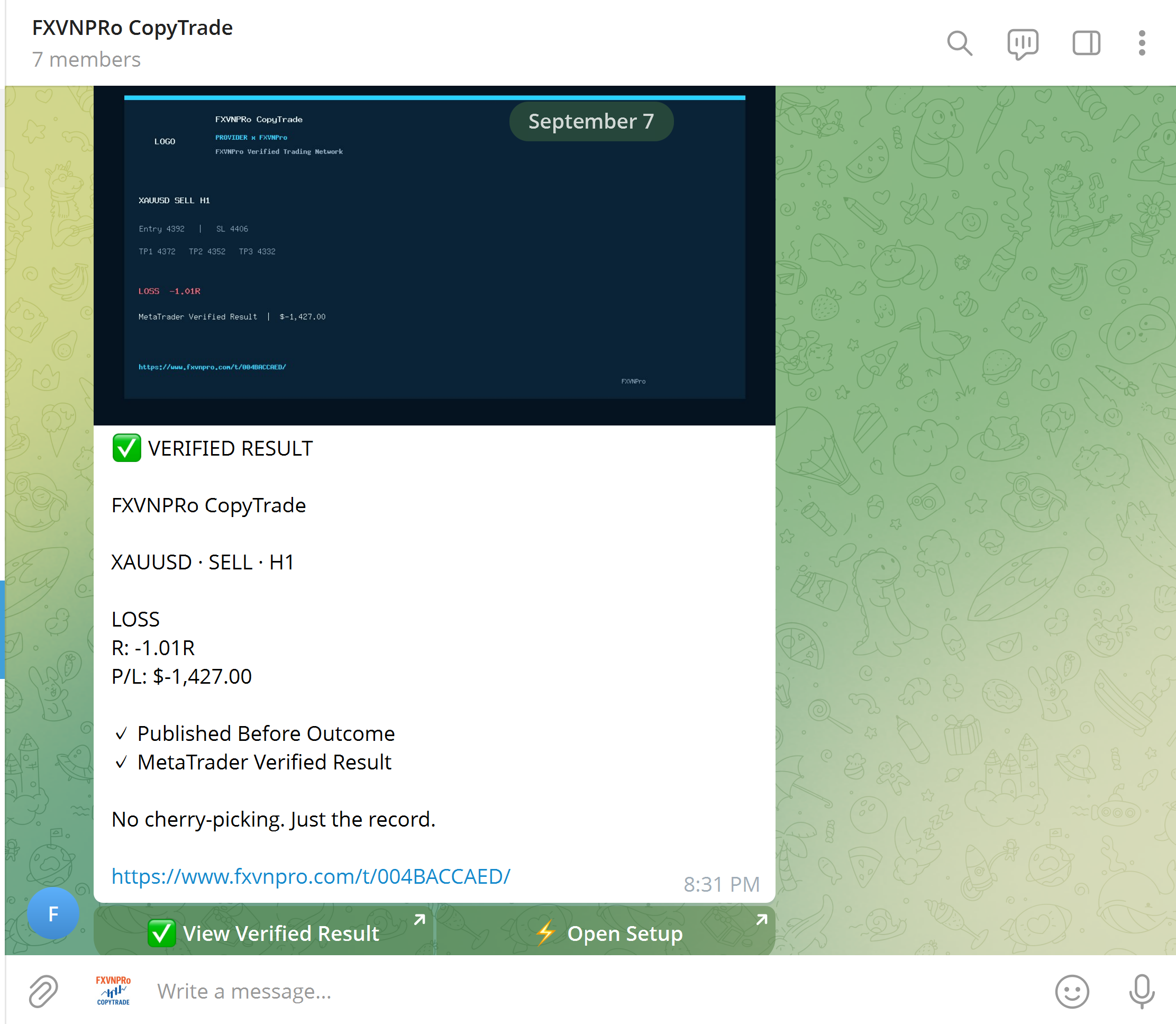 3 · VERIFIED
FXVNPro connects trade plans, Telegram trading communities and verified CopyTrade activity in one practical MT4/MT5 ecosystem.
Turn Entry, Stop Loss and Targets into a trade plan. Publish it before the outcome, then track and verify the result.
Turn Telegram signals into actionable MT4/MT5 setups. Signal Admins create the strategy while Members stay in control of risk.
Discover TRADERs, inspect verified trading history and performance, then decide who you want to follow across MT4 & MT5.
Build your strategy, distribute it to a community, or follow trading activity across MT4 & MT5.
Create Entry, Stop Loss and Targets before the outcome, then build a verified trading record.
Turn Telegram signals into an actionable workflow while followers keep control of their own risk.
Connect Chrome to MT4 or MT5 and open, modify or close trades from your browser.
Explore Masters and copy trading activity to your own MT4 or MT5 terminal with independent risk rules.