

HFM
FVP Score
6.8/10
HFM
- Minimum Deposit$5
- RegulationFCA, DFSA, FSA
- PlatformsMT4, MT5
- SpreadFrom 0.1 pips
Start with your goal. You do not have to learn the FXVNPro architecture before using the tools.
Build an idea, use Telegram signals, trade from Chrome or follow a trader while technical setup stays in the background.
Technical connection details remain available inside each product when needed.
Compare HFM and XM by rating, regulation, minimum deposit, platforms, spreads, and overall trading conditions.
Use the FXVNPro Broker Checker Chrome extension to quickly review broker trust signals, ratings, and safety information while browsing broker websites.

| Feature | HFM | XM |
|---|---|---|
| Rating | 6.8 | 7.1 |
| Minimum Deposit | $5 | $5 |
| Regulation | FCA, DFSA, FSA | CySEC, ASIC, IFSC |
| Platforms | MT4, MT5 | MT4, MT5 |
| Spread | From 0.1 pips | From 0.6 pips |
Below is a detailed breakdown of fees, spreads, regulation, platforms, and real trading suitability to help you decide which broker fits your trading style better.
If you’ve ever finished a week of trading and thought, “Wait… where did my edge go?”, spreads and execution quirks are usually the silent culprits. On paper, HFM vs XM can look like a simple matchup: both offer MT4/MT5, both start with a $5 minimum deposit, and both advertise tight spreads. But in real trading, those tiny numbers can stack up quickly—especially if you’re scalping, trading news, or running a strategy that takes dozens of entries.
This comparison is for traders who actually care about performance, not just broker features. If you’re wondering which broker is better for your trading style, the answer changes depending on your timeframe, risk management, and how sensitive your strategy is to trading costs and execution quality.
Here’s the quick gist: HFM comes in with a stronger overall score (6.8 vs 7.1) and notably lower spreads “from 0.1 pips” compared with XM “from 0.6 pips.” That spread gap matters. XM’s regulatory mix (CySEC, ASIC, IFSC) is broad as well, while HFM also lists FCA, DFSA, and FSA. Both have MT4 and MT5, but the day-to-day trading experience is where you’ll feel the difference—especially around slippage, liquidity, and how often you get the price you expected.
Keep reading if you want a fees comparison that’s grounded in how trading costs hit your P&L in the real world.
Let’s talk about spreads and trading costs in a way that doesn’t sound like marketing. The headline is simple: HFM offers spreads from 0.1 pips, while XM lists spreads from 0.6 pips. On a low-spread platform, your stop-loss placement, trade frequency, and even your break-even logic can all become easier.
Why does this matter? Because spread isn’t just “a cost”—it’s friction. If your strategy targets, say, 8–15 pips per trade, paying an extra 0.5 pips on every entry and exit can quietly erase your edge. And yes, spread is usually quoted “from,” meaning it depends on instrument, time of day, and market conditions. Still, the practical expectation is that HFM’s baseline is tighter more often.
In real trading conditions, I’ve seen traders with similar win rates lose because their costs were underestimated. For example, imagine you run a day trading plan on EUR/USD taking 40 round trips per week. Even if the average spread difference is only 0.2–0.3 pips, that’s extra cost on 80 transaction points. Multiply that over a month and suddenly it’s not “small.”
Now, what about hidden fees? With forex brokers, the usual suspects are overnight financing (swap), inactivity fees, deposit/withdrawal costs, and commissions if you’re on a commission model. You didn’t provide commission figures here, so I can’t claim one broker is always commission-free or always cheaper on every account type. But spreads alone already create a meaningful fees comparison.
Bottom line: based on the spread data you gave, HFM is the more likely winner for lower average trading costs—especially if your approach depends on tight execution and frequent entries.
Regulation is one of those topics that gets treated like a checkbox. It’s not. For active traders, safety isn’t abstract—it shows up in how confidently you can deposit funds, how transparent the broker’s operations are, and how accountable they are if something goes wrong.
HFM lists FCA, DFSA, and FSA. XM lists CySEC, ASIC, and IFSC. On the surface, both have a respectable regulatory spread. But here’s the practical difference: regulators in major jurisdictions tend to enforce stricter conduct requirements, risk management expectations, and consumer protection standards. That reduces the “tail risk” you really don’t want when markets are stressed.
Still, regulation doesn’t eliminate execution risk. If liquidity thins out during volatile sessions, you can still face slippage or wider spreads regardless of the regulator. So the safest mindset is: regulation helps, but it doesn’t replace good execution monitoring and disciplined risk control.
One verification step I recommend to traders is checking the exact entity you’re trading with. Brokers often operate under multiple entities across regions. The regulation you see on a site can apply to different account types depending on where you’re located. Before committing serious capital, confirm which regulated entity holds your account.
In real terms, this matters when you’re scaling. As your account grows, the cost of being wrong about broker reliability becomes much higher. If you’re thinking “HFM vs XM, which broker is better for safety?”—your best answer comes from matching your country to the broker’s regulated entity and then stress-testing execution during normal and volatile market hours.
Both HFM and XM offer MT4 and MT5. That’s good news because it means you can keep your workflow: charting, EAs (Trading Programs (Expert Advisors)), custom indicators, and the general ecosystem most retail traders already know. But platform support is only part of the trading experience. The more important question is how the broker’s execution interacts with your strategy.
For execution speed, traders often notice differences during fast markets—news releases, rate decisions, or sudden risk-off/risk-on moves. MT4 and MT5 provide the interface, but the broker’s infrastructure and liquidity routing determine whether your order fills close to the expected price or drifts.
Usability-wise, MT5 tends to feel more modern for multi-timeframe analysis and additional order types, but many traders still prefer MT4 for simplicity and compatibility. If you already trade an MT4 EA, both brokers give you that path. If you’re using MT5 features—like certain market depth views or strategy tester workflows—then your day-to-day experience will depend more on stability (requotes, server response time) than on the platform itself.
Here’s a scenario: suppose you run a rule-based system that enters when spread is below a threshold (common for mean reversion). If one broker’s spreads widen more often or fluctuate faster, your EA might skip trades you thought would trigger—or worse, it might trigger at slightly worse cost than expected. That can be the difference between a stable backtest and a frustrating live run.
So while both brokers check the “MT4/MT5 supported” box, HFM’s tighter spreads from 0.1 pips make it easier for cost-sensitive strategies to behave closer to backtests. With XM starting from 0.6 pips, you’ll want to be more careful with your strategy’s minimum expected edge.
Minimum deposit is the easy part: both start at $5. But what matters for most traders is the friction around moving money—deposit methods, verification steps (KYC), processing times, and withdrawal handling. Those details often decide whether you enjoy the broker or constantly feel slowed down.
In real trading, deposits and withdrawals aren’t frequent for everyone, but when you do need them, you want the process to be predictable. Picture this: you start small, fund your account, and then after a couple of months you want to withdraw a test profit. If the broker requires repeated document verification or delays withdrawals during high-volume periods, that’s when you’ll feel it.
Even if both brokers are generally fine (and many are), the difference tends to come from how smooth their payment processors are and whether certain methods carry extra fees. Some brokers charge nothing on deposits but take a cut or impose limits on withdrawals. Others are fast for bank transfers but slower for certain e-wallets depending on region.
Because you didn’t include specific deposit/withdrawal fee structures or processing timelines, I can’t fairly claim which one is cheaper or faster. But I can tell you what to look for before choosing: withdrawal minimums, proof-of-address requirements, whether withdrawals must go back to the original payment method, and any “inactivity” or account maintenance charges that can surprise you later.
For a trader who’s building consistency, friction is a risk multiplier. It affects your ability to manage capital and respond to drawdowns. If you’re still deciding between HFM vs XM, prioritize the payment method you actually plan to use, not the one you wish you could use.
Beginners usually don’t lose because they picked the “wrong indicator.” They lose because execution costs, spreads, and platform behavior quietly make their plan harder to follow. So which broker is better for beginners: HFM or XM?
With both brokers offering MT4 and MT5 and a $5 minimum deposit, the entry barrier looks similar. But the spread difference is where the beginner experience becomes real. If you’re learning and taking smaller profits while you practice, you need your broker’s trading costs to be gentle. A spread from 0.1 pips (HFM) is typically more forgiving than spreads from 0.6 pips (XM), especially when your targets are modest.
Now, think about decision-making. Beginners often trade during busy hours, when liquidity is decent—but they also tend to trade without fully understanding how spreads widen around rollover, session transitions, or news. In those moments, a broker with consistently tighter spreads can reduce the frequency of “Why didn’t my trade close at my level?” frustration.
Another beginner factor is transparency. You want a broker that clearly explains what costs you’re paying and how orders TRADE. If you’re constantly guessing whether your loss was “market” or “spread,” you’ll struggle to learn efficiently.
For a new trader, I’d lean toward HFM on the cost-efficiency angle because tighter spreads can help your learning curve. But if you’re in a jurisdiction where XM’s regulated entity aligns better with your account setup, that safety/comfort factor can matter just as much.
Active traders live and die on execution. Your strategy might be brilliant on paper, but if spreads average higher than expected—or if slippage shows up at the worst times—your stats will drift fast.
Here’s where the spreads and trading costs comparison becomes non-negotiable. HFM advertises spreads from 0.1 pips. XM advertises spreads from 0.6 pips. Even if real-world averages narrow the gap, that starting point suggests HFM is more likely to support frequent trading without your costs exploding.
Let’s make it concrete. A day trader trading multiple Connects during London and New York will rack up dozens of entries. If your average spread difference ends up being just 0.2–0.3 pips, that’s still a meaningful weekly drag. And for scalpers, that drag is often the difference between “scalping works” and “scalping is dead on this broker.”
Execution speed and slippage matter too, especially around news. You can’t see slippage until you’re trading live. So the best approach is to test: run the same strategy on both brokers for a short period (demo or micro size), then compare fill quality during volatile sessions. Watch how often your stop-loss is exceeded by a few extra ticks.
Tools and order types on MT4/MT5 also matter for active traders. If you rely on limit orders, stop orders, or specific EA logic, your broker’s order handling can affect outcomes. Both brokers support the same platforms, but cost and execution quality will likely decide which one feels “faster.”
If your style is scalping or high-volume day trading, HFM looks like the more cost-friendly choice based on the spreads data provided. XM might still work, but you’ll need tighter strategy controls and more careful monitoring of trading costs and slippage.
One thing I’d avoid doing is choosing based only on the rating numbers (6.8 vs 7.1). Ratings are noisy. Traders write reviews for different reasons—withdrawal experiences, platform stability, customer support, or spread complaints. Instead, match the broker to how you trade.
If your edge depends on low spreads and frequent execution, HFM is the more logical fit. If your priority is aligning with a specific regulator structure in your region and you’re not as spread-sensitive, XM can still be a reasonable option.
So, which broker is better—HFM or XM? Here’s the clean decision framework, because “both are fine” doesn’t help anyone who’s trying to protect capital.
Choose HFM if: you’re an active trader, scalper, or day trader who cares about spreads and trading costs and wants more consistent friction. The spread advantage (from 0.1 pips) is significant enough that it can improve your odds of staying close to backtested assumptions—especially if you take many trades per week. In plain terms: if you’re paying the market often, you want the market to be cheaper.
Choose XM if: you value its regulatory setup for your account jurisdiction and you’re comfortable with wider “from” spreads (from 0.6 pips). XM may still suit swing traders and position traders whose strategies tolerate higher entry costs and don’t rely on tight spreads every day.
If you’re a beginner, I’d still lean toward HFM for the learning benefit: lower spreads make it easier to reach break-even and recover from the inevitable early mistakes. But don’t ignore your local account’s regulated entity—verify that first, then optimize for costs.
My recommendation is straightforward: for most traders looking for an edge via spreads and execution consistency, HFM is the better fit. For traders whose primary requirement is specific regulator coverage and who trade less frequently, XM can be the safer “fit” choice.
Before you commit real money, do one last test: compare spreads across the Connects you trade during the same sessions, watch how execution behaves in fast markets, and then decide. That’s the part that actually turns HFM vs XM from a reading exercise into a trading decision.
One real XAUUSD trade: created before the outcome, sent to Telegram, TRADEd in MT5 and returned as a verified result.
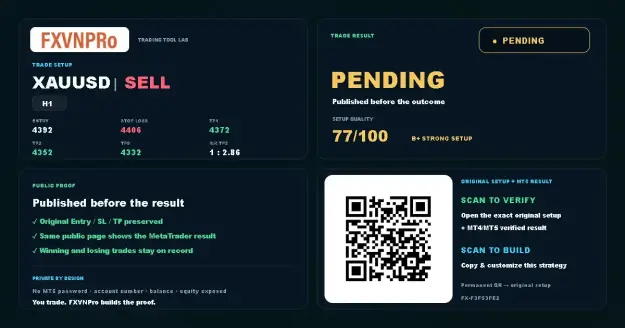 1 · SETUP
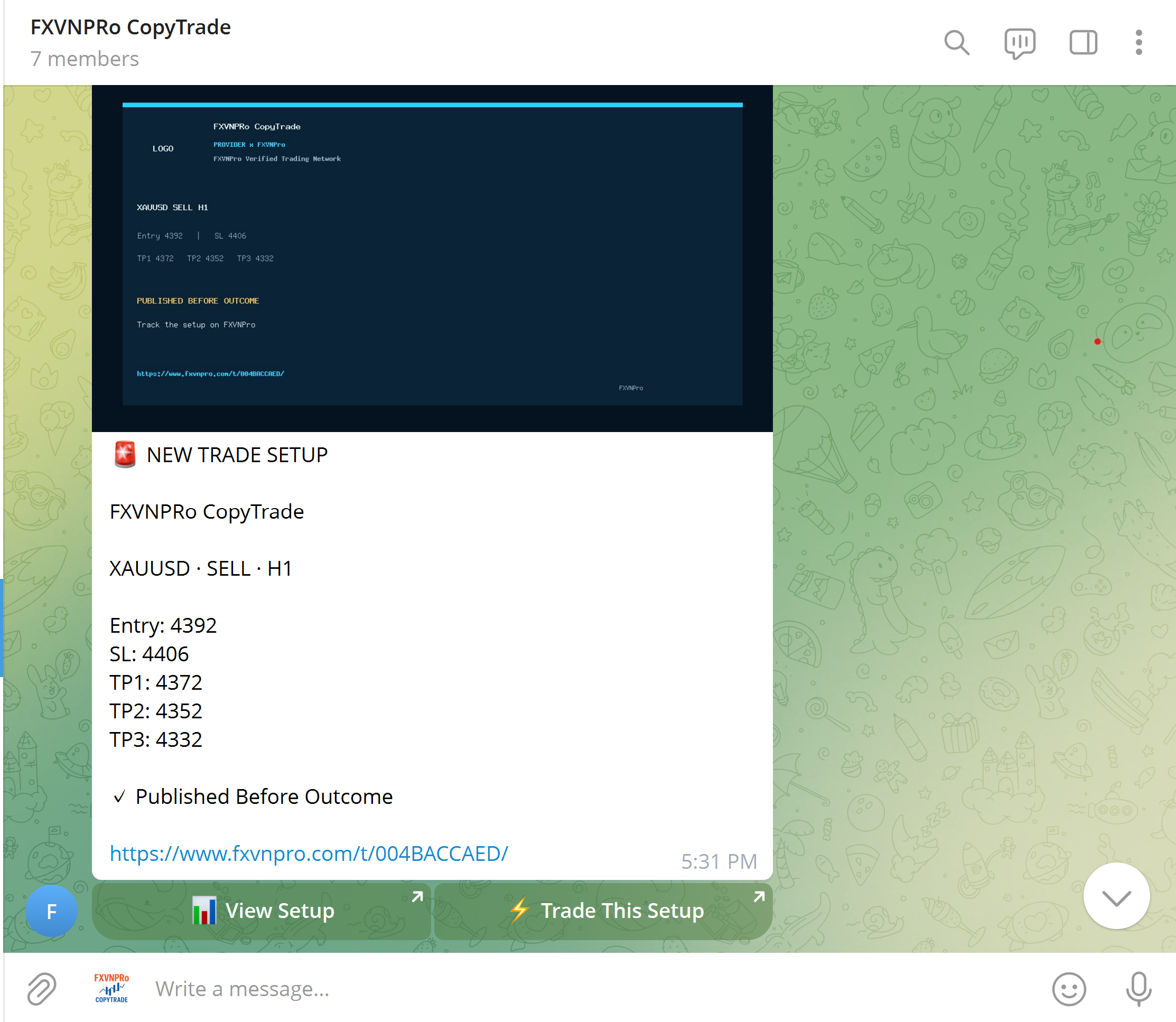 2 · TELEGRAM
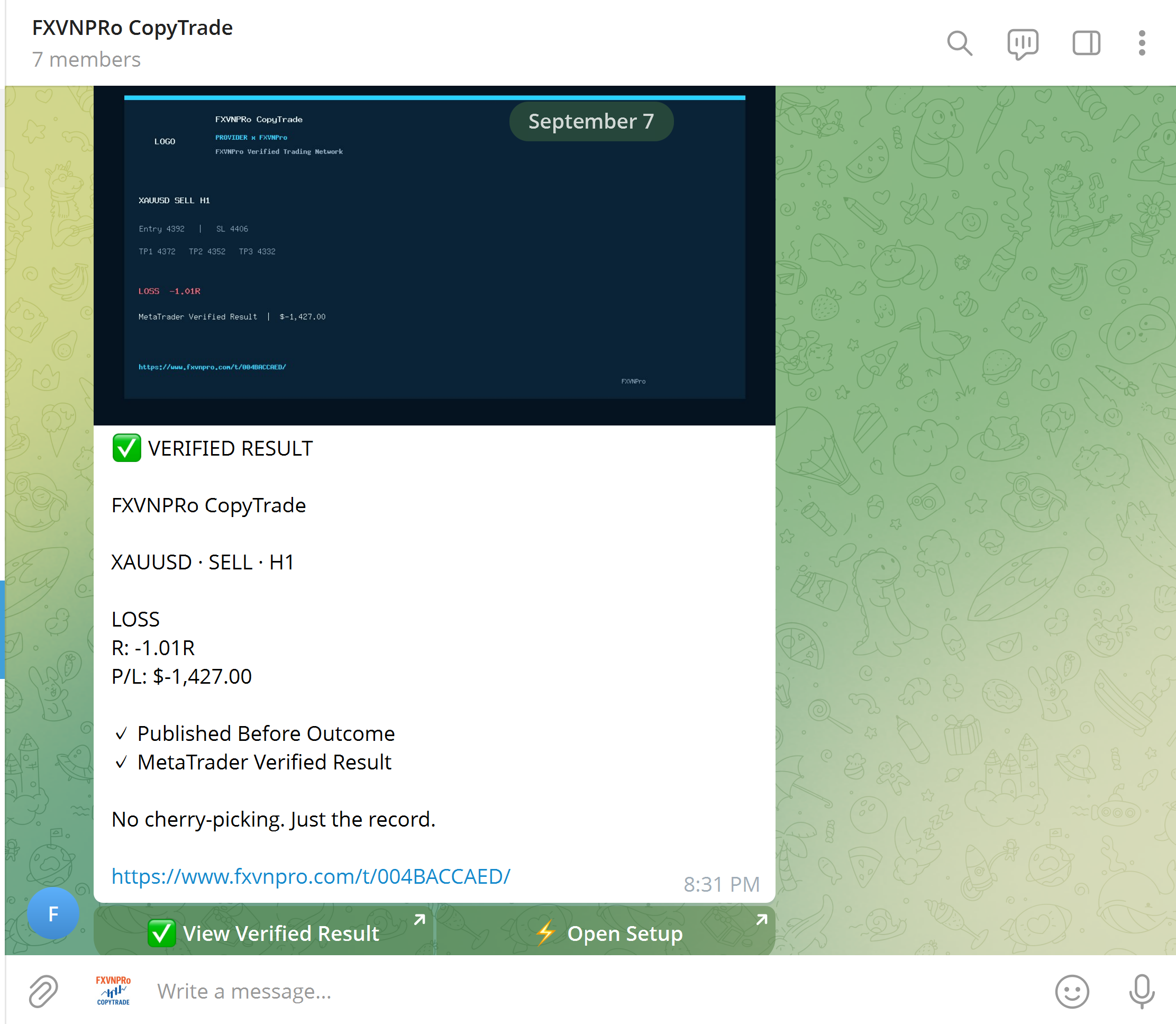 3 · VERIFIED
FXVNPro connects trade plans, Telegram trading communities and verified CopyTrade activity in one practical MT4/MT5 ecosystem.
Turn Entry, Stop Loss and Targets into a trade plan. Publish it before the outcome, then track and verify the result.
Turn Telegram signals into actionable MT4/MT5 setups. Signal Admins create the strategy while Members stay in control of risk.
Discover TRADERs, inspect verified trading history and performance, then decide who you want to follow across MT4 & MT5.
Build your strategy, distribute it to a community, or follow trading activity across MT4 & MT5.
Create Entry, Stop Loss and Targets before the outcome, then build a verified trading record.
Turn Telegram signals into an actionable workflow while followers keep control of their own risk.
Connect Chrome to MT4 or MT5 and open, modify or close trades from your browser.
Explore Masters and copy trading activity to your own MT4 or MT5 terminal with independent risk rules.