Plan a Trade
Build a trade plan and use practical trading tools before you act.
Trade IdeasRisk ToolsCalculators
BUILD A TRADE IDEA →
Start with your goal. You do not have to learn the FXVNPro architecture before using the tools.
Build an idea, use Telegram signals, trade from Chrome or follow a trader while technical setup stays in the background.
Technical connection details remain available inside each product when needed.
Plan trades, connect MT4 & MT5, review verified execution, explore traders and research brokers — without learning the whole platform first.
Build a trade plan and use practical trading tools before you act.
Use Browser Trading or turn supported Telegram signals into a structured trading workflow.
Explore CopyTrade TRADERs, review their records and choose your own risk settings.
Everything is still here — organized by what it helps you do.
Compare Exness and IC Markets by rating, regulation, minimum deposit, platforms, spreads, and overall trading conditions.
Use the FXVNPro Broker Checker Chrome extension to quickly review broker trust signals, ratings, and safety information while browsing broker websites.


| Feature | Exness | IC Markets |
|---|---|---|
| Rating | 7 | 7 |
| Minimum Deposit | $10 | $1 |
| Regulation | - | ASIC, CySEC |
| Platforms | MT4, MT5 | MT4, MT5 |
| Spread | From 0.0 pips | From 0.0 pips |
Below is a detailed breakdown of fees, spreads, regulation, platforms, and real trading suitability to help you decide which broker fits your trading style better.
Here’s the uncomfortable truth most traders learn the hard way: broker comparison isn’t about who has the shinier platform. It’s about the stuff that shows up after you place the trade—spreads during fast markets, execution quality when price whipsaws, and whether your “cheap” account is actually cheap after commissions and trading conditions are considered.
That’s why this Exness vs IC Markets review is written the way a working trader would think about it. I’m going to focus on the fees comparison that matters, the spreads and trading costs you feel in live conditions, and the practical impact of regulation and safety. If you’ve ever had a backtest look great and then your live fills tell a different story, you already know what I mean.
Quick snapshot: both brokers offer MT4 and MT5, and both advertise spreads from 0.0 pips. The minimum deposit is different—Exness at $10 vs IC Markets at $1—and regulation is also a big divergence: IC Markets is regulated by ASIC and CySEC, while the data you provided for Exness shows no regulation listed. That alone can change the risk profile of your account over the long run.
So which broker is better for you—especially when your strategy depends on tight trading costs and consistent execution?
Spreads and trading costs are where “small differences” turn into meaningful money. Let’s start with what we can say from your data: Exness spreads are advertised from 0.0 pips, and IC Markets also lists spreads from 0.0 pips. On paper, that sounds like a draw.
But in real trading conditions, the spread you pay isn’t just a minimum—it’s what you experience across your session. During news, London open, or when liquidity thins out, spreads widen. That’s the moment you’ll notice whether the broker’s liquidity model holds up. If you’re trading mean-reversion or scalping, widenings don’t just reduce profit—they can flip a trade from “fine” to “loss with momentum.” This matters because your edge is often measured in fractions of pips, not whole points.
Now the hidden part: the difference between “spread-only” and “spread + commission.” Even if both brokers advertise 0.0 pips, the total cost can differ depending on commission structure and how it’s bundled. Your data didn’t include commission details, so I can’t claim one is definitively cheaper on every account type. However, when traders ask about fees comparison, they’re usually asking: “Which broker gives me the lowest all-in cost on my typical trade size?”
For example, imagine you do 200 trades per month with an average spread cost of 0.8 pips vs 0.6 pips after all-in pricing. At typical forex lot sizing, that difference can easily become a noticeable chunk of your monthly performance. The cheapest broker on a banner is often not the cheapest after you include execution realities like slippage and widenings.
When you’re choosing Exness vs IC Markets, regulation affects more than headlines. It affects how your broker is supervised, how consumer risk is handled, and how disputes are processed if something goes wrong. Your provided data shows IC Markets regulated by ASIC and CySEC. Exness, in the data you shared, has no regulation listed.
This matters because forex trading is not a simple “press buy/sell” transaction. You’re entrusting the broker with order execution, account handling, and in many cases leverage policies. Regulators don’t eliminate risk—no one can promise that—but they add a framework: reporting requirements, oversight, and rules around client money handling and operational standards.
In real trading conditions, the “safety” question often becomes urgent during stress events: rapid market moves, platform outages, or when traders attempt withdrawals after a profitable run. I’ve personally seen how some traders underestimate this until they need it most. They think execution is everything—until they can’t access funds when they want to.
Verification also matters. Traders should confirm regulation status independently (broker website, regulator register, and account jurisdiction) rather than relying on screenshots or memory. It’s not paranoia; it’s basic diligence.
If you’re trading bigger size, holding positions longer, or not planning to actively monitor every platform message, regulated oversight becomes more than “comfort.” It becomes part of your risk management.
Both brokers offer MT4 and MT5, which is great if you already have templates, EAs, or indicators built around those platforms. But the platform experience isn’t only about whether MT4/MT5 exists. It’s about how usable it is day-to-day and how quickly the broker’s infrastructure responds during active trading.
Execution speed and slippage are where you feel differences. In fast conditions—say, during the US session when EUR/USD starts moving like it has something to prove—your entry price and how consistently it fills matters as much as your strategy logic. A strategy that relies on tight stop-loss placement and consistent order fills can get quietly undermined by worse execution quality.
Tools and usability also matter. Some traders care about charting and order management; others care about automation reliability. MT4 is still widely loved for simpler EAs and a straightforward workflow. MT5 can offer more flexibility, but the learning curve and EA compatibility can be a factor depending on what you run.
In practice, both brokers being on MT4/MT5 means you can likely keep your workflow intact. That reduces friction in the transition. Still, I’d focus on one thing before committing: how stable are live quotes, how fast do orders confirm, and how often do you see requotes or abnormal spreads at your preferred trading times?
If you’re experimenting with scalping or grid-style systems, you’ll notice quickly whether execution and slippage match what you expected from the backtest. And if you’re discretionary trading, you’ll notice via “stability of fills” more than anything else.
Minimum deposit is not just a number—it’s a signal about how each broker fits different trading budgets. Exness shows a $10 minimum deposit, while IC Markets shows $1. If you’re learning, you might not care much. But if you’re testing a strategy or building confidence, a lower minimum reduces stress and lets you iterate faster.
Now, deposits and withdrawals are where traders sometimes get disappointed. Speed, fees, and process complexity can differ even when both brokers offer similar payment methods. Your data doesn’t list withdrawal fees or processing times, so I can’t claim one is faster across the board. What I can say is this: the friction level matters when you move from “demo brain” to “real money decisions.”
For example, if you’re a beginner and you deposit, trade a couple of weeks, then try a first withdrawal, you want the process to be straightforward. Any delay can affect your motivation and your ability to manage risk. For active traders, withdrawals timing matters too—especially if you’re cycling capital, topping up margin, or withdrawing profits regularly.
Another practical point: some traders underestimate how account verification requirements can slow withdrawals. Even if your trading performance is strong, you can still hit a stall if identity checks are incomplete. That’s not a broker “scam,” but it’s still friction.
So when comparing Exness vs IC Markets, think like this: “If I needed my funds within a week, how painful would it be?” You’re not only trading the market—you’re trading operational reliability.
If you’re new, your biggest enemy isn’t only the market—it’s decision pressure. That’s where broker onboarding and day-to-day friction become part of your performance. With Exness minimum deposit at $10 and IC Markets at $1, IC Markets is generally easier to start with for smaller budgets. Being able to start with less capital can help you learn execution, spread behavior, and platform workflow without feeling like every mistake is expensive.
However, beginners shouldn’t choose only on deposit size. Regulation matters for beginners too. If a broker is supervised by recognized regulators (IC Markets has ASIC and CySEC in your data), it can be a psychological and practical advantage. It’s not that regulated brokers never have issues—but it’s easier to assess the risk when oversight exists.
Now let’s talk about what beginners actually experience. In the first weeks, you’ll likely make trades during “normal” market hours, and you’ll learn through feedback—charts, trade history, and whether your fills match expectations. If you see unexpected slippage or consistently wider spreads than you expected from the advertised “from 0.0,” you can lose confidence fast.
So which broker is better for beginners? Based strictly on the details you gave: IC Markets has the edge on regulation transparency and lower minimum deposit. Exness may still work for new traders, especially if you like MT4/MT5 and the trading conditions fit your style, but the lack of regulation listed in your data is a major missing piece.
If you’re learning and want fewer unknowns, that matters more than you think.
For active traders, “from 0.0 pips” is only the starting line. Your strategy is built on repeatability: consistent spreads, consistent execution, and manageable slippage. Exness and IC Markets both advertise spreads from 0.0 pips, so the question becomes: how do they behave when you actually trade—during your session, with your trade frequency, and under volatility?
Scalpers care about micro-costs. Even a slight widening at the wrong time can wipe out several clean setups. Day traders care about execution stability and whether order fills are reliable when trends accelerate. High-volume traders care even more about trading costs across many executions, and about whether the broker’s infrastructure stays stable during spikes in activity.
In real trading conditions, you also notice how quickly the platform processes market data and how orders are handled. If you run automated systems (EAs) or semi-automated setups, execution speed and slippage patterns matter because they compound over hundreds of trades.
Now, fees comparison again: without commission details in your data, we can’t calculate exact all-in costs. But we can still reason about what matters. If one broker offers tighter all-in pricing on average and better execution during volatility, it’s the better choice for an active trader—because your edge is fragile.
Also, regulation can matter for active traders because you’re more likely to move funds, manage margin actively, and rely on operational continuity. IC Markets having ASIC and CySEC in your provided data gives it an advantage on oversight.
If you’re seriously trading multiple lots and multiple times a day, you should treat execution quality and all-in cost as non-negotiable—not optional.
If you’re wondering which cons hurt more: for many traders, the regulation gap (or clarity about it) hurts more than a theoretical spread difference—especially when you’re dealing with larger size or longer-term account growth.
And if you’re thinking “I only care about spreads and speed,” you’re not wrong—just be careful. Execution and slippage are part of trading costs too, even if they don’t show up as a line item called “commission.” That’s the part people tend to discover after the fact.
Let’s make this decision concrete. Based on your provided information, IC Markets is the better overall choice for most traders—especially if you value regulation transparency and want to start with less capital.
Which broker is better for beginners? IC Markets. The combination of a $1 minimum deposit and clear regulation via ASIC and CySEC reduces entry barriers and uncertainty. Beginners benefit from fewer unknowns while they’re still learning execution and building consistency.
Which broker is better for active traders? IC Markets has the stronger advantage on paper because regulation is defined and oversight is clearer. For execution, both offer MT4/MT5 and advertise spreads from 0.0 pips, so the deciding factor for active traders becomes all-in fees comparison and real slippage/spread behavior in your session. Since commission and exact cost structure weren’t included in your data, the “best” active trader choice depends on testing your typical Connect/size during live market conditions.
Where does Exness fit? Exness can still be a solid practical option if you’re comfortable with the regulation visibility in your specific account setup and you’ve verified that execution and trading costs meet your expectations. But with regulation not listed in the data you gave, it’s harder to justify as the safer, more transparent default.
If you want a single answer to “Exness vs IC Markets—who wins?”: IC Markets wins on the information we can trust here. Then, for the final confirmation, do a short live test focusing on spreads and trading costs for your exact strategy. That’s the part that turns a review into a decision.
One real XAUUSD trade: created before the outcome, sent to Telegram, TRADEd in MT5 and returned as a verified result.
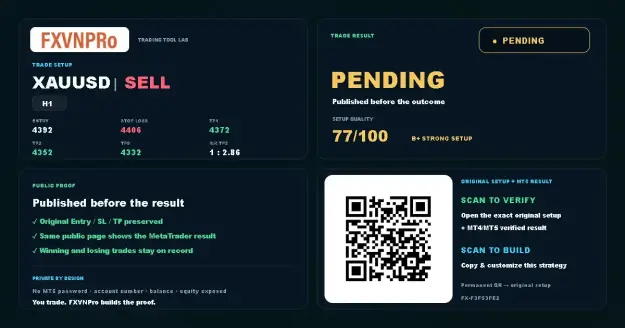 1 · SETUP
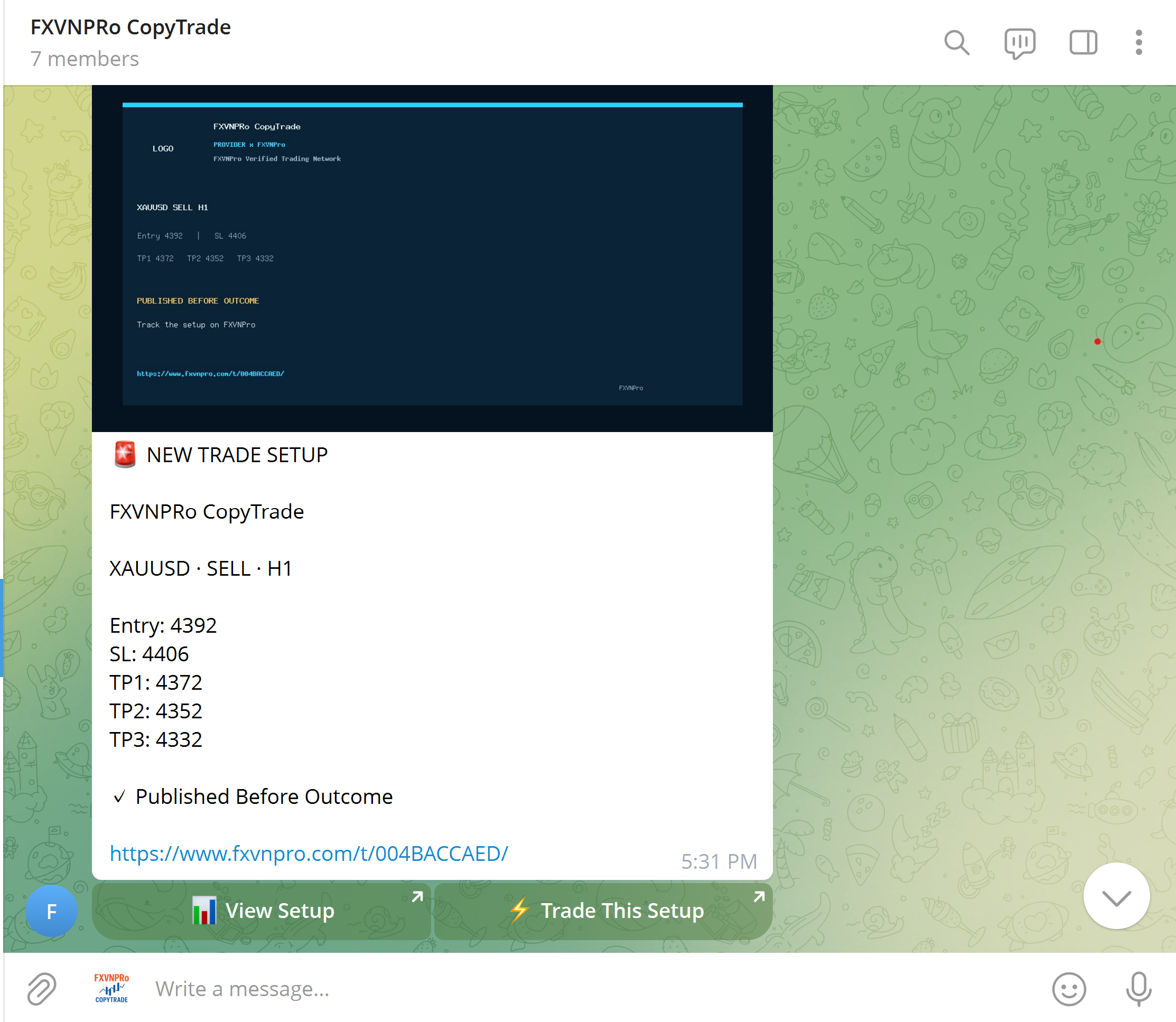 2 · TELEGRAM
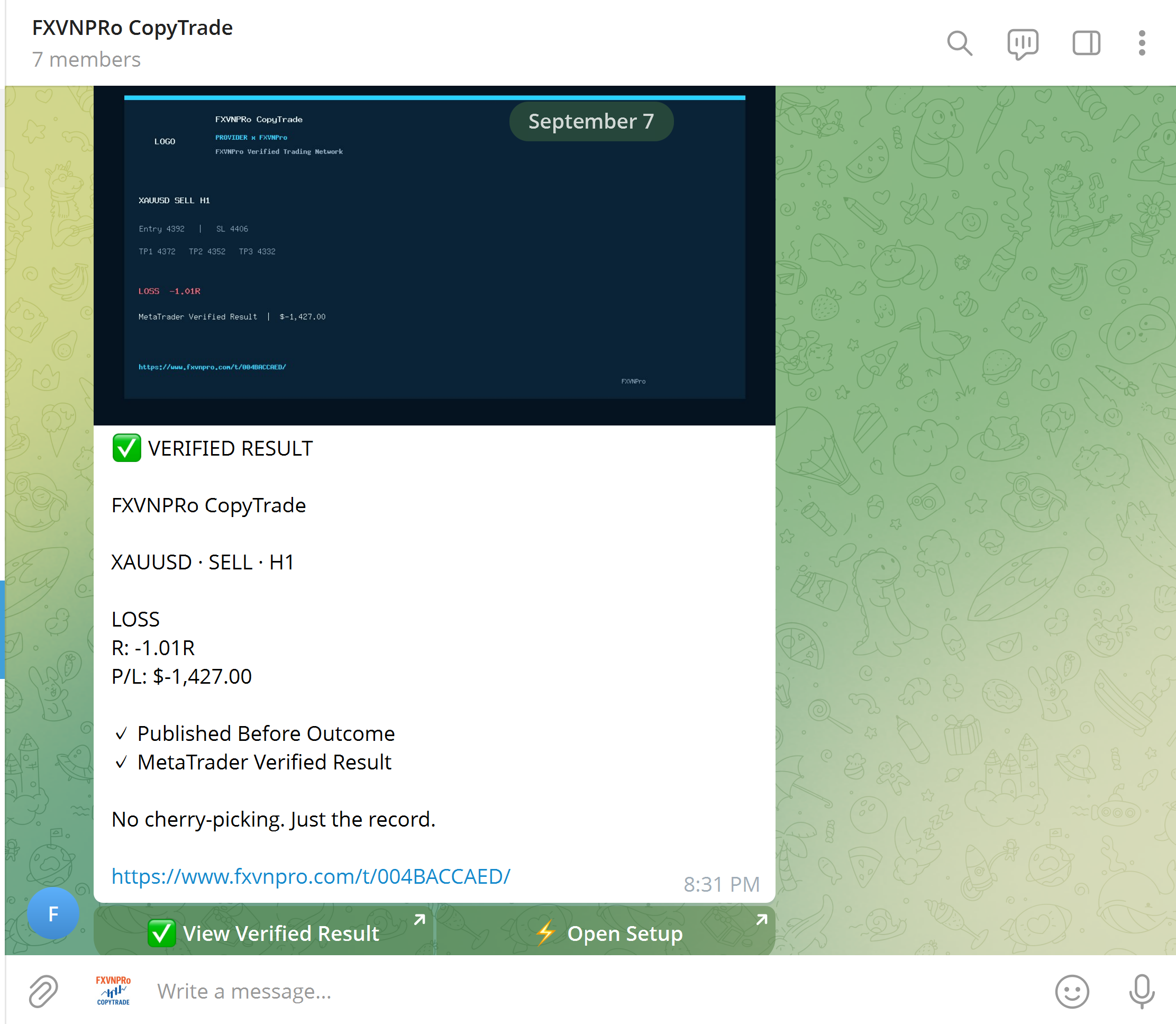 3 · VERIFIED
FXVNPro connects trade plans, Telegram trading communities and verified CopyTrade activity in one practical MT4/MT5 ecosystem.
Turn Entry, Stop Loss and Targets into a trade plan. Publish it before the outcome, then track and verify the result.
Turn Telegram signals into actionable MT4/MT5 setups. Signal Admins create the strategy while Members stay in control of risk.
Discover TRADERs, inspect verified trading history and performance, then decide who you want to follow across MT4 & MT5.
Build your strategy, distribute it to a community, or follow trading activity across MT4 & MT5.
Create Entry, Stop Loss and Targets before the outcome, then build a verified trading record.
Turn Telegram signals into an actionable workflow while followers keep control of their own risk.
Connect Chrome to MT4 or MT5 and open, modify or close trades from your browser.
Explore Masters and copy trading activity to your own MT4 or MT5 terminal with independent risk rules.