

IC Markets
FVP Score
7/10
IC Markets
- Minimum Deposit$1
- RegulationASIC, CySEC
- PlatformsMT4, MT5
- SpreadFrom 0.0 pips
Start with your goal. You do not have to learn the FXVNPro architecture before using the tools.
Build an idea, use Telegram signals, trade from Chrome or follow a trader while technical setup stays in the background.
Technical connection details remain available inside each product when needed.
Compare IC Markets and Tickmill by rating, regulation, minimum deposit, platforms, spreads, and overall trading conditions.
Use the FXVNPro Broker Checker Chrome extension to quickly review broker trust signals, ratings, and safety information while browsing broker websites.

| Feature | IC Markets | Tickmill |
|---|---|---|
| Rating | 7 | 7.2 |
| Minimum Deposit | $1 | $50 |
| Regulation | ASIC, CySEC | FCA, FSCA, CySEC |
| Platforms | MT4, MT5 | MT4, MT5 |
| Spread | From 0.0 pips | From 0.0 pips |
Below is a detailed breakdown of fees, spreads, regulation, platforms, and real trading suitability to help you decide which broker fits your trading style better.
If you’ve ever felt like your strategy “should” work, yet your results don’t match the backtest, broker costs and execution quality are usually the quiet culprits. Not always. But often enough that it’s worth looking closely—especially when you’re trading multiple times a day and spreads, commissions, and slippage start stacking up.
This IC Markets vs Tickmill comparison is aimed at traders who care about the stuff that hits your account in real conditions: spreads and trading costs, execution speed, platform usability, and how regulation translates into day-to-day safety. If you’re scalping, day trading, or simply trying to keep your edge from getting eaten by fees, the details matter.
Quick take: both brokers offer MT4/MT5 and advertise spreads from 0.0 pips, with solid regulatory coverage including CySEC. The bigger practical differences show up in minimum deposit, which can shape how you fund and manage risk early on, and in the overall “friction level” you’ll feel when you’re placing frequent trades.
So which broker is better for you? Keep reading and you’ll get a more grounded answer than a brochure-style comparison. Because in trading, “cheap” isn’t just a number—it’s how costs behave when volatility spikes, liquidity thins, and your execution window gets tighter.
Let’s talk costs like a trader, not like a marketing page. When people say “spreads from 0.0 pips,” it’s tempting to treat it as the whole story. But your real trading cost is usually a blend of spread plus commission (if applicable), plus occasional widening during news or lower-liquidity hours. And yes—slippage matters too, even if it’s not always billed as a “fee.”
Both IC Markets and Tickmill advertise spreads from 0.0 pips. On a calm day, the difference between “0.0” and “0.3” might feel irrelevant. In live trading, though, you’re rarely trading in perfect conditions. For example, imagine you scalp EUR/USD during London open when order flow is strong. If your broker consistently keeps spreads tight, you’ll enter at better prices and your take-profits get hit more easily. If spreads widen even slightly when volatility ramps, your scalps can start missing by fractions.
Now consider a more typical day-trader scenario: you place 30–60 trades over a week, using tight stops around support/resistance. In that setting, small cost differences compound. The “cheapest” broker isn’t always the one with the lowest headline spread—it’s the one that delivers lower effective spread after commissions and execution quirks.
Here’s the part many reviews skip: hidden fees. In forex, “hidden” usually means costs embedded in execution (slippage) or in non-obvious areas like inactivity policies, account base currency conversion, or withdrawal friction. IC Markets and Tickmill both have reputable setups, but you still need to check your specific account type and instrument because costs can shift by product and region.
Bottom line for costs: start by comparing the fee model for your exact account and symbol set, then run a simple cost drill—estimate average spread during your trading hours, add any commission, and multiply by your expected weekly trade count. That’s how you figure out which broker is cheaper in real scenarios, not theoretical ones.
Regulation is one of those topics that can get reduced to a logo list. But for traders, the question is simpler: how much protection exists if something goes wrong, and how credible is the oversight?
IC Markets is regulated by ASIC and CySEC. Tickmill is regulated by FCA, FSCA, and CySEC. These are meaningful jurisdictions, but they don’t all play the same role. In real terms, tighter oversight usually means better operational controls, clearer client protections, and stricter reporting expectations. That matters when you’re withdrawing funds, when you’re dealing with account maintenance, and when you want your broker to remain stable through market stress.
Why does this affect traders day-to-day? Because broker risk doesn’t only show up during extreme events. It can show up as slow withdrawals, messy account handling, or inconsistent execution practices. Strong regulation doesn’t guarantee perfect trading conditions, but it raises the odds that the broker has to follow rules that protect the client.
Verification also matters. “Regulated” doesn’t help if you can’t complete KYC smoothly. In real trading, you don’t want your money stuck while you’re in the middle of a deposit/withdrawal cycle—especially if you’re actively managing risk. So check the broker’s process: documentation requirements, how long approvals take, and whether there are any withdrawal limits that surprise you.
Between the two, Tickmill’s inclusion of FCA and FSCA alongside CySEC gives it a slightly broader regulatory footprint. IC Markets is still firmly on the “serious oversight” side with ASIC and CySEC. For most retail traders, both are in the regulated category you’d actually want.
The practical takeaway: choose the broker you’re most comfortable with for your region and account type, but don’t ignore how regulation shows up in real operations—withdrawal speed, compliance friction, and transparency of trading conditions.
On paper, both IC Markets and Tickmill offer MT4 and MT5. That’s good because it keeps your workflow familiar. If you already trade with MT4 indicators, copy tools, or automated strategies, you won’t be starting from zero. Still, the platform experience isn’t just “MT4 vs MT5”—it’s also about how the broker supports execution, order handling, and stability under load.
Execution speed and responsiveness are where traders feel differences. In fast markets, a platform that sends orders cleanly and receives fills quickly can reduce the gap between your intended entry and the actual fill. Does that mean you’ll always get perfect fills? No. But fewer delays and smoother order placement can reduce the frustration factor, especially when you’re trading breakouts or managing multiple positions quickly.
MT5 users often care about additional features, like more order types and deeper market data options. But the real question is: do the broker’s feed and pricing behave consistently across timeframes? In other words, your charts might look fine, but what matters is whether your trading prices are aligned with what you see.
For example, suppose you’re running an EA and it places orders at a specific candle close. If the broker’s execution is reliable and spreads behave predictably, your backtested logic stays closer to reality. If spreads jump around unexpectedly or there’s noticeable lag, your EA performance can drift.
Tools like VPS hosting, economic calendars, and market analysis are helpful, but they’re secondary to the trading core: pricing, execution handling, and platform stability. In my experience, traders can adapt to a platform difference. They can’t adapt to inconsistent fills.
So yes—both brokers give you MT4/MT5. The real decision comes down to how stable the trading environment feels for your style and whether your execution experience matches what you expect from a professional setup.
Deposits and withdrawals are where traders often get caught off guard. It’s not glamorous, but it affects how confidently you can manage risk. If you’re scaling into positions, moving funds between accounts, or just withdrawing profits regularly, the “friction” level matters.
IC Markets lists a minimum deposit of $1, which is a big deal for traders who want to start small or test the waters with live conditions. Tickmill’s minimum deposit is $50. That doesn’t automatically make it “worse,” but it does change the early experience. With a higher minimum, beginners may feel forced to commit more capital than they’re comfortable with before they’ve fully validated spreads, slippage, and execution on their chosen instruments.
Withdrawal speed and fees can vary based on payment method and region. Even when a broker is reputable, processing times can fluctuate during peak periods or when compliance checks require extra steps. A common real-world scenario: you win on a volatile week, you request a withdrawal, and suddenly you’re waiting while your account is reviewed. That’s where having a smooth verification process beforehand saves you stress.
Hidden friction can also show up as minimum withdrawal amounts, bank transfer delays, or the “cost” of using certain payment rails. Sometimes the fees aren’t large, but the time delay can be. If your trading plan depends on weekly fund rotation—say, moving money off the platform to manage overall risk—delays matter.
In practice, I’d recommend doing two things early: (1) run a small live test with your intended trading hours, and (2) understand the withdrawal flow before you’re emotionally invested in a profit target.
On minimum deposit alone, IC Markets feels more accessible. On the withdrawal experience, the story is more about your payment method and your ability to complete verification quickly. Either way, don’t wait until you’re profitable to learn the process.
Beginners don’t need “more features.” They need clarity, predictable costs, and a setup that doesn’t punish mistakes. When you’re new, you’ll likely trade smaller sizes, test strategies, and sometimes violate your own rules because you’re still learning how emotions and market noise interact.
Minimum deposit is a big part of beginner suitability. IC Markets at $1 lets you practice with minimal financial pressure. Tickmill at $50 means you need more upfront commitment. That can be fine for some people—especially if they’re disciplined—but for others it creates a psychological barrier. Why does that matter? Because the early stage is about learning execution and platform behavior. You don’t want the first real lesson to be “I lost more than I expected because I couldn’t scale down.”
Next is the cost structure feel. If spreads are tight and execution is consistent, your trade outcomes align more closely with your analysis. If your first few trades repeatedly suffer from worse-than-expected entries, beginners often blame themselves or their strategy—even when the broker’s effective cost is the issue.
Also, beginners benefit from straightforward account setup and smooth compliance. If verification is slow or confusing, you can end up waiting at the moment you want to trade. Neither broker is known for being “hard” in the way some low-quality Signal Admins are, but the experience still depends on your documentation and your region.
So, which broker is easier to start with? If you want the lowest barrier to entry and live testing with minimal funds, IC Markets edges ahead. If you’re already ready to start with a more meaningful initial deposit and you prefer Tickmill’s broader regulatory footprint, that’s also workable—but the $50 minimum is a real consideration.
Active traders care about one thing more than anything: repeatable execution. Not “best case.” Repeatable. When you trade frequently, spreads and commissions become a daily matter, not a footnote. And when volatility hits—news releases, economic surprises, sudden trend shifts—your broker’s execution behavior becomes the difference between a solid week and a frustrating one.
Both IC Markets and Tickmill advertise spreads from 0.0 pips, which is attractive for scalpers who need tight entry conditions. But in real trading, the spread “from” number doesn’t guarantee that you’ll see it at all times. What matters is how costs behave during your actual trading window. For example, if you scalp at times when liquidity is thin (late US session, weekend gaps, or during early Asian volatility dips), you’ll likely see more variability.
Execution speed and slippage are where active traders feel it. Even a small delay can turn a perfect setup into a mediocre one, especially if you’re using narrow stop-losses. For day traders, consistent order handling and stable pricing reduces the “did my order fill where I thought it would?” anxiety. That’s not just comfort—it directly impacts risk management.
Tools can help too. If you’re managing multiple charts, using MT4/MT5 indicators, or running automated systems, platform reliability matters. You want your charts to reflect market movement without lag, and you want your EAs to place and modify orders without weird intermittent behavior.
In terms of minimum deposit, active traders typically start with more than the minimum anyway, because risk sizing needs room to breathe. So the $1 vs $50 difference is less critical for you. Your decision should focus more on effective trading costs (spreads plus any commission model tied to your account) and execution behavior under pressure.
If you’re scalping or trading high volume, I’d personally prioritize the broker that gives you the tightest effective spread in your own testing, during your preferred hours—not the one with the most flattering headline.
If your main goal is to start small, validate the live trading feel, and keep beginner risk under control, IC Markets is the cleaner choice. The $1 minimum deposit lowers the barrier to testing spreads and execution in real conditions without forcing you to tie up unnecessary funds. For new traders asking “which broker is better,” this matters more than people think.
If you’re an intermediate trader who already knows how much capital you want to commit and you value a broader regulatory footprint, Tickmill has a slight edge on paper with FCA and FSCA alongside CySEC. That doesn’t automatically mean cheaper trading costs, but it does mean you’re choosing within a wider safety net framework.
For active traders, the decision should come down to your fees comparison in practice: effective spread, any commission model tied to your account, and how slippage behaves during your trading hours. Both advertise spreads from 0.0 pips, so your “which broker is better” answer should be based on your own cost drill—run a week of small live trades, track entry prices and realized spread, then scale your lot size if the numbers hold up.
My recommendation: pick IC Markets if you want low-friction onboarding and easier live testing; pick Tickmill if you prioritize broader regulation and are comfortable with the higher minimum deposit. Either way, don’t skip the trial—real trading conditions will tell you more than any spreadsheet.
One real XAUUSD trade: created before the outcome, sent to Telegram, TRADEd in MT5 and returned as a verified result.
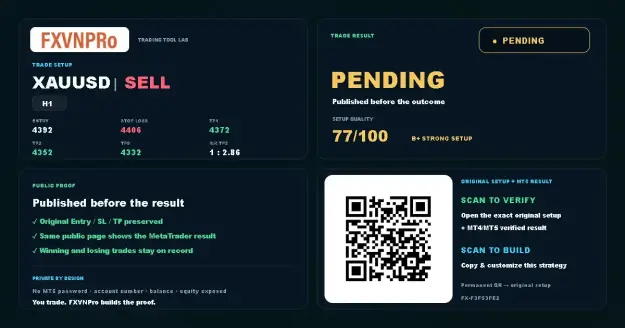 1 · SETUP
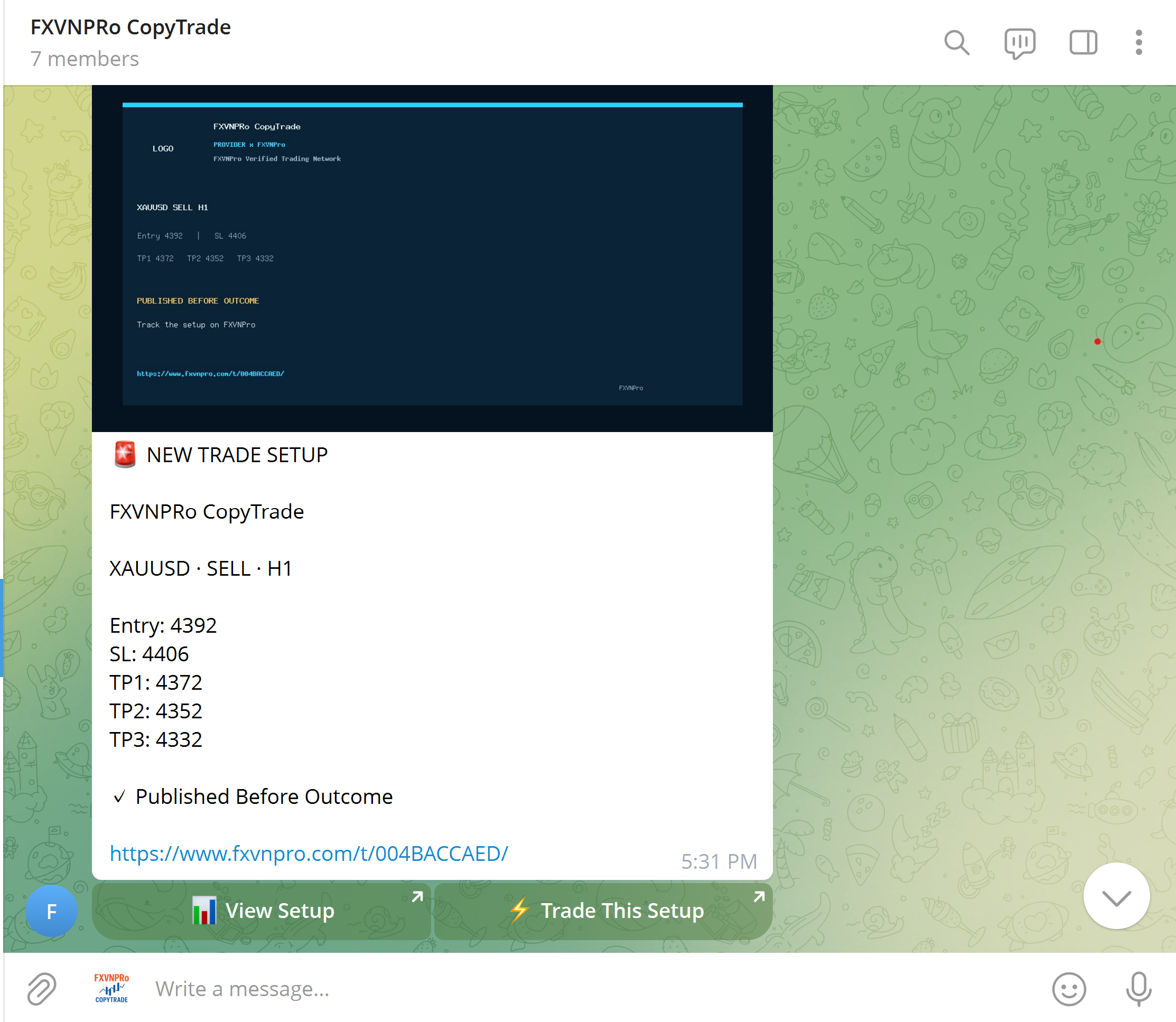 2 · TELEGRAM
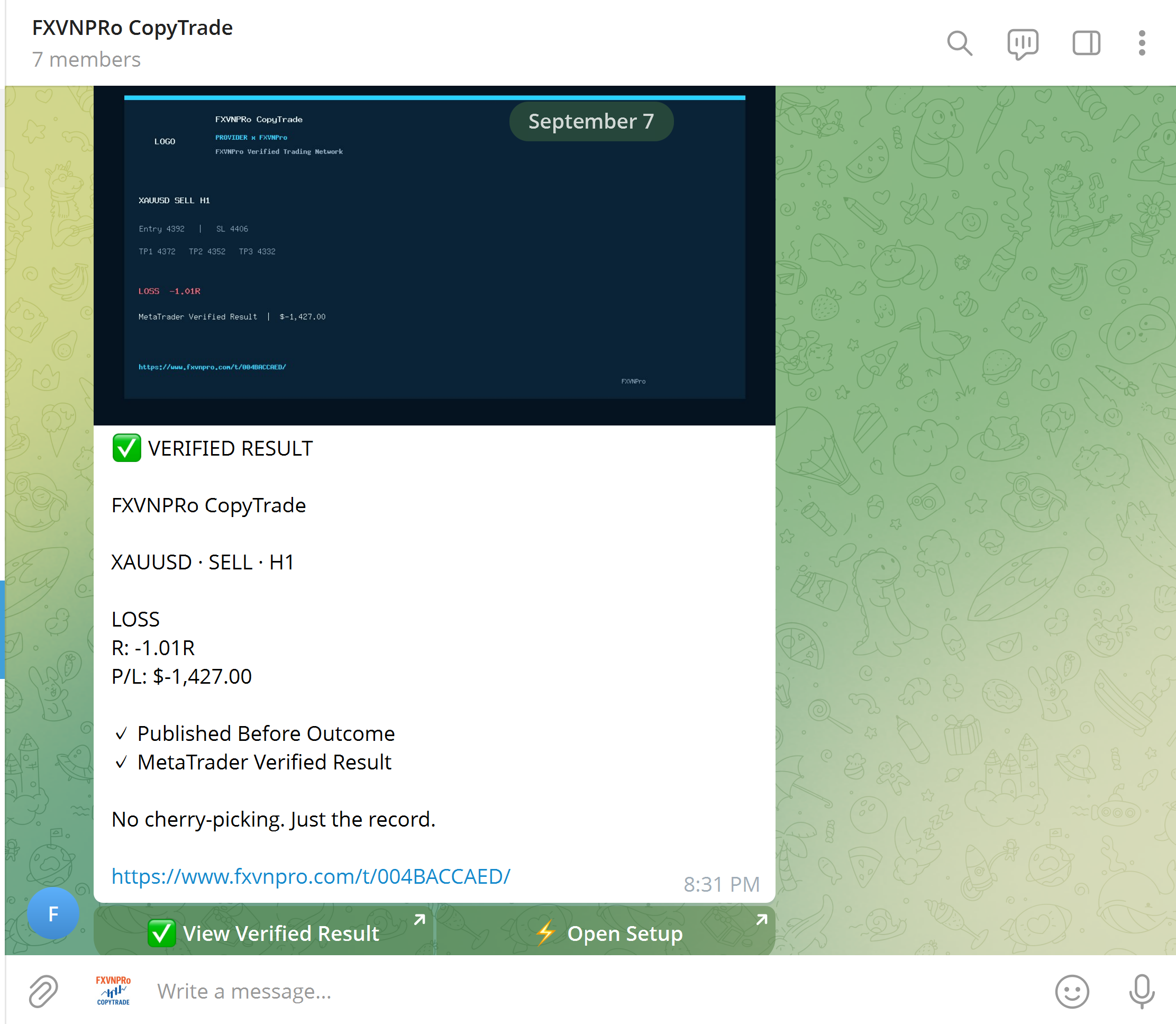 3 · VERIFIED
FXVNPro connects trade plans, Telegram trading communities and verified CopyTrade activity in one practical MT4/MT5 ecosystem.
Turn Entry, Stop Loss and Targets into a trade plan. Publish it before the outcome, then track and verify the result.
Turn Telegram signals into actionable MT4/MT5 setups. Signal Admins create the strategy while Members stay in control of risk.
Discover TRADERs, inspect verified trading history and performance, then decide who you want to follow across MT4 & MT5.
Build your strategy, distribute it to a community, or follow trading activity across MT4 & MT5.
Create Entry, Stop Loss and Targets before the outcome, then build a verified trading record.
Turn Telegram signals into an actionable workflow while followers keep control of their own risk.
Connect Chrome to MT4 or MT5 and open, modify or close trades from your browser.
Explore Masters and copy trading activity to your own MT4 or MT5 terminal with independent risk rules.