

IC Markets
FVP Score
7/10
IC Markets
- Minimum Deposit$1
- RegulationASIC, CySEC
- PlatformsMT4, MT5
- SpreadFrom 0.0 pips
Start with your goal. You do not have to learn the FXVNPro architecture before using the tools.
Build an idea, use Telegram signals, trade from Chrome or follow a trader while technical setup stays in the background.
Technical connection details remain available inside each product when needed.
Compare IC Markets and OCTA by rating, regulation, minimum deposit, platforms, spreads, and overall trading conditions.
Use the FXVNPro Broker Checker Chrome extension to quickly review broker trust signals, ratings, and safety information while browsing broker websites.

| Feature | IC Markets | OCTA |
|---|---|---|
| Rating | 7 | 6.6 |
| Minimum Deposit | $1 | $25 |
| Regulation | ASIC, CySEC | FSC, FSCA, CySEC, MISA |
| Platforms | MT4, MT5 | MT4, MT5 |
| Spread | From 0.0 pips | From 0.1 pips |
Below is a detailed breakdown of fees, spreads, regulation, platforms, and real trading suitability to help you decide which broker fits your trading style better.
If you’ve ever opened a live chart, placed a trade, and then watched the spread widen right when volatility hits… you already know the annoying truth: forex brokers don’t just “offer access to markets.” They affect your actual results. That’s why comparisons like IC Markets vs OCTA matter—because the difference between 0.0 and 0.1 pips isn’t academic when you’re doing it hundreds of times.
This review is for traders who care about trading costs, execution quality, and day-to-day friction. If you’re trading EUR/USD around London open, scalping during news, or simply tired of guessing whether your broker is quietly adding cost through spreads and execution, you’ll likely find something useful here.
Quick snapshot before we dive deeper: IC Markets has a lower minimum deposit ($1) and can quote spreads from 0.0 pips on MT4/MT5, which is attractive if you’re testing strategies or running smaller accounts. OCTA’s minimum deposit is higher ($25), and its spreads start from 0.1 pips, but it operates under multiple regulators (FSC, FSCA, CySEC, MISA), which some traders value for regional comfort.
So which broker is better? It depends on your style. In real trading conditions, spreads and execution speed matter most for active traders, while onboarding friction and account flexibility matter more for beginners. Let’s get into the fees comparison and the stuff that actually hits your P&L.
Let’s talk about the fees comparison people usually misunderstand. When a broker says “spreads from X pips,” that number is typically the best-case scenario. In real trading conditions, the spread depends on liquidity, time of day, and volatility (especially around releases). Still, the starting point matters—because many traders build strategies around expected transaction costs.
IC Markets shows spreads from 0.0 pips. On a quiet market, that can be excellent for scalpers and short-term systems. But here’s the practical part: you’re not only paying the spread. You’re also paying through how consistently the broker holds those tight spreads when price moves fast. If spreads widen in the exact moments your entry triggers, the “from 0.0” headline becomes less relevant.
OCTA lists spreads from 0.1 pips. That sounds small, but over a high-frequency week it adds up. For example, if you’re trading 30–50 times per day and your average spread is only slightly higher than expected, you’ll feel it in your monthly drawdown calculations. This matters because many traders underestimate how quickly transaction costs compound.
Now, hidden fees: some brokers quietly GROW through commission structures, swap/rollover terms, or execution characteristics like slippage. In this comparison, we don’t have commission details in the provided data, so you should verify whether OCTA’s “from 0.1” is commission-free or commission-based. Likewise, confirm whether IC Markets includes any commission on certain account types. Either way, the cheaper broker isn’t always the one with the tightest “from” spread—it’s the one with the lower all-in cost at your actual trade frequency.
Regulation matters because it affects oversight, complaint handling, and overall risk controls. But let’s be real: traders rarely read the regulator pages. They care whether the broker is likely to behave responsibly when markets get messy.
IC Markets is regulated by ASIC and CySEC. That combination is often viewed as a strong baseline in the retail space. ASIC is known for strict standards, and CySEC adds additional European oversight. For many traders, this provides a comfort layer—especially if you’re keeping funds there long-term or you’re using the broker as your main execution venue.
OCTA is regulated by FSC, FSCA, CySEC, and MISA. On paper, that’s broader coverage across different regions. In practice, it can matter because regulatory frameworks differ in how they handle leverage limits, marketing standards, and investor protections. If you’re trading from a region covered by those authorities, it can reduce friction and increase confidence that the broker operates within local expectations.
Verification importance: always check that the entity you’re actually trading with (the legal company name and account location) matches the regulator listings you’re reading. It’s surprisingly common to find brokers advertising “regulated by X” while different entities are involved depending on your signup country. This matters because enforcement and protections attach to the specific regulated entity.
So which is safer? Based on the data alone, both have meaningful oversight. If you prioritize “multiple-region” regulatory coverage, OCTA may feel more reassuring. If you prioritize the familiar strength of ASIC plus CySEC, IC Markets tends to look cleaner for trust-minded traders.
Both brokers offer MT4 and MT5. That’s good news because platform choice usually affects workflow more than performance. If you already run indicators, EAs, or custom scripts, you’re not starting from scratch. In both cases, you can trade, manage risk, and backtest using the tools you already understand.
But trading experience isn’t only about the platform. It’s about how the broker handles order execution, fills, and latency under pressure. In real trading conditions, the same EA can behave very differently on two brokers because of slippage, requotes, and how quickly the broker updates prices.
IC Markets is known in the trading community for supporting professional-grade execution and for being popular among algorithmic traders. You’ll typically see traders choose it when they run scalping systems or automated strategies that depend on consistent tick data. With spreads from 0.0 pips, the environment can be favorable for strategies that are sensitive to transaction cost.
OCTA also supports MT4/MT5, but with spreads from 0.1 pips. The question for traders using the platform daily is: does OCTA maintain tight spreads during your “high activity” windows—like the first 1–2 hours after London opens or around major news? If your strategy targets those windows, execution speed and slippage behavior matter more than a platform feature list.
Usability and tools: beyond MT4/MT5, check whether the broker provides VPS options, economic calendar access, and whether stop-loss placement behaves predictably. Are stops respected cleanly, or do you see wider deviations during volatile periods? That’s the kind of thing you only notice when you trade live.
Deposits and withdrawals are one of those areas traders “accept” until something goes wrong. Then suddenly it’s all anyone talks about. Here, the minimum deposit difference is stark: IC Markets starts at $1, while OCTA starts at $25. That affects more than affordability—it affects how fast you can start testing.
If you’re a new trader, you might want to run a mini trial: fund a small amount, validate spreads, check how your platform fills orders, and see how withdrawals feel. With IC Markets, starting smaller is easier. With OCTA, you’ll need a bigger initial commitment before you can verify your real trading costs and execution behavior.
Withdrawals: the speed and fee structure aren’t provided in the data you gave, so you should verify them on the broker’s site and also look for recent user experiences. In real life, the “fastest method” is often tied to payment rail availability and your account verification status (KYC). Some traders end up waiting longer than expected because they didn’t complete verification upfront.
Hidden friction can also show up through minimum withdrawal amounts, bank fees, or processing times by payment method. This matters because traders who withdraw regularly—like those funding other expenses or moving between accounts—need clarity.
Real-world scenario: suppose you deposit on Monday, run a strategy live for a week, and decide to withdraw on Friday. If verification or withdrawal processing takes longer than you expected, it disrupts your trading routine. That’s not just inconvenience—it can affect your risk management because you may be forced to keep funds locked longer than planned.
Given the minimum deposit alone, IC Markets is more flexible for quick experimentation. OCTA is still workable, but the $25 start can be a bigger barrier if you’re carefully building up account size.
For beginners, the biggest enemy isn’t the market—it’s the learning curve multiplied by stress. So when asking which broker is better for new traders, you should focus on friction, platform comfort, and how easy it is to test without risking too much.
IC Markets starts at $1. That’s a meaningful advantage for someone who wants to learn the mechanics: placing orders, understanding spreads, setting stops, and seeing how execution looks in different sessions. You can make mistakes cheaply—then scale up when you’re confident. This matters because beginners often overtrade at first, and transaction costs can turn small errors into bigger ones.
OCTA’s $25 minimum deposit is not huge, but it can be enough to discourage “trial mode.” If you’re still learning position sizing, margin requirements, and how spreads affect stop-out levels, you’ll want the option to keep your early experiments small.
Regulation also influences beginner confidence. Knowing the broker is overseen by regulators like ASIC/CySEC (IC Markets) or multiple entities including CySEC (OCTA) can reduce anxiety—especially when markets whip around.
But there’s a subtle point: beginners often think “tighter spread = always better.” Not necessarily. If a broker’s execution during volatile periods is inconsistent, a headline spread can mislead. So a beginner should still test using a demo or very small live amount, watch how orders fill, and pay attention to slippage behavior.
Bottom line for beginners: IC Markets feels more forgiving because the minimum deposit makes it easier to validate live conditions before you commit meaningful capital.
If you trade actively—scalping, day trading, or running high-volume strategies—the comparison shifts. You’re no longer impressed by “from” numbers. You’re focused on execution quality in messy moments: fast candles, partial retracements, and news spikes that widen spreads.
IC Markets’ spreads from 0.0 pips can be a big deal for scalpers. In real trading conditions, scalping profit targets are small. A few extra ticks can flip a strategy from “works” to “barely breaks even.” The key question isn’t whether IC Markets can be tight in quiet conditions—it’s whether it stays tight enough when your entry happens during the spread-widening window.
OCTA starts from 0.1 pips. That is still competitive, but the difference can matter for strategies that do frequent round trips. If you’re day trading with a tight average range, 0.1 pips might not sound like much—until you account for commissions (if any), slippage, and spread variability.
Execution speed and slippage: this is where traders often feel the difference immediately, especially when placing market orders. Are fills smooth, or do you see occasional deviations? Do stop orders trigger as expected, or do you notice worse-than-anticipated stop behavior? Those aren’t theoretical concerns—they show up in backtesting vs live performance.
For active traders, also consider tools. While both provide MT4/MT5, the practical advantage is whether the broker supports reliable VPS setups, provides good tick data quality, and keeps platform performance stable during peak sessions.
My practical lean: IC Markets is the stronger “active trading” candidate on the data provided, mainly due to its tighter spread potential. But you should still verify real slippage and all-in trading costs for your account type.
So, which broker is better—IC Markets or OCTA? If you want a clear decision instead of a vague “depends,” here it is.
Choose IC Markets if: you’re an active trader, scalper, or day trader focused on spreads and transaction cost control. The minimum deposit ($1) is also a big plus if you’re the type who wants to test execution quality with minimal risk before scaling. Based on the provided data, IC Markets has the more favorable spreads setup (from 0.0 pips), which can translate into better results for strategies with tight targets—assuming execution and slippage are in line with expectations.
Choose OCTA if: you value multi-regulator coverage for added regional comfort, and you’re fine starting with a $25 minimum deposit. Its spreads from 0.1 pips can still work well for many day traders, especially if your average holding time is longer and you’re not scalping every few minutes.
One thing I’d strongly recommend regardless of choice: do a short “real cost” test. Pick your main Connect (say EUR/USD), run a consistent strategy for several sessions, and compare all-in costs: spread behavior, slippage, and any commissions/swap/rollover terms tied to your account type. That’s the only way to turn “fees comparison” into a decision that matches your trading style.
If you’re asking me directly which broker is better for most traders who care about execution and spreads, I’d lean IC Markets. OCTA is a credible alternative, but with the given minimum deposit and spread positioning, IC Markets looks like the more practical choice for both live testing and active trading.
One real XAUUSD trade: created before the outcome, sent to Telegram, TRADEd in MT5 and returned as a verified result.
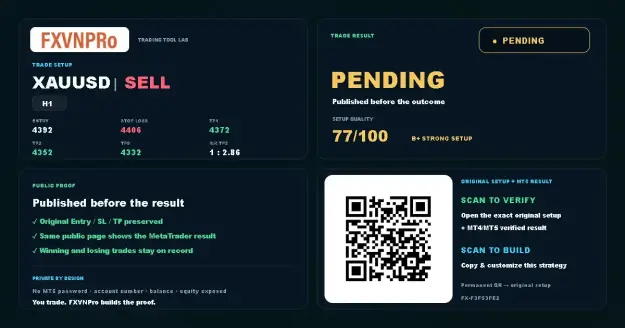 1 · SETUP
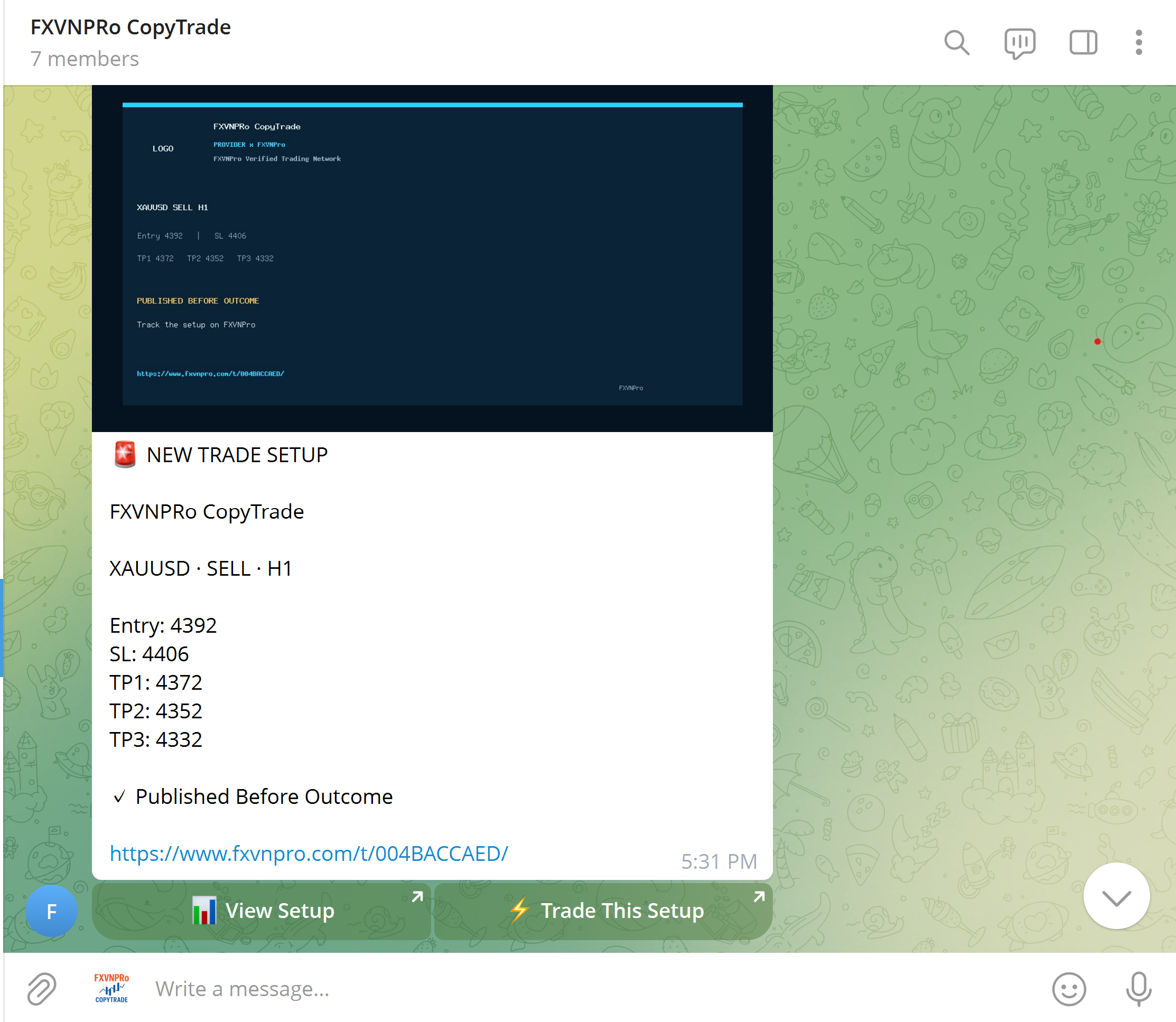 2 · TELEGRAM
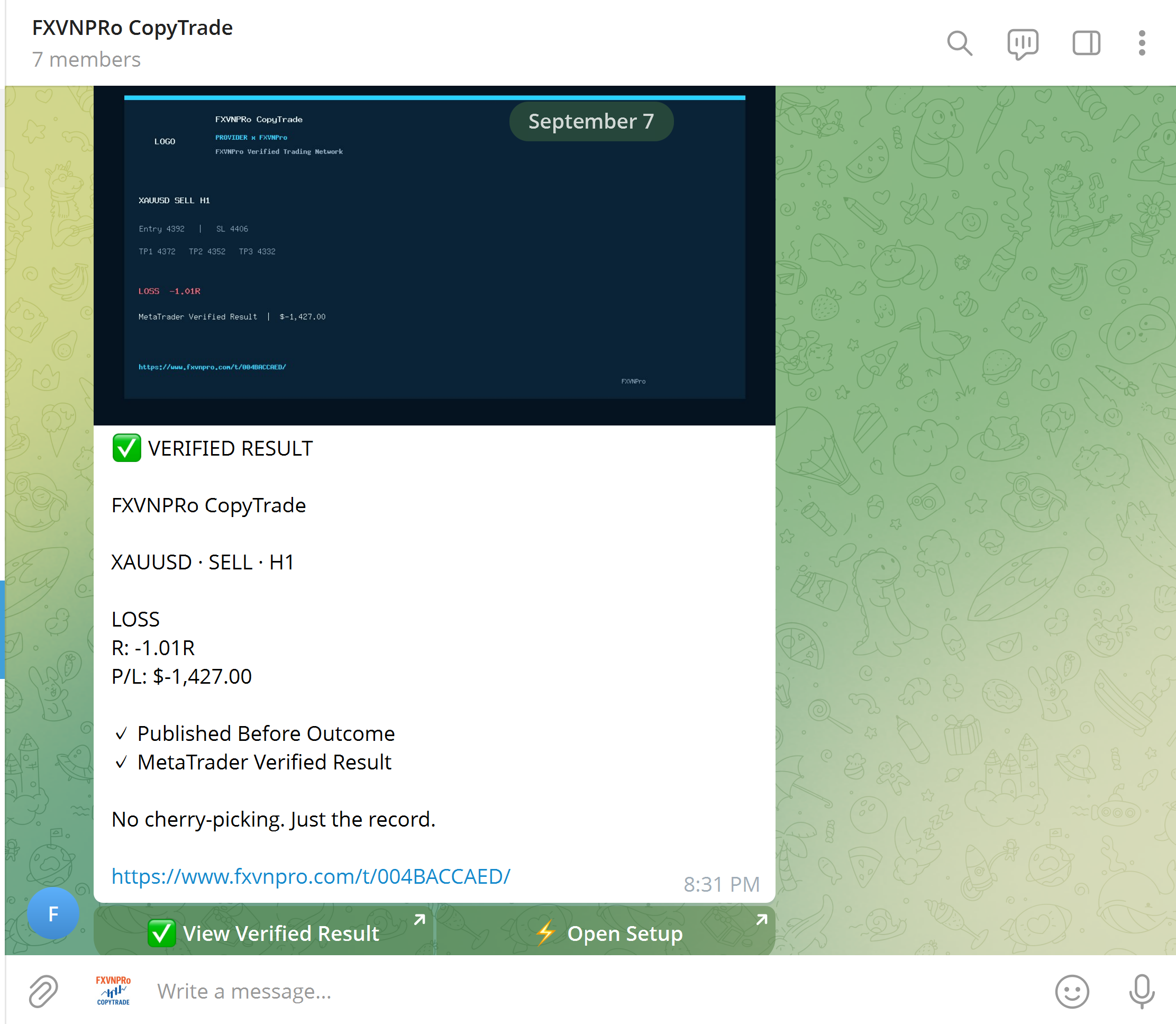 3 · VERIFIED
FXVNPro connects trade plans, Telegram trading communities and verified CopyTrade activity in one practical MT4/MT5 ecosystem.
Turn Entry, Stop Loss and Targets into a trade plan. Publish it before the outcome, then track and verify the result.
Turn Telegram signals into actionable MT4/MT5 setups. Signal Admins create the strategy while Members stay in control of risk.
Discover TRADERs, inspect verified trading history and performance, then decide who you want to follow across MT4 & MT5.
Build your strategy, distribute it to a community, or follow trading activity across MT4 & MT5.
Create Entry, Stop Loss and Targets before the outcome, then build a verified trading record.
Turn Telegram signals into an actionable workflow while followers keep control of their own risk.
Connect Chrome to MT4 or MT5 and open, modify or close trades from your browser.
Explore Masters and copy trading activity to your own MT4 or MT5 terminal with independent risk rules.