

OCTA
FVP Score
6.6/10
OCTA
- Minimum Deposit$25
- RegulationFSC, FSCA, CySEC, MISA
- PlatformsMT4, MT5
- SpreadFrom 0.1 pips
Start with your goal. You do not have to learn the FXVNPro architecture before using the tools.
Build an idea, use Telegram signals, trade from Chrome or follow a trader while technical setup stays in the background.
Technical connection details remain available inside each product when needed.
Compare OCTA and XM by rating, regulation, minimum deposit, platforms, spreads, and overall trading conditions.
Use the FXVNPro Broker Checker Chrome extension to quickly review broker trust signals, ratings, and safety information while browsing broker websites.

| Feature | OCTA | XM |
|---|---|---|
| Rating | 6.6 | 7.1 |
| Minimum Deposit | $25 | $5 |
| Regulation | FSC, FSCA, CySEC, MISA | CySEC, ASIC, IFSC |
| Platforms | MT4, MT5 | MT4, MT5 |
| Spread | From 0.1 pips | From 0.6 pips |
Below is a detailed breakdown of fees, spreads, regulation, platforms, and real trading suitability to help you decide which broker fits your trading style better.
I’ll be blunt: most traders don’t lose money because they can’t pick a strategy. They lose because the broker’s trading conditions silently tax every attempt—through spreads that widen at the wrong time, execution quirks during volatility, or “small” frictions like minimum deposit rules and withdrawal bottlenecks. And when you’re running a plan that relies on tight risk controls, those costs compound fast.
This OCTA vs XM comparison is for traders who actually trade. If you scalp, day trade, or you’re just trying to build consistency, you’ll care about spreads and trading costs first. If you’re new, you’ll care about deposit/withdrawal friction and how smooth the platforms feel. And if you’re managing bigger size, regulation and safety become non-negotiable.
Here’s the quick snapshot: OCTA starts with a higher minimum deposit ($25 vs $5) but advertises tighter spreads (from 0.1 pips). XM starts lower on the account entry ($5) but lists spreads from 0.6 pips. Both offer MT4 and MT5, and both sit under well-known regulatory umbrellas—OCTA with FSC/FSCA/CySEC/MISA, while XM holds CySEC/ASIC/IFSC.
By the end, you’ll have a clearer answer to which broker is better for your style—because “best” isn’t universal. It depends on what you do in live market conditions.
Let’s talk spreads and trading costs in a way that matches real trading. A broker advertising “from 0.1 pips” sounds great—until you ask, “from” what conditions, and “how often” do I actually see that number?
OCTA lists spreads from 0.1 pips. On paper, that’s a massive advantage if you trade EUR/USD, GBP/USD, or liquid Connects during active hours. But spreads aren’t static; they breathe with market liquidity. In the real world, your average spread matters more than the headline. If your average spread ends up only slightly better than the other broker, that still improves your win-rate buffer. If it’s meaningfully tighter, it improves your ability to scalp or keep tighter stops without getting clipped.
XM lists spreads from 0.6 pips. That’s a wider baseline. For swing traders running stops of 30–100 pips, 0.5 pips difference may be noise. For day traders trading intraday ranges of 5–20 pips, it’s not. It changes whether a “small loser” becomes a “forced exit.”
Now the common confusion: “spread-only” vs commission. In your provided data, we only have spreads, not commissions or swaps. That means we can’t claim one is universally cheaper on a fully loaded cost basis. However, in practical terms, if both brokers have similar commission structures (or both operate as spread-based accounts), the spread difference becomes the dominant factor.
For example: suppose you open and close the same Connect 20 times in a week. A 0.5 pip spread advantage on each round-trip can add up quickly. Over months, that’s not a rounding error—it’s the difference between “strategy performs” and “strategy dies under costs.” This is why spreads and trading costs are usually the first thing I compare when deciding OCTA vs XM.
Regulation isn’t just a list of acronyms—it’s about enforcement culture, oversight, and how confident you should be that the broker is required to operate under meaningful rules. In forex, that matters because you’re not only trading price; you’re trading execution integrity and account handling.
OCTA is regulated by FSC, FSCA, CySEC, and MISA. That’s a broad footprint. CySEC is generally respected in Europe, while FSCA is a well-known South African regulator. The FSC and MISA add more regional coverage. What I look for, beyond the names, is whether the broker has to maintain segregated funds (or equivalent protections), follow client money rules, and submit to regular reporting. You can’t assume all regulators provide identical investor protections, but multiple layers of oversight is usually a positive sign.
XM is regulated by CySEC, ASIC, and IFSC. ASIC is often seen as strict and compliance-heavy, and CySEC again anchors credibility for many EU clients. IFSC adds an additional jurisdiction layer.
Here’s the point most traders miss: verification and compliance affect operational stability. A broker that’s properly supervised is less likely to treat your account like an afterthought when markets get messy. And markets do get messy—NFP, CPI, big rate events. In those moments, execution speed, slippage behavior, and dispute handling become more than technical details.
So which is “safer”? With only the provided regulator list, I won’t invent certainty. But between these two, both appear to operate under notable oversight. If you’re prioritizing regulation as a key decision factor for which broker is better, both can fit, yet your emphasis might shift back to costs and execution style—because safety won’t help if the pricing you receive doesn’t match your strategy.
Both OCTA and XM offer MT4 and MT5. That matters because it keeps your workflow familiar. If you already code indicators, use EAs, or rely on chart templates, you’re not forced into a whole new ecosystem.
In real trading, the platform experience isn’t only about charts. It’s about how smoothly orders are handled when the market moves fast. MT4/MT5 are stable, but brokers can still influence execution quality through their server setup, liquidity routing, and how quickly the platform reflects price changes.
MT5 is often preferred by traders who use more advanced backtesting or want additional order types and features. But even then, your live performance depends on the broker’s handling of market data and order execution. For example, you might backtest a scalping EA with consistent spreads and then run it live and discover your fills are worse during news windows. That difference is usually not “MT5 vs MT4.” It’s the broker’s real-world execution.
Trading tools also matter, but in a practical way. Do you get economic calendar visibility? Are order tickets simple? Does the broker’s environment feel consistent across both MT4 and MT5? These are the small frictions that can cost you when you’re managing multiple positions at once.
From a trader’s standpoint, OCTA’s tighter spreads (from 0.1 pips) suggest it could be more supportive for strategies sensitive to entry costs. XM’s wider spread baseline may still work for many traders, especially if you trade fewer times per day or use wider stop logic. Still, execution speed and slippage behavior under stress are what you should verify with a demo and then a small live test—because “platform offered” isn’t the same thing as “platform performs.”
Deposits and withdrawals sound boring until you’re in a live drawdown and you need to add margin or you want to pull profits. Then it becomes one of the most important parts of your broker selection.
OCTA’s minimum deposit is $25. XM’s is $5. That difference is meaningful for two groups: beginners testing the waters and traders who want to start small while they validate spreads and execution. If you’re comparing OCTA vs XM on “which broker is better,” this is one of the early deciding factors for traders who don’t want to lock more capital than necessary.
But minimum deposit is only half the story. Withdrawals and processing times are where friction shows up. Even if a broker supports many payment methods, the practical experience can vary—verification steps, statement requirements, and how quickly funds move back to your original payment source.
In real trading, I’ve seen traders get delayed at the exact moment they needed funds. Sometimes it’s because of identity document mismatches. Sometimes it’s because a broker requests additional verification after deposits, especially if the activity changes (new region, new payment method, larger withdrawal). You can’t control that, but you can reduce the odds by choosing a broker with a smoother account lifecycle.
So what should you do? Treat the first deposit like a test: verify your documents early, test withdrawals with a small amount once you have a profit buffer, and keep an eye on what the broker asks for. This matters because the “true risk” isn’t only market volatility—it’s also operational delay.
If your priority is low-friction onboarding, XM’s $5 minimum deposit is a clear advantage. If you’re comfortable with $25 and you want tighter spreads potential, OCTA’s entry requirement is less of a deal-breaker.
Beginner traders usually focus on features: leverage, charting, indicators, maybe bonus programs. But if you’ve ever watched a new trader try to learn risk management, you know the real issue is confusion under pressure. When price moves quickly, they need a broker that makes the mechanics feel straightforward.
XM’s $5 minimum deposit is psychologically and financially easier. You can start small, learn how spreads affect your entries, and test execution with minimal damage. That matters because beginners often overtrade early. A tight minimum deposit reduces the “cost of learning.”
OCTA’s minimum deposit is higher at $25. That’s not huge, but it does raise the stakes for someone who’s still building the discipline to follow a plan. On the other hand, OCTA’s advertised spreads from 0.1 pips could be beneficial for beginners who trade small ranges and want cleaner fills. If your strategy depends on quick entries/exits, the difference between 0.1 and 0.6 pips is noticeable.
Here’s the beginner reality: most new traders won’t immediately optimize order placement or avoid volatile news windows. They’ll hit the market when they feel confident, then wonder why their backtest doesn’t match live results. That mismatch is often costs + spreads, not “bad trading.” So the broker you choose can either help you learn faster or frustrate you.
Also consider regulation visibility. Both brokers list reputable regulators. That’s helpful for beginners because it reduces the chance of unpleasant surprises.
So which is better for beginners? If you want the easier start and lower initial commitment, XM is the more beginner-friendly entry point. If you’re willing to deposit $25 and you want the potential for tighter spreads, OCTA can also work well—but you’ll be more exposed to learning costs upfront.
Active traders don’t just care about spreads—they care about how spreads behave when things get loud. And they care about execution consistency, because a scalping edge can be erased by repeated slippage or widening spreads at the wrong second.
OCTA’s spreads “from 0.1 pips” immediately puts it in the conversation for scalpers and day traders. In real intraday conditions, that can mean more flexibility with stop placement and more realistic break-even thresholds. When you trade multiple times per day, cost per round trip becomes the real metric, not the headline spread.
XM’s spreads “from 0.6 pips” suggests higher baseline friction. That doesn’t automatically disqualify day traders—it just means your strategy must be built around it. If your average target is larger (say 30–80 pips) and you trade fewer times, XM can still fit. But if you run a tight mean reversion system aiming for small moves, that 0.5 pip difference can be the difference between consistent grading and grind losses.
There’s also the issue of execution speed and slippage. Even if both brokers offer MT4/MT5, actual order routing can differ. Active traders should test during the sessions they trade. For example, if you trade London open and NY overlap, do a demo test and record typical spreads and slippage on market orders and limit orders. You want to know whether spreads jump around, whether your orders fill at expected levels, and whether your platform gets delayed during spikes.
Tools matter more for active traders too: alerts, copy trading limitations (if you use it), economic calendar integration, and the ease of managing orders quickly. In practice, traders don’t have time to wrestle with order tickets.
If you’re choosing OCTA vs XM for active trading, OCTA is the more natural fit based on the tighter spread profile. XM can still work, but your strategy has to tolerate higher trading costs.
Let’s make it practical: if your trading style involves many entries and tight targets, the spreads and trading costs matter more than almost anything else. If your style is less frequent and targets are wider, XM’s higher baseline spread may be manageable—especially if you value low minimum deposit and a simpler start.
If you force me to answer “which broker is better” without pretending one size fits all, here’s the clean recommendation based on the data you provided and how traders actually feel costs in live markets.
Choose OCTA if you’re active and cost-sensitive. The advertised spreads from 0.1 pips give OCTA the edge for scalpers, day traders, and anyone running a plan where 0.5 pips repeatedly matters. Connect that with the multiple-regulator footprint and you get a broker that’s more aligned with traders who measure performance down to the last pip. Just don’t skip the boring part: test average spreads and execution quality during your normal trading sessions.
Choose XM if you want the easiest entry and lower initial commitment. The $5 minimum deposit is a real advantage for beginners and traders who want to validate conditions with minimal capital. If your strategy targets larger moves, XM’s from 0.6 pip spreads may be acceptable. Also, XM’s regulation list includes ASIC and CySEC, which adds credibility for many traders who prioritize compliance.
My decision rule is simple: if you trade frequently and your edge is tight, OCTA wins on spreads and trading costs. If you’re still learning, building discipline, and you prefer a low-friction start, XM is the better starting point.
Whatever you pick in OCTA vs XM, do one small live test after demo—because the market doesn’t care what a broker advertises. It only cares what you actually get filled at.
One real XAUUSD trade: created before the outcome, sent to Telegram, TRADEd in MT5 and returned as a verified result.
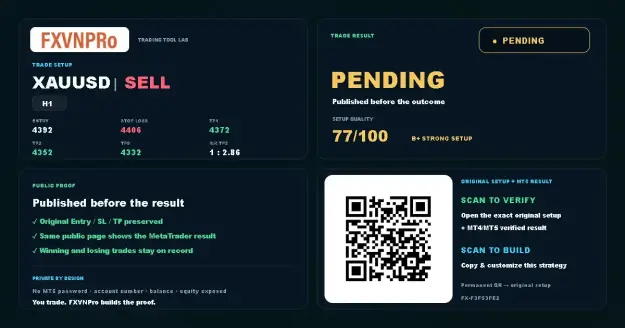 1 · SETUP
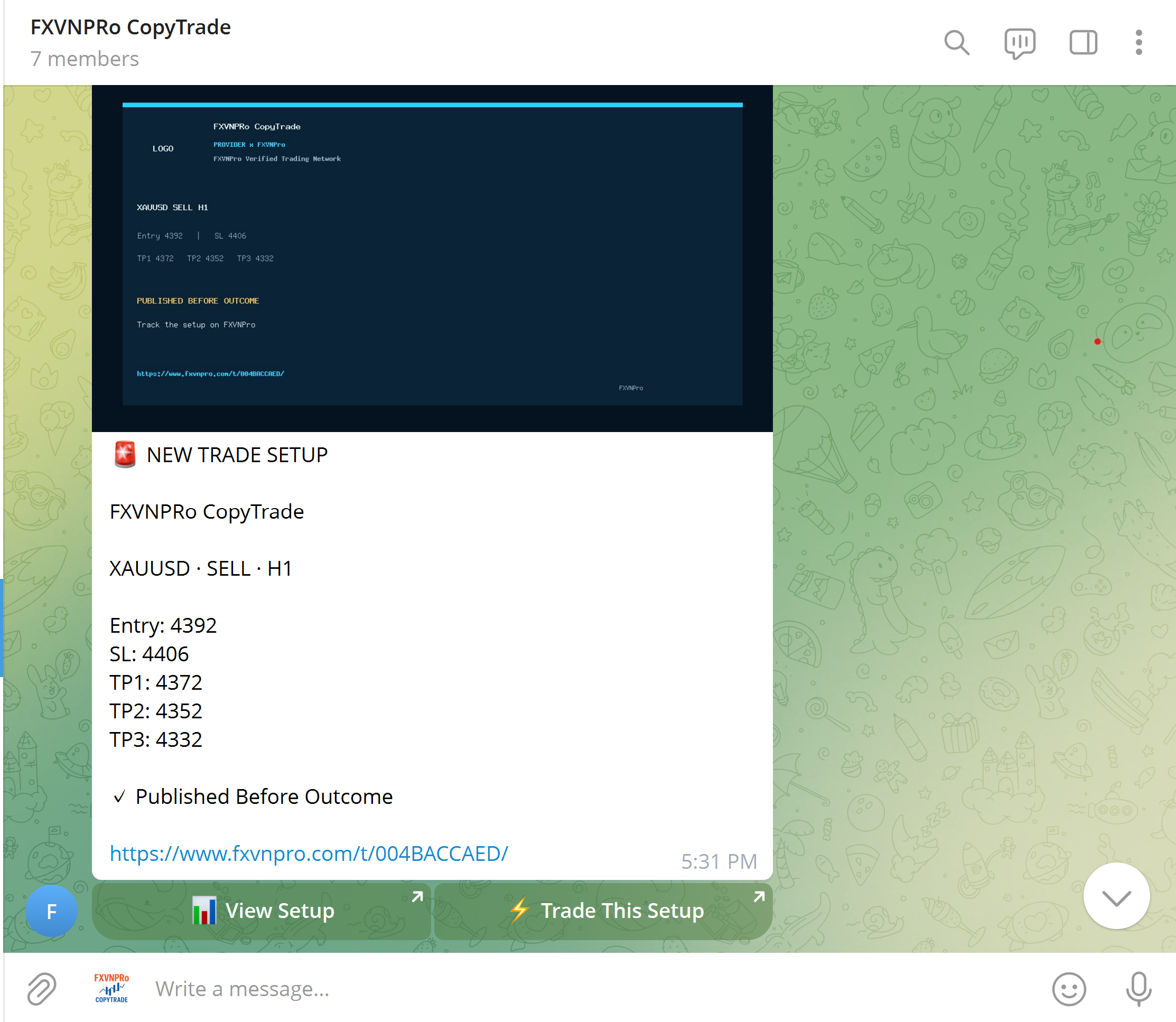 2 · TELEGRAM
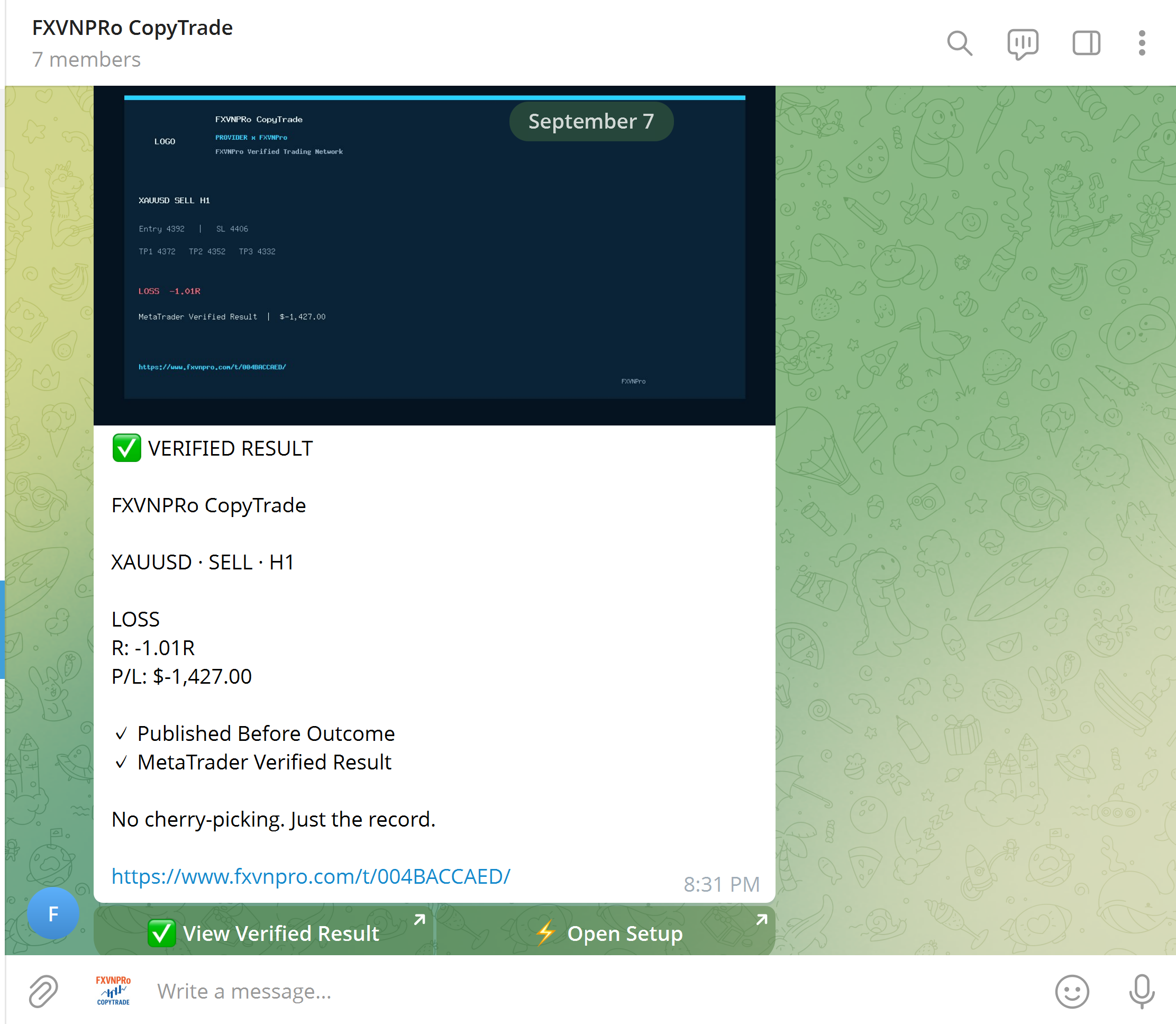 3 · VERIFIED
FXVNPro connects trade plans, Telegram trading communities and verified CopyTrade activity in one practical MT4/MT5 ecosystem.
Turn Entry, Stop Loss and Targets into a trade plan. Publish it before the outcome, then track and verify the result.
Turn Telegram signals into actionable MT4/MT5 setups. Signal Admins create the strategy while Members stay in control of risk.
Discover TRADERs, inspect verified trading history and performance, then decide who you want to follow across MT4 & MT5.
Build your strategy, distribute it to a community, or follow trading activity across MT4 & MT5.
Create Entry, Stop Loss and Targets before the outcome, then build a verified trading record.
Turn Telegram signals into an actionable workflow while followers keep control of their own risk.
Connect Chrome to MT4 or MT5 and open, modify or close trades from your browser.
Explore Masters and copy trading activity to your own MT4 or MT5 terminal with independent risk rules.