

OCTA
FVP Score
6.6/10
OCTA
- Minimum Deposit$25
- RegulationFSC, FSCA, CySEC, MISA
- PlatformsMT4, MT5
- SpreadFrom 0.1 pips
Start with your goal. You do not have to learn the FXVNPro architecture before using the tools.
Build an idea, use Telegram signals, trade from Chrome or follow a trader while technical setup stays in the background.
Technical connection details remain available inside each product when needed.
Compare OCTA and Vantage Markets by rating, regulation, minimum deposit, platforms, spreads, and overall trading conditions.
Use the FXVNPro Broker Checker Chrome extension to quickly review broker trust signals, ratings, and safety information while browsing broker websites.

| Feature | OCTA | Vantage Markets |
|---|---|---|
| Rating | 6.6 | 6.5 |
| Minimum Deposit | $25 | $50 |
| Regulation | FSC, FSCA, CySEC, MISA | ASIC, FSCA, VFSC |
| Platforms | MT4, MT5 | MT4, MT5,cTrader,TradingView |
| Spread | From 0.1 pips | From 1.0 pips |
Below is a detailed breakdown of fees, spreads, regulation, platforms, and real trading suitability to help you decide which broker fits your trading style better.
If you’ve ever looked at two brokers on paper and thought, “It’s basically the same,” I get it. Most forex broker pages are built to confuse you with features. But in day-to-day trading, the stuff that actually matters is usually narrower: spreads and trading costs, how reliably orders fill, and whether your broker’s regulation gives you a safety net when things get messy.
In this OCTA vs Vantage Markets comparison, I’m going to focus on the decisions that cost traders money: fees comparison in real scenarios, spreads and trading costs during volatile sessions, and what regulation means when you need to move funds or resolve an issue. I’ll also touch trading experience—because platform comfort and execution behavior can be the difference between sticking with a strategy or abandoning it after a bad month.
Quick summary: OCTA starts from tighter spreads (from 0.1 pips) and has a lower minimum deposit ($25). Vantage Markets has a higher minimum deposit ($50) and wider spreads (from 1.0 pips), but it offers more platform variety (MT4, MT5, cTrader, TradingView) depending on what style you trade.
Who should care most? If you scalp, trade news, or run high-frequency strategies, spreads and execution speed matter more than almost anything else. If you’re building consistency as a newer trader, starting costs, platform usability, and friction in deposits/withdrawals will weigh more heavily. Let’s dig in.
Let’s talk trading costs the way a trader experiences them: not as a number on a webpage, but as repeated friction. The headline spread matters, but the effective cost matters more. “From 0.1 pips” or “from 1.0 pips” tells you where pricing can start—yet real trading conditions (London open, US news, holiday liquidity) decide where your fills actually come from.
OCTA spreads and cost profile: with spreads from 0.1 pips and platforms MT4/MT5, the cost structure is built for traders who care about entry precision. If you’re running a strategy where your edge is small—think mean reversion on a 5-minute chart—tight spreads reduce the number of trades that break even just to cover transaction costs.
Vantage Markets spreads and cost profile: spreads from 1.0 pips and platforms including MT4/MT5/cTrader/TradingView. The wider “from” spread doesn’t automatically mean you’ll lose more—sometimes brokers make up for it through other pricing mechanics (like commissions), but based on the data provided, the straightforward expectation is higher spread-based cost, especially on short holding periods.
Real-world example: imagine you trade EUR/USD 40 times a week with an average spread difference of even 0.5–0.8 pips. Over a month, that can become a non-trivial chunk of your P&L—particularly if your strategy targets 5–10 pip moves. This matters because most traders don’t lose on “one big mistake.” They bleed slowly through costs.
Hidden fees? The biggest “hidden” for most retail traders is not a mysterious withdrawal charge—it’s widening spreads during volatile moments plus any commission/markup structure (not specified in the data you provided). If you want an apples-to-apples fees comparison, the key is to measure average spread on your instruments at the times you actually trade. That’s where OCTA vs Vantage Markets usually separates in practice.
Regulation is one of those topics traders either overthink or ignore completely. Both are dangerous. The point isn’t to worship a regulator’s name—it’s to understand how likely you are to get proper oversight if something goes wrong (withdrawals delayed, account issues, dispute resolution).
OCTA regulation: OCTA is listed with FSC, FSCA, CySEC, and MISA. That multi-regulator footprint can be reassuring because different jurisdictions apply different requirements around segregation of client funds, risk controls, and complaint handling. CySEC (in particular) is widely recognized in Europe, and FSCA is a known South African regulator. The practical takeaway? You generally get more structured oversight compared to brokers with lighter regulatory presence.
Vantage Markets regulation: Vantage Markets is listed with ASIC, FSCA, and VFSC. ASIC is often viewed as one of the stricter regulators, especially in terms of compliance expectations. VFSC is also a regulator, though the level of perceived investor protection can vary by region and specific broker setup.
Verification matters: what you should verify before depositing is not just “which regulators are listed,” but whether your account is actually held under the entity that is regulated in your region. Traders get burned when marketing lists multiple regions but the account they opened belongs to a different entity or has different terms.
So which broker is “safer”? Based on the regulator mix, both sound credible. But for many traders, the real safety difference shows up in how cleanly the broker’s processes map to your country and whether you can escalate issues without getting stuck in procedural limbo. Safety isn’t a vibe—it’s the ability to resolve problems quickly.
Platforms are where execution speed and usability show up indirectly. You can have the best spreads in the world, but if the platform is clunky, charts are laggy, or order handling is annoying, your trading experience suffers—and your performance follows.
OCTA platforms: MT4 and MT5 only. For many professional traders, MT4/MT5 is the “known quantity.” Indicators, EAs, and custom tools are everywhere. If you already trade with MT4/MT5 automation, OCTA fits neatly into that ecosystem. The simpler platform lineup can also mean fewer moving parts and less learning curve if you’re already fluent.
Vantage Markets platforms: MT4, MT5, cTrader, and TradingView. This matters because cTrader tends to feel more modern for certain charting and order workflows, and TradingView is a big deal for traders who start with ideas on charts first and TRADE from there. If you’re trading manually and you care about chart layout and drawing tools, having TradingView can streamline your process.
Execution speed and slippage: neither broker’s data here confirms latency metrics, and slippage depends heavily on liquidity conditions and your order type (market vs limit). In real trading conditions—especially around news—your order type and timing matter as much as the broker.
Here’s the trader question: what do you actually use day to day? If your strategy is MT4/MT5 centric, OCTA’s setup is straightforward. If you rely on TradingView for analysis or prefer cTrader’s order interface, Vantage Markets can reduce workflow friction. That friction reduction is real money over months, even when spreads look similar on paper.
People talk about spreads, but withdrawals are where calm confidence is tested. A broker can offer tight pricing and still frustrate you if deposits take forever, fees are unclear, or withdrawal processing drags on.
OCTA minimum deposit: $25. That lower barrier matters for beginners and for traders who want to test the waters with a smaller risk budget. In real life, you don’t always start with full size. Sometimes you deposit, run a demo/low-risk period, and only then scale.
Vantage Markets minimum deposit: $50. Not extreme, but higher. It can matter if you’re connection your first live deposit with a strict risk plan. If you’re building discipline, you don’t want to feel pressured to “use the whole deposit” because it’s already sitting there.
Speed and fees: the data you provided doesn’t include specific deposit/withdrawal times or fees. So rather than pretending, I’ll give you the practical approach I use: look for (1) supported payment methods in your country, (2) any stated withdrawal fees, and (3) whether the broker uses “processing time” versus “bank time” wording. This matters because a withdrawal can be marked “processed” while your bank/transfer network takes additional days.
Real-world scenario: suppose you hit a good week and want to withdraw. If your withdrawal method is slow or if you need extra verification steps, you may end up delaying risk reduction. That delay can turn a planned move into accidental overexposure.
Between OCTA and Vantage Markets, the cleaner decision point from your data is the minimum deposit: OCTA is easier to start small. But the withdrawal experience is something you should confirm directly for your region and payment method before choosing which broker is better for your setup.
For beginners, it’s not about squeezing 0.1 pips versus 1.0 pips forever. Early on, you’re learning position sizing, managing emotions, and not overtrading. Still, your broker can either support that learning curve or add unnecessary obstacles.
OCTA for beginners: the lower minimum deposit ($25) is a big psychological win. It allows a smaller “mistake budget.” Also, MT4/MT5 are widely used and have countless tutorials and community examples. If a beginner gets stuck, they’re more likely to find help for MT4/MT5 issues than for niche platform workflows.
Vantage Markets for beginners: the broader platform lineup (including TradingView and cTrader) can help beginners because TradingView is visually friendly and often easier for chart-based learners. But the $50 minimum deposit means you start with more capital tied up. That can be good if you’re disciplined, and stressful if you’re not.
What matters more than features: in real trading conditions, beginners lose money because of poor execution timing, confusion around order types, and inconsistent fills during volatility. Platform clarity and order handling matter here. If a beginner accidentally places a market order during a news spike, spreads and slippage can make the trade look “random.” It isn’t random—it’s cost + volatility.
So which broker is easier to start? If you’re starting small and you’re planning to follow MT4/MT5 learning resources, OCTA’s $25 minimum and tight starting spreads are a practical advantage. If you’re more chart-first and want TradingView from day one, Vantage Markets can feel smoother—just be mindful of the higher starting deposit.
Active traders live and die by execution quality. That means spreads and trading costs are only one side of the coin; the other side is how consistently the broker handles fast entries/exits and how often you experience ugly fills during fast markets.
OCTA for active trading: spreads from 0.1 pips are exactly what scalpers and short-term day traders look for. With MT4/MT5, you can automate, run multiple charts, and manage complex trade logic. This matters because high-frequency strategies are extremely sensitive to average cost per trade. A few extra pips of spread across hundreds of trades can wipe out an edge that looked profitable in backtests.
Vantage Markets for active trading: the spread “from 1.0 pips” is the immediate concern for strategies that target small moves. That said, Vantage Markets gives active traders more platform choice—cTrader and TradingView can be valuable if your workflow demands speed in charting, order ticket management, or signal execution.
Day trading scenario: picture a trader executing during the London session, switching between Connects, and relying on tight spreads to keep the risk-reward ratio intact. If average spreads are meaningfully wider at the times you trade, your stop-outs increase and your take-profit hit rate can drop—not because your analysis is wrong, but because the market is taking your spread first.
Without specific commission data and without measured slippage stats, the safer conclusion is based on spreads alone: OCTA is more aligned with scalping and high-volume trading in the information provided. Vantage Markets can still work for day traders, but you’ll want to confirm average spread and any additional cost components on your exact instruments and trading hours before committing serious volume.
If you’re asking which broker is better in the most practical sense—“where will my trading costs likely be lower and my workflow likely match my strategy?”—the answer leans toward OCTA for most active traders, mainly because of the tighter spreads from 0.1 pips and the lower minimum deposit ($25). For scalpers and day traders, that matters because small edges get consumed by transaction costs. You want pricing that doesn’t fight your setup.
But if your priority isn’t spread micro-optimization and instead you care about tools and workflow—especially if you trade using TradingView signals or you prefer cTrader’s interface—then Vantage Markets can be the better match. It’s not that it’s “worse,” it’s that the provided spread starting point (from 1.0 pips) suggests higher cost friction for strategies targeting small moves.
Clear recommendations:
Before you commit, do one simple test: trade the same Connect(s) you use most, at the same times, for a week or two on a small account. That’s the fastest way to turn “OCTA vs Vantage Markets” from a guess into a decision you can stand behind.
One real XAUUSD trade: created before the outcome, sent to Telegram, TRADEd in MT5 and returned as a verified result.
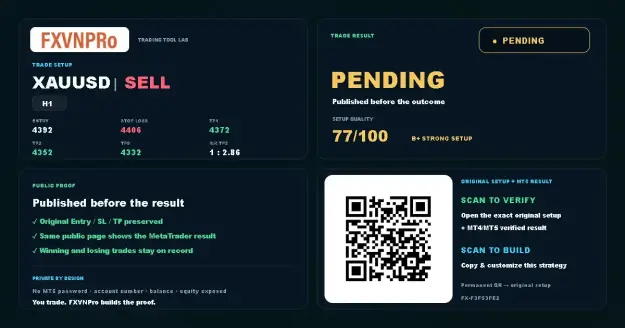 1 · SETUP
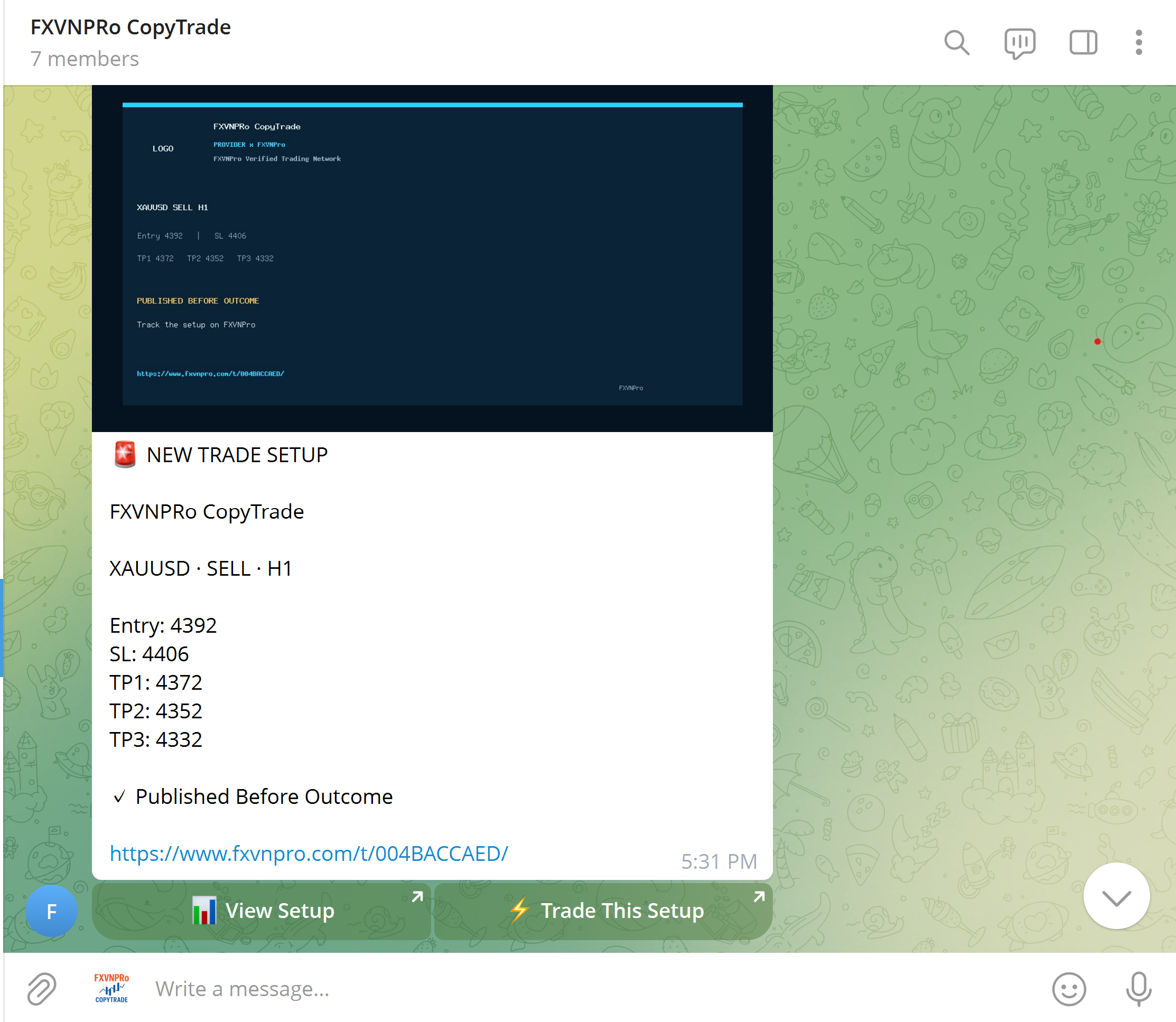 2 · TELEGRAM
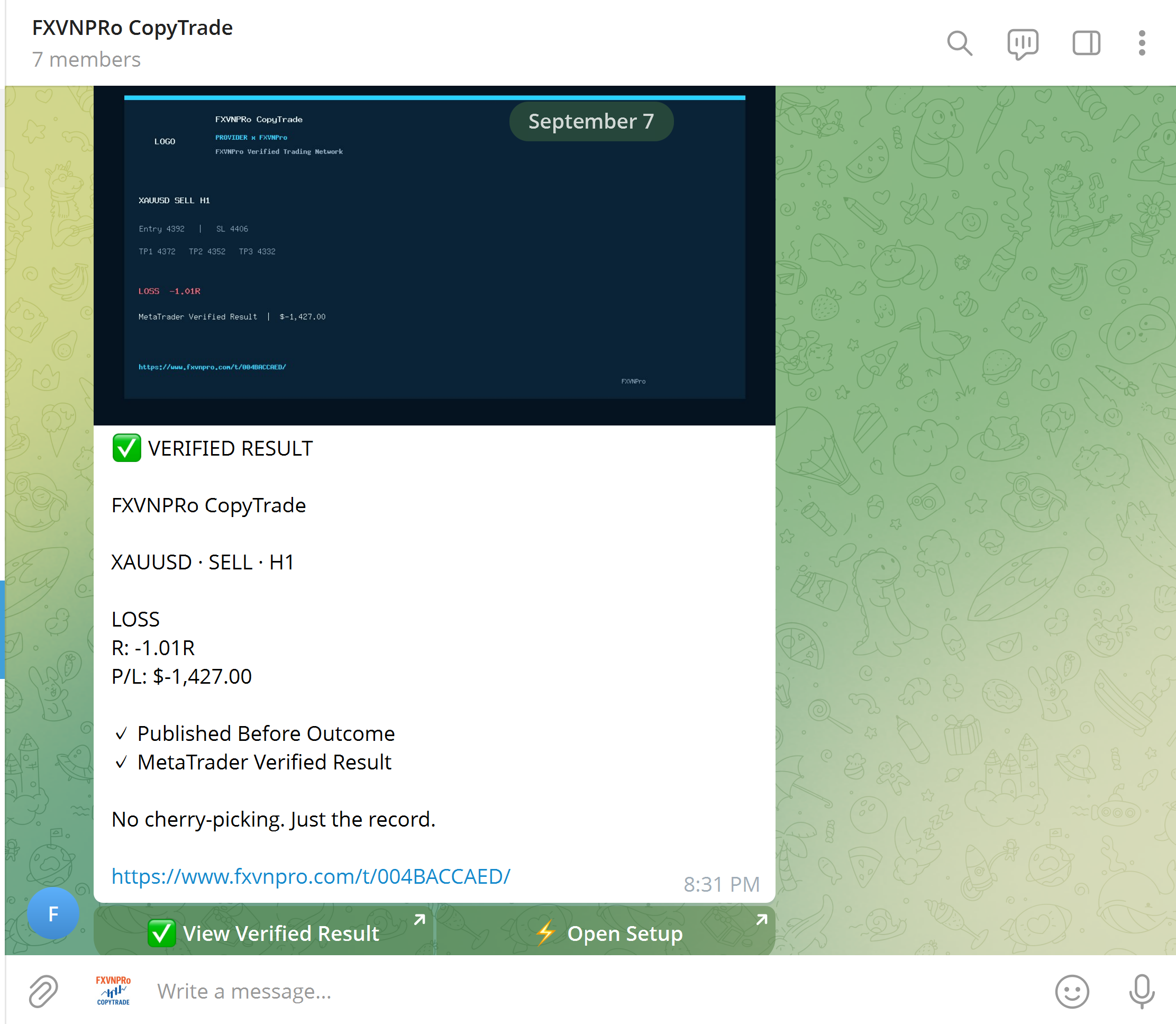 3 · VERIFIED
FXVNPro connects trade plans, Telegram trading communities and verified CopyTrade activity in one practical MT4/MT5 ecosystem.
Turn Entry, Stop Loss and Targets into a trade plan. Publish it before the outcome, then track and verify the result.
Turn Telegram signals into actionable MT4/MT5 setups. Signal Admins create the strategy while Members stay in control of risk.
Discover TRADERs, inspect verified trading history and performance, then decide who you want to follow across MT4 & MT5.
Build your strategy, distribute it to a community, or follow trading activity across MT4 & MT5.
Create Entry, Stop Loss and Targets before the outcome, then build a verified trading record.
Turn Telegram signals into an actionable workflow while followers keep control of their own risk.
Connect Chrome to MT4 or MT5 and open, modify or close trades from your browser.
Explore Masters and copy trading activity to your own MT4 or MT5 terminal with independent risk rules.