Plan a Trade
Build a trade plan and use practical trading tools before you act.
Trade IdeasRisk ToolsCalculators
BUILD A TRADE IDEA →
Start with your goal. You do not have to learn the FXVNPro architecture before using the tools.
Build an idea, use Telegram signals, trade from Chrome or follow a trader while technical setup stays in the background.
Technical connection details remain available inside each product when needed.
Plan trades, connect MT4 & MT5, review verified execution, explore traders and research brokers — without learning the whole platform first.
Build a trade plan and use practical trading tools before you act.
Use Browser Trading or turn supported Telegram signals into a structured trading workflow.
Explore CopyTrade TRADERs, review their records and choose your own risk settings.
Everything is still here — organized by what it helps you do.
Compare PU PRIME and Vantage Markets by rating, regulation, minimum deposit, platforms, spreads, and overall trading conditions.
Use the FXVNPro Broker Checker Chrome extension to quickly review broker trust signals, ratings, and safety information while browsing broker websites.


| Feature | PU PRIME | Vantage Markets |
|---|---|---|
| Rating | 6.8 | 6.5 |
| Minimum Deposit | $20 | $50 |
| Regulation | ASIC, FSA | ASIC, FSCA, VFSC |
| Platforms | MT4, MT5 | MT4, MT5,cTrader,TradingView |
| Spread | From 0.1 pips | From 1.0 pips |
Below is a detailed breakdown of fees, spreads, regulation, platforms, and real trading suitability to help you decide which broker fits your trading style better.
When you’re trading live, the difference between brokers isn’t in the homepage claims—it’s in the stuff that hits your P&L every day: spreads, execution quality, deposit friction, and whether your platform actually behaves when volatility spikes. That’s why this PU PRIME vs Vantage Markets comparison matters. Two brokers can both offer MT4/MT5 and “tight spreads,” but your trading costs and experience can diverge fast once you start placing real orders.
If you’re a retail trader testing strategies, you probably care about minimum deposit and platform usability. If you’re an active trader—scalping, day trading, or running high-frequency entries—then spreads and execution speed become the whole story. And for anyone focused on risk management, regulation and account safety aren’t “nice to have.” They’re the foundation.
Quick snapshot: PU PRIME has a lower minimum deposit ($20) and advertises spreads from 0.1 pips, while Vantage Markets starts from $50 and lists spreads from 1.0 pips. Both offer MT4 and MT5, with Vantage adding cTrader and TradingView. Regulation is listed as ASIC and FSA for PU PRIME, and ASIC, FSCA, VFSC for Vantage.
So which broker is better? Let’s break it down in a way that mirrors how trading actually goes—where costs stack, where slippage shows up, and where “small” differences become big decisions.
Let’s talk spreads and trading costs, because in forex the spread is basically the first “tax” you pay each time you enter. PU PRIME advertises spreads from 0.1 pips. Vantage Markets advertises spreads from 1.0 pips. On paper, that’s a massive gap. But here’s the practical question: are those numbers realistic during the times you actually trade?
In real trading conditions, spreads widen during major news releases, rollovers, and low-liquidity sessions. If you scalp or do tight-range mean reversion, the broker offering the lower “from” spread can help—but only if execution doesn’t degrade at the same time. If slippage is frequent, the “cheap spread” can disappear into worse fills. This matters because your strategy edge is usually thin; the broker cost becomes the difference between consistent small wins and recurring stop-outs.
Now add the hidden angle: commission vs spread structure. Both brokers in your provided data list spreads but don’t specify commission here. Some brokers run near-zero spreads with commission; others widen spreads and keep commission low. Without commission figures, I’d treat the spread headline as the primary cost indicator, but I’d still verify the actual contract specs in your account type.
Scenario: imagine you take 50 trades a week on EUR/USD. If the typical effective spread at your entry time is closer to 1.0 pip on one broker and 0.3–0.5 on the other, that’s not “micro.” It can easily swing weekly results. The fees comparison you should care about is the one that matches your frequency.
Based strictly on the available spread data, PU PRIME looks cheaper for spreads and trading costs, especially for traders who place frequent orders. Vantage may still be worth it if execution and platform fit your workflow better—but on pure spread economics, PU PRIME has the advantage.
Regulation isn’t just a logo on a website. It affects oversight, complaint handling, and how brokers are expected to manage client funds and risk. Both brokers list ASIC as part of their regulation footprint, which is a meaningful signal for trader confidence. ASIC is known for being fairly serious about market integrity and consumer protections.
PU PRIME lists ASIC and FSA. The tricky part is that “FSA” can refer to different entities depending on the country context, and traders should verify which specific authority applies to the entity they’ll open an account with. Still, the presence of ASIC is the strongest point in PU PRIME’s safety story from the data you shared.
Vantage Markets lists ASIC, FSCA, and VFSC. The addition of FSCA (South Africa) and VFSC (Vanuatu) suggests the broker operates across multiple jurisdictions. In practice, the safest feeling comes from understanding the exact regulator tied to your account’s legal entity. Why does that matter? Because when something goes wrong—delays, disputes, or operational failures—you want the correct regulator and complaint process behind your account, not a vague “we’re regulated somewhere.”
Real-world trading scenario: say you’ve been profitable for months and you want to withdraw after a strong run. The difference between a smooth withdrawal workflow and weeks of back-and-forth can be the difference between staying calm and getting stressed at the worst time.
Safety isn’t only regulation, either—execution integrity, transparency of trading conditions, and responsiveness during volatility matter. But regulation is your first checkpoint. If you’re deciding which broker is better for risk comfort, both have ASIC listed, while Vantage adds more jurisdictions. Still, you should confirm the exact regulated entity for your country before you deposit—this is the part most traders skip, and it’s the part that matters most.
Both PU PRIME and Vantage Markets offer MT4 and MT5. For most experienced traders, that’s enough to start: MT4 for the classic charting + EA world, MT5 for more modern order types and built-in features. But when you’re trading frequently, the platform experience becomes personal. Do you hate the way order tickets behave? Does your indicator update reliably? Does the terminal feel stable during news spikes?
Vantage Markets goes further by including cTrader and TradingView. This can matter a lot depending on how you trade. TradingView is excellent for charting, screening, and strategy planning. Being able to go from idea to execution without feeling like you’re switching “universes” can save time and reduce mistakes. cTrader, in my experience, often feels smoother for order management and provides a different execution workflow than MT terminals.
PU PRIME sticks to MT4/MT5 in your data. That’s not a negative by itself. If your whole routine is built around MT4/MT5, EAs, and familiar indicator setups, you might actually prefer the simplicity. Fewer platforms can mean fewer “quirks” to learn.
Execution speed and usability are where traders notice differences. In fast markets, the platform has to handle rapid order placement cleanly. If you’re scalping, you also care about how the platform displays spreads, how it handles partial fills, and whether your modifications are rejected or delayed.
So which broker is better for trading experience? If you rely heavily on TradingView and want more than MT4/MT5, Vantage has the edge. If you’re already deep in MT4/MT5 EAs and you don’t need extra chart ecosystems, PU PRIME may feel just as “enough” to get started—especially if the spreads align with your strategy.
Depositing is easy until it isn’t. The reality is that withdrawal timing, required documents, and funding method fees can become a serious issue when you’re trading actively. If you’re profitable and want to pull money out consistently, you don’t want financial processes to interrupt your routine.
Minimum deposit is one of the clearest differences you provided: PU PRIME at $20 versus Vantage Markets at $50. That alone changes who can realistically start. If you’re testing with a smaller account, PU PRIME is less demanding. But minimum deposit is only the entry point. The bigger question is what happens after you win.
In real trading, I’ve seen traders get stuck not because the broker “refused” withdrawals, but because withdrawals became slow due to verification cycles or mismatched account details. Some brokers also process differently depending on whether you used card, bank transfer, e-wallets, or local methods. Your real experience will depend on the funding rails available in your region.
So when comparing deposits and withdrawals, think beyond cost and into operational friction. Ask yourself: will you be able to withdraw after 1–2 weeks of trading if you’re trying to track performance? Or will you need to wait until your account reaches a certain condition?
PU PRIME’s lower minimum deposit suggests it may be friendlier for smaller accounts and early testing. Vantage’s higher minimum deposit isn’t automatically a problem—it could reflect different account types or internal policies—but it does mean you need more capital committed upfront.
Bottom line: based on the data, PU PRIME is easier to start financially. For withdrawal experience, you’ll need to check your region’s funding methods and the account verification steps, because that’s where traders usually feel the difference.
For beginners, the best broker isn’t the one with the most features—it’s the one that lets you learn without your mistakes costing too much. You’ll likely trade fewer times at first, but you’ll still be sensitive to spreads when you’re learning entry/exit timing. If you place trades and the spread is consistently wide, your losses feel unfair. That’s demoralizing.
PU PRIME’s lower minimum deposit ($20) lowers the barrier to entry. That matters if you’re building confidence and want to keep risk controlled while you learn how orders, stop-losses, and take-profits really behave. Also, spreads from 0.1 pips look attractive for beginners because the cost of experimentation can stay lower.
Vantage Markets starts at $50, which is higher. For some new traders, $30 difference doesn’t matter. For others, it’s the difference between starting immediately and waiting. Vantage’s platform variety—TradingView and cTrader—can also help beginners because charting and analysis are easier when the tool matches how you think.
However, here’s the part beginners often overlook: switching platforms can be confusing. If you’re brand new and you open a TradingView chart, then you need to TRADE in cTrader or MT, you’ll spend time figuring out “how” rather than focusing on “why” your trade is working or not.
So which broker is better for beginners? If you’re starting small and want tighter spreads right away, PU PRIME is likely the more accessible choice. If you strongly prefer TradingView charting and want a broader toolset from day one, Vantage can feel more intuitive. But if you’re unsure, the lower minimum deposit plus the better spread headline gives PU PRIME a clearer learning advantage.
Active traders don’t just “like” tight spreads. They live or die by trading costs and fill quality. If you’re scalping, even a 0.5 pip difference can represent a meaningful portion of your target profit. And if execution slips during high volatility, your setup can fail even when your analysis is correct.
Here, PU PRIME looks more favorable based on spread data: from 0.1 pips versus Vantage from 1.0 pips. For day traders running multiple entries per session, that spread gap can compound quickly. But again, check the reality: effective spreads are what matter—especially during London/NY overlaps and around news.
Vantage Markets has additional platform options, which can be beneficial for active execution. TradingView can support advanced chart workflows, while cTrader often appeals to traders who care about order handling and workflow speed. For scalpers, the ability to place and manage orders quickly is part of execution speed, not just network latency.
Execution speed and slippage are where brokers differentiate in practice. If one broker has slightly wider spreads but better liquidity routing and less slippage, the “from” spread number becomes less meaningful. On the flip side, if a broker advertises tight spreads but you see worse fills during your active hours, you’ll feel it immediately.
Scenario: you’re trading a momentum system with frequent entries around trend breaks. During a fast move, you place market orders and limit orders. If one broker consistently gives you better fills and tighter effective spreads, your win rate and expectancy improve. If not, your Risk / Reward shrinks.
Given only the provided spread data, PU PRIME is the more cost-efficient option for active traders. Vantage may still win if your personal experience shows better execution quality on your instruments, but on pure “spreads and trading costs,” PU PRIME has the edge.
For many traders, the biggest decision isn’t “which broker has more features.” It’s which broker matches your strategy costs and your day-to-day workflow. If your edge is tight, costs win the argument. If your edge depends on charting workflow and execution tools, platform fit matters more.
If you’re asking which broker is better in a straight line, based on the data you provided, PU PRIME edges it for most traders—mainly because of spreads and the lower minimum deposit. For cost-focused strategies (scalping, frequent day trading, tight-range systems), PU PRIME’s spreads from 0.1 pips are the most compelling difference. That’s the kind of advantage that shows up week after week in a fees comparison, even when your strategy is solid.
Vantage Markets is the better “workflow” choice for traders who want TradingView charting and cTrader execution alongside MT platforms. If you’re the type who plans in TradingView and TRADEs in a platform that feels smoother to you, that can matter as much as a pip here and there. But with spreads from 1.0 pips listed, you should be careful if you scalp or trade high frequency—unless your actual fills and slippage performance clearly offset those wider headline spreads.
Here’s the practical recommendation:
One last rhetorical question before you deposit: are you optimizing for the numbers you can see (like “from” spreads), or for the outcomes you actually get (effective spreads, slippage, and withdrawal experience)? The best decision is the one you can verify with a demo or a small live test—because that’s where PU PRIME vs Vantage Markets stops being a review and starts being your trading reality.
One real XAUUSD trade: created before the outcome, sent to Telegram, TRADEd in MT5 and returned as a verified result.
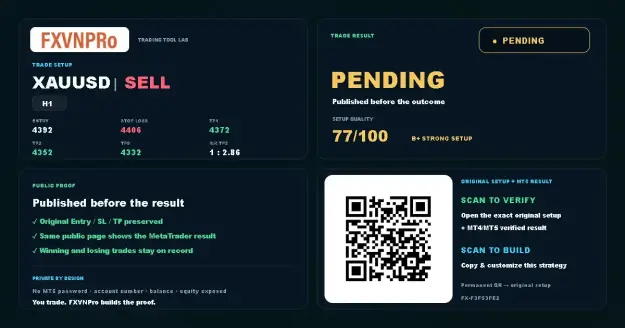 1 · SETUP
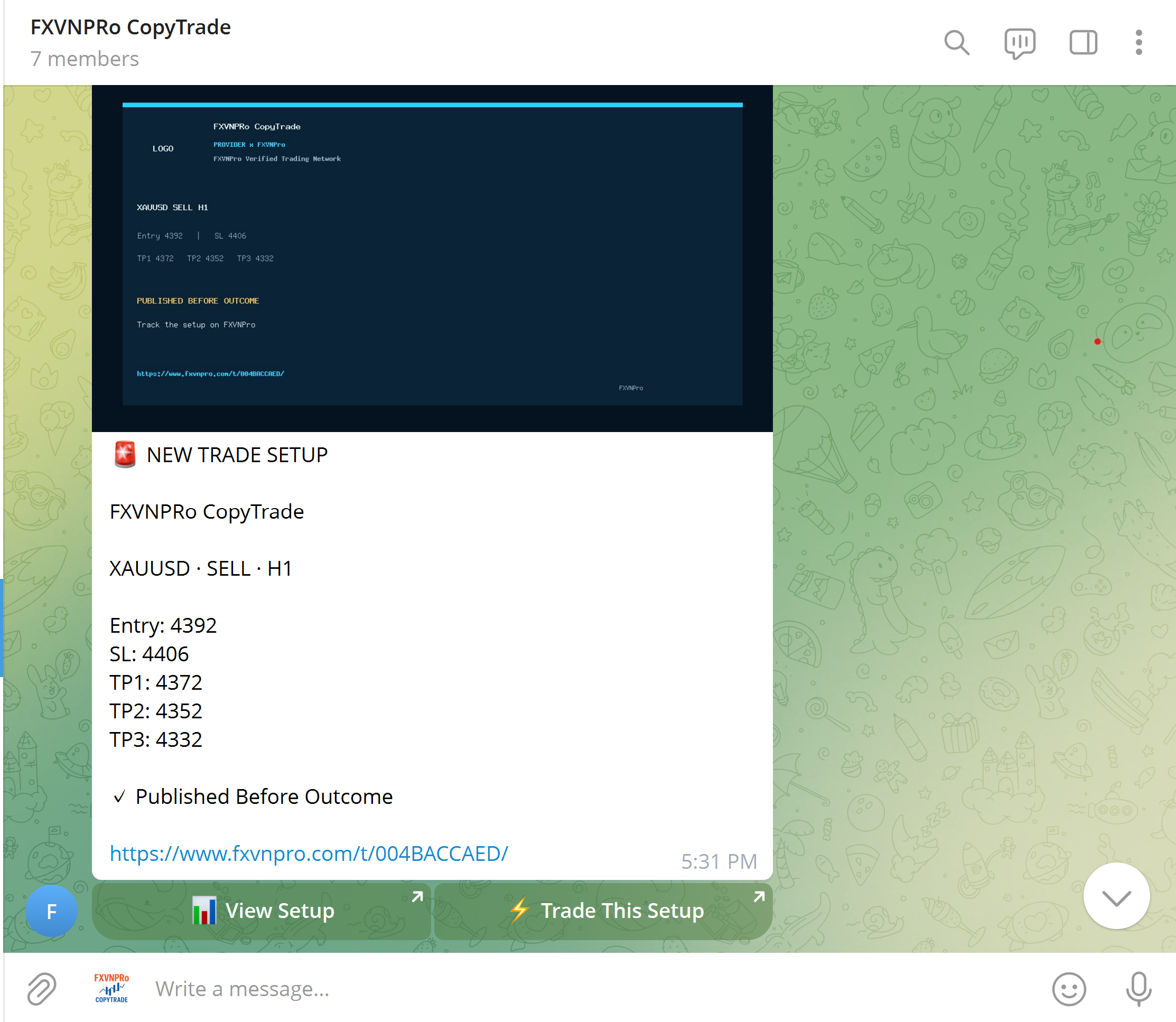 2 · TELEGRAM
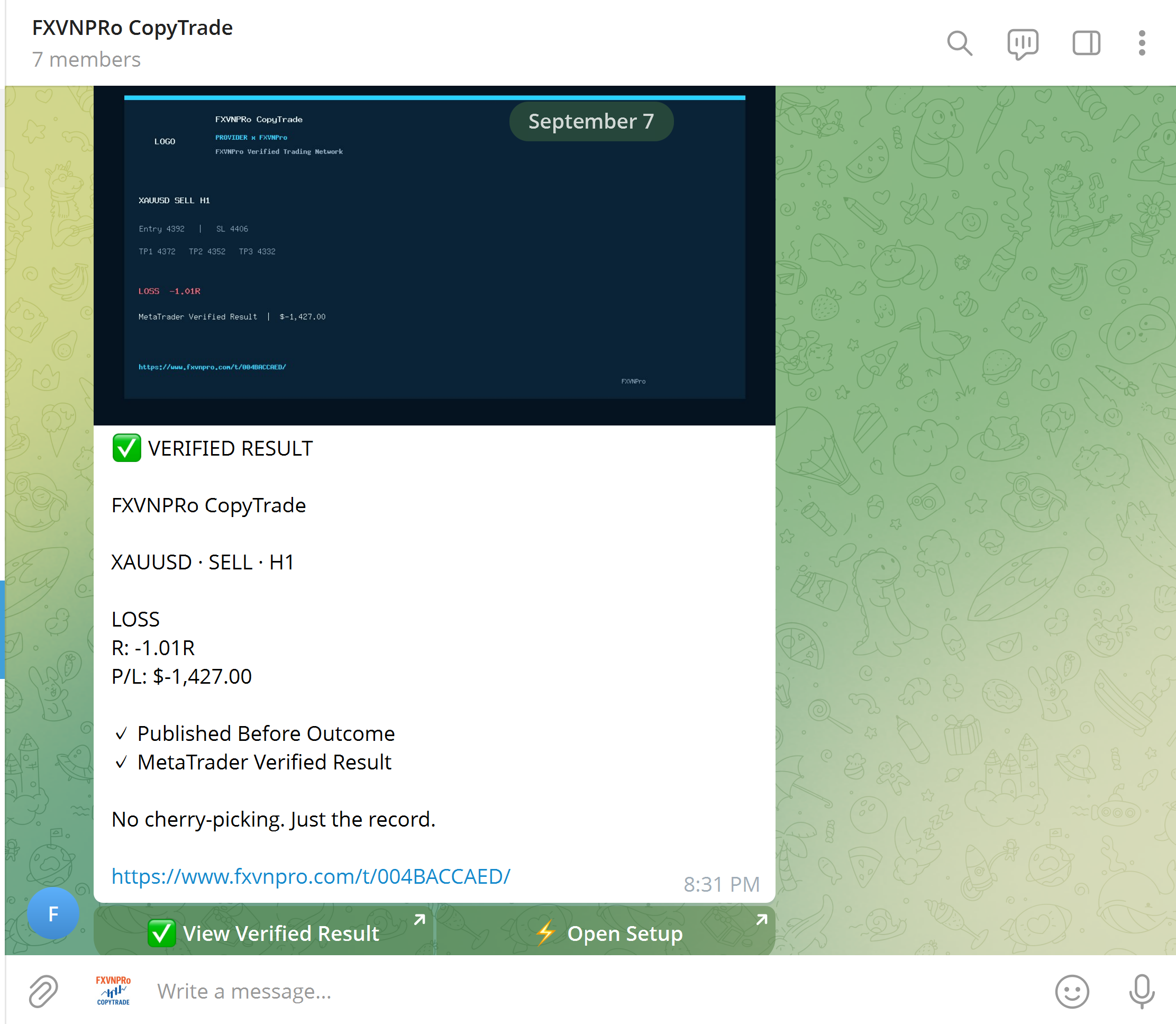 3 · VERIFIED
FXVNPro connects trade plans, Telegram trading communities and verified CopyTrade activity in one practical MT4/MT5 ecosystem.
Turn Entry, Stop Loss and Targets into a trade plan. Publish it before the outcome, then track and verify the result.
Turn Telegram signals into actionable MT4/MT5 setups. Signal Admins create the strategy while Members stay in control of risk.
Discover TRADERs, inspect verified trading history and performance, then decide who you want to follow across MT4 & MT5.
Build your strategy, distribute it to a community, or follow trading activity across MT4 & MT5.
Create Entry, Stop Loss and Targets before the outcome, then build a verified trading record.
Turn Telegram signals into an actionable workflow while followers keep control of their own risk.
Connect Chrome to MT4 or MT5 and open, modify or close trades from your browser.
Explore Masters and copy trading activity to your own MT4 or MT5 terminal with independent risk rules.