

PU PRIME
FVP Score
6.8/10
PU PRIME
- Minimum Deposit$20
- RegulationASIC, FSA
- PlatformsMT4, MT5
- SpreadFrom 0.1 pips
Start with your goal. You do not have to learn the FXVNPro architecture before using the tools.
Build an idea, use Telegram signals, trade from Chrome or follow a trader while technical setup stays in the background.
Technical connection details remain available inside each product when needed.
Compare PU PRIME and Tickmill by rating, regulation, minimum deposit, platforms, spreads, and overall trading conditions.
Use the FXVNPro Broker Checker Chrome extension to quickly review broker trust signals, ratings, and safety information while browsing broker websites.

| Feature | PU PRIME | Tickmill |
|---|---|---|
| Rating | 6.8 | 7.2 |
| Minimum Deposit | $20 | $50 |
| Regulation | ASIC, FSA | FCA, FSCA, CySEC |
| Platforms | MT4, MT5 | MT4, MT5 |
| Spread | From 0.1 pips | From 0.0 pips |
Below is a detailed breakdown of fees, spreads, regulation, platforms, and real trading suitability to help you decide which broker fits your trading style better.
If you’ve ever opened a “low spread” account, placed a trade, and then watched the price move just enough to widen your effective cost—yeah, that’s the moment brokers stop being marketing and start being math. The comparison “PU PRIME vs Tickmill” isn’t just about who advertises the tightest numbers. It’s about what you pay across dozens of trades, how reliably fills show up during busy sessions, and whether your platform experience helps you stay consistent (or constantly second-guess execution).
This is the kind of decision that matters most for traders who actively manage risk: scalpers, day traders, and anyone trading news windows. If you’re mostly placing a few swing trades per week, spreads still matter—but your overall cost will be less sensitive to micro-widening. If you’re hunting momentum intraday, cost and execution speed are the whole ball game.
Here’s the quick snapshot of the key differences. PU PRIME starts with a lower minimum deposit ($20) and offers spreads from 0.1 pips on MT4/MT5. Tickmill has a higher minimum deposit ($50), but advertises spreads from 0.0 pips and operates under FCA, FSCA, and CySEC regulation. Both provide MT4/MT5, but the “cheaper in real trading” question comes down to fees comparison and how spreads behave when liquidity thins.
Let’s talk fees comparison the way you actually experience them: not as a table, but as a P/L line that keeps getting nudged by costs. PU PRIME advertises spreads from 0.1 pips. Tickmill advertises spreads from 0.0 pips. Sounds simple—until you remember spreads aren’t the only ingredient. Commission (if applicable), swaps, and occasional widening during volatile moments can flip the outcome.
In real trading conditions, the “from” spread is usually a best-case reference. During London open or New York overlap, tight pricing can look great for both brokers. But when liquidity drops—late US afternoon, early Asian session, or around high-impact news—the effective spread tends to widen. This matters because your stop-loss distance doesn’t change, but your entry price does. Even a 0.2–0.5 pip difference can be meaningful when you’re trading frequently or using smaller stops.
Consider a practical example: you scalp EUR/USD with 0.5 pip to 1 pip targets. With spreads from 0.1 pips, PU PRIME may still be competitive if execution is clean and costs stay predictable. Tickmill’s “from 0.0 pips” can be attractive for high-frequency entries, especially if your strategy benefits from capturing small moves. Still, the deciding factor is the total cost per round turn—spread plus any commission or other execution-related charges.
So which is cheaper? In most trader-style scenarios where you’re sensitive to micro-costs, Tickmill often has the edge due to the headline spread advantage. But if PU PRIME’s execution remains stable and you’re trading with larger stops (less spread-sensitive), the cost gap may narrow quickly. The real question becomes: what does your backtest assume, and what does live trading actually charge you?
Regulation isn’t just a checkbox—it affects oversight, complaint handling, and the broker’s incentive to operate within rules. PU PRIME is listed under ASIC and FSA. Tickmill is regulated by FCA, FSCA, and CySEC. On paper, both offer respectable regulatory coverage, but the practical difference is how strict and visible enforcement tends to feel depending on the region and regulator.
Why does this matter for a trader? Because safety is not only about whether a broker “exists,” but whether it follows the procedures when things get messy—market volatility, client fund segregation expectations, and how disputes are handled. In real trading, you won’t test these systems often, which is exactly why verification matters. You want your broker to be the kind that’s incentivized to stay compliant even when your trading activity spikes or spreads move fast.
Also, regulation can influence the way execution and risk controls are structured. A well-regulated environment doesn’t magically prevent losses—trading is still trading—but it can reduce the odds of operational surprises. If you’ve ever tried withdrawing funds and had to chase confirmations, you know how much friction can matter.
Tickmill’s multiple EU/UK/Africa registrations (FCA, CySEC, FSCA) generally signal a broker that’s used to higher compliance expectations. PU PRIME’s ASIC/FSA listing is also meaningful, but if you’re choosing “which broker is better” for peace of mind, Tickmill’s broader regulatory footprint typically carries extra weight for many international traders.
None of this is a guarantee. But when you’re comparing brokers, regulation is one of the few variables you can evaluate before you risk a dollar.
Both PU PRIME and Tickmill offer MT4 and MT5. That’s important because it means you’re not locked into a proprietary platform. If you already have indicators, Trading Programs (Expert Advisors), or custom chart templates built around MT4/MT5, switching brokers is usually straightforward. From a trading experience perspective, that reduces friction.
But “same platform” doesn’t automatically mean “same experience.” What changes in practice is execution speed, quote stability, and how consistently the platform reflects real pricing under load. MT4/MT5 can look identical, yet the live feed quality and fill behavior can differ—especially during fast markets.
For example, if you run a moving-average crossover strategy on MT5 and trade around the London open, you care about whether the candle closes and fills align cleanly. If you use pending orders, you care about whether order activation and distance requirements are handled smoothly. If you’re using an EA, you care about slippage and whether trade requests are rejected during brief spreads spikes.
In usability terms, both platforms are mature. Most traders won’t find “missing features” that stop them. Where the real comparison shows up is in reliability during the busiest times. Tight spreads are only useful if they translate into consistent fills. Otherwise, your chart looks great and your results look… suspiciously worse.
If you’re choosing between PU PRIME and Tickmill purely for platform capability, it’s a near tie. The better “trader fit” comes from how execution behaves with your style—scalping, day trading, or swing trading—and how often you’ll be stressed by micro-latency.
Minimum deposit matters, but so does the “path” from deposit to usable balance. PU PRIME’s minimum deposit is $20, which makes it easier to test the waters without committing meaningful capital. Tickmill’s minimum deposit is $50, which is still reasonable, but it’s a bigger psychological step if you’re experimenting.
In real trading, withdrawals are where traders discover operational differences. Some brokers process quickly; others require extra verification steps; some have stricter documentation. Even if two brokers are both reputable, the day you request a withdrawal is when you find out how smooth their process really is.
Fees can also sneak in indirectly. Even when brokers don’t charge a withdrawal fee, your payment method might. Also, if you deposit via one route and withdraw via another, certain rails can cause delays or require additional compliance checks.
Think about a scenario: you deposit, trade a week, then withdraw after hitting a small profit target. If your broker is quick and the steps are clear, you’ll keep your routine stable. If it’s slow or unclear, you may hesitate to scale up—even if your trading edge is real.
From the data provided, we can’t confirm exact processing times or withdrawal fees. But we can say the practical friction factor: PU PRIME’s lower minimum deposit tends to attract trial-style trading, while Tickmill’s $50 entry often correlates with more “committed” account usage and typically more standardized onboarding for regulated regions.
If you’re the type who wants to keep risk minimal while you validate execution, PU PRIME’s $20 minimum is appealing. If you prefer a broker ecosystem that feels established across multiple regulators, Tickmill often feels more predictable operationally.
Beginners don’t lose only because of lack of strategy—they lose because of cost surprises, confusing execution, and emotional swings after bad fills. So when people ask “which broker is better” for a beginner, the answer is rarely about platform features. It’s about how forgiving the environment is while you’re still building consistency.
PU PRIME has the advantage on entry cost: a $20 minimum deposit lowers the barrier to learning. That matters because beginners often need multiple attempts—practice trades, strategy tweaks, and careful monitoring. With a smaller initial commitment, you can iterate without feeling like every mistake is too expensive.
Tickmill’s spreads from 0.0 pips sound great, but beginners should also understand that tight spreads won’t protect you from overtrading or entering at bad times. What tight pricing does help with is keeping your learning process cleaner—your stop-outs and small wins aren’t eaten as much by transaction costs.
Here’s the reality: beginners usually trade too often, too close to the spread, and with stops that aren’t calibrated. In that environment, even small differences in spreads and execution quality can compound into a frustrating experience. If Tickmill’s pricing tends to be more consistently tight, that can make the first months feel less punishing.
Still, if your budget is tiny and you need a low-stakes start, PU PRIME is easier to begin with. If your priority is minimizing trading costs while you practice intraday and you can handle a $50 minimum, Tickmill is likely the smoother path.
Active traders live and die by small edges. That’s why “spreads and trading costs” isn’t a minor detail—it’s the entire strategy. When you’re scalping, you’re not just buying the direction; you’re buying the timing and paying the spread on every attempt. That’s where PU PRIME vs Tickmill becomes more than preference.
Tickmill advertises spreads from 0.0 pips. Even if the “true” average includes moments of widening, the headline suggests a better potential cost structure for frequent entries. In fast sessions, that can matter a lot. If your average trade only nets a few pips, you don’t have room for inefficiencies.
But spreads alone don’t guarantee good scalping conditions. You also need dependable execution and low slippage. If a broker shows tight spreads but your fills slip frequently during high volatility, your edge gets eaten by execution variance. This is why execution speed and quote stability matter as much as the spread number.
Imagine two day traders both use the same strategy. Trader A trades 40 times a day. Trader B trades 10 times a day. Even if cost differences are small per trade, Trader A will feel it. That’s the “this matters because…” moment: the cost structure compounds with frequency.
For active traders, Tickmill generally fits better based on the spread profile and multi-regulator oversight. PU PRIME can still work if execution is stable and you manage your risk tightly, but if you’re scaling volume and rely on consistent low-cost fills, Tickmill’s setup is more aligned with that style.
PU PRIME pros: low minimum deposit ($20) makes testing easier; MT4/MT5 support for flexible strategy usage; spreads from 0.1 pips can be workable for many traders.
PU PRIME cons: headline spreads are slightly less aggressive than Tickmill’s “from 0.0 pips”; depending on execution behavior in fast markets, the effective cost may be less predictable for scalpers.
Tickmill pros: spreads and trading costs look potentially better for frequent trading (from 0.0 pips); stronger multi-regulator presence (FCA/FSCA/CySEC); MT4/MT5 support for serious workflows.
Tickmill cons: higher minimum deposit ($50) for beginners; tight spreads only help if execution quality and slippage stay consistent during volatility.
One more thing I’d mention as a pro trader: don’t choose a broker based solely on the minimum deposit or the lowest advertised spread. Test with a demo, then a small live account, and watch the numbers during the sessions where you actually trade.
If you forced me to pick “which broker is better” without hedging, I’d lean toward Tickmill for most traders who actively trade—especially day traders and scalpers. The logic is straightforward: spreads from 0.0 pips typically translate into lower transaction costs when you’re trading frequently, and that matters because your edge gets multiplied by execution quality. Add the multi-regulator setup (FCA, FSCA, CySEC), and Tickmill looks like the more robust choice for scaling up responsibly.
PU PRIME is the more approachable option if you’re cost-sensitive at the start. With a $20 minimum deposit and spreads from 0.1 pips, it can make sense for beginners who want to practice and learn without tying up capital. It can also fit traders who don’t rely on very tight stops or who trade less often, where spread differences matter less than overall strategy quality.
So here’s the clear split:
Choose PU PRIME if: you’re starting small, want a lower minimum deposit, and your strategy isn’t heavily dependent on ultra-tight spreads every trade.
Choose Tickmill if: you care about spreads and trading costs for active trading, want tighter headline spreads, and value stronger regulatory coverage across major jurisdictions.
Whatever you choose, do one live test in the exact hours you trade. Watch your average spread, look at real fills, and track slippage over a sample size. That’s how you turn “PU PRIME vs Tickmill” from a reading exercise into a decision you can actually defend.
One real XAUUSD trade: created before the outcome, sent to Telegram, TRADEd in MT5 and returned as a verified result.
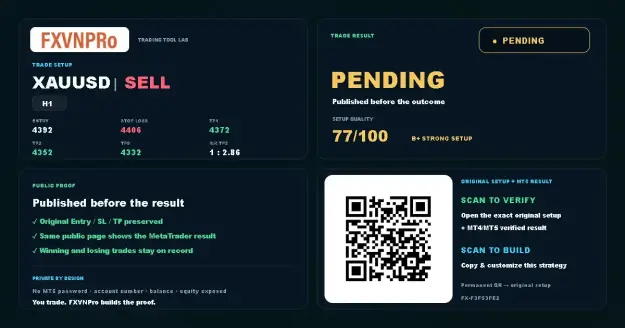 1 · SETUP
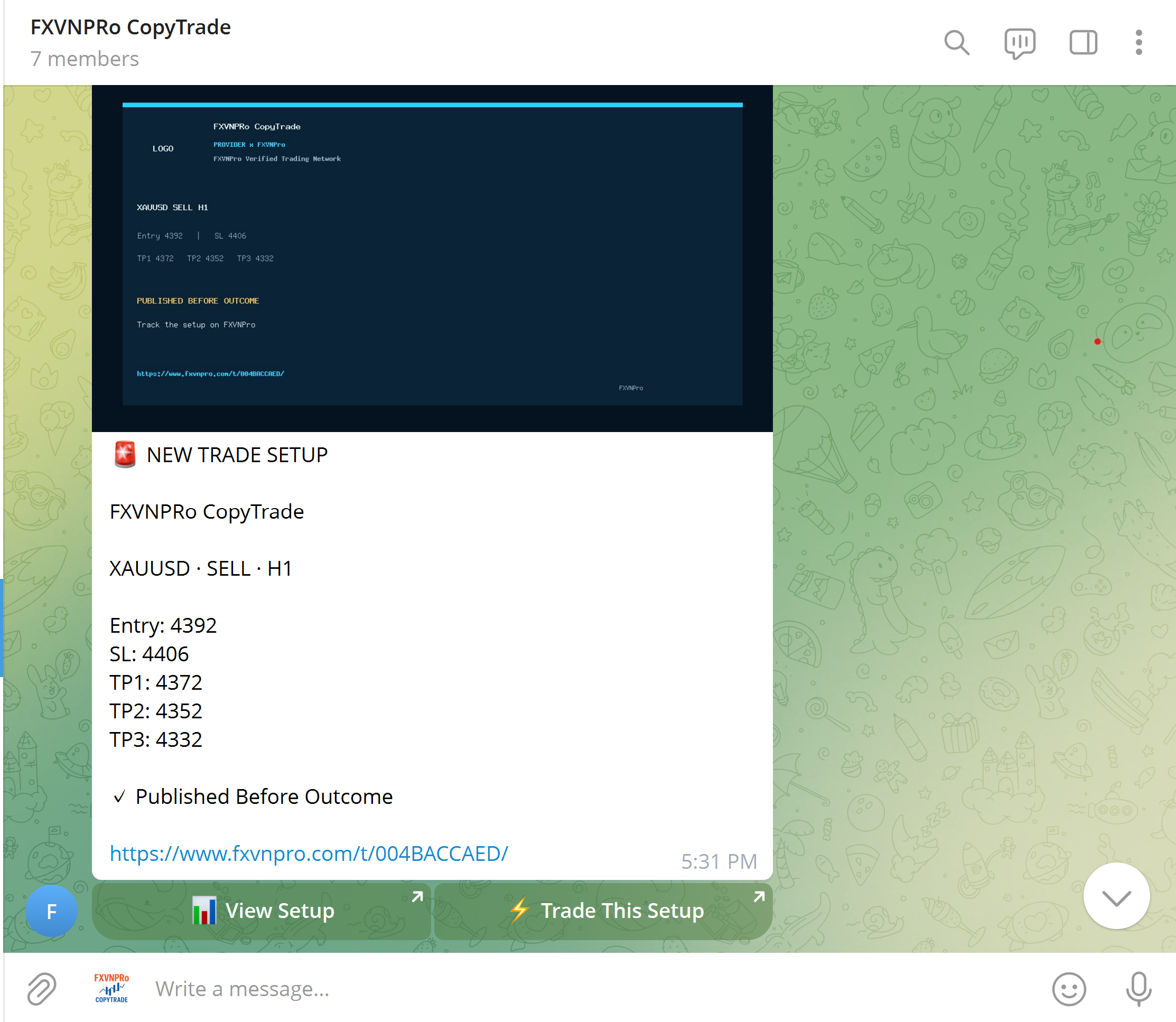 2 · TELEGRAM
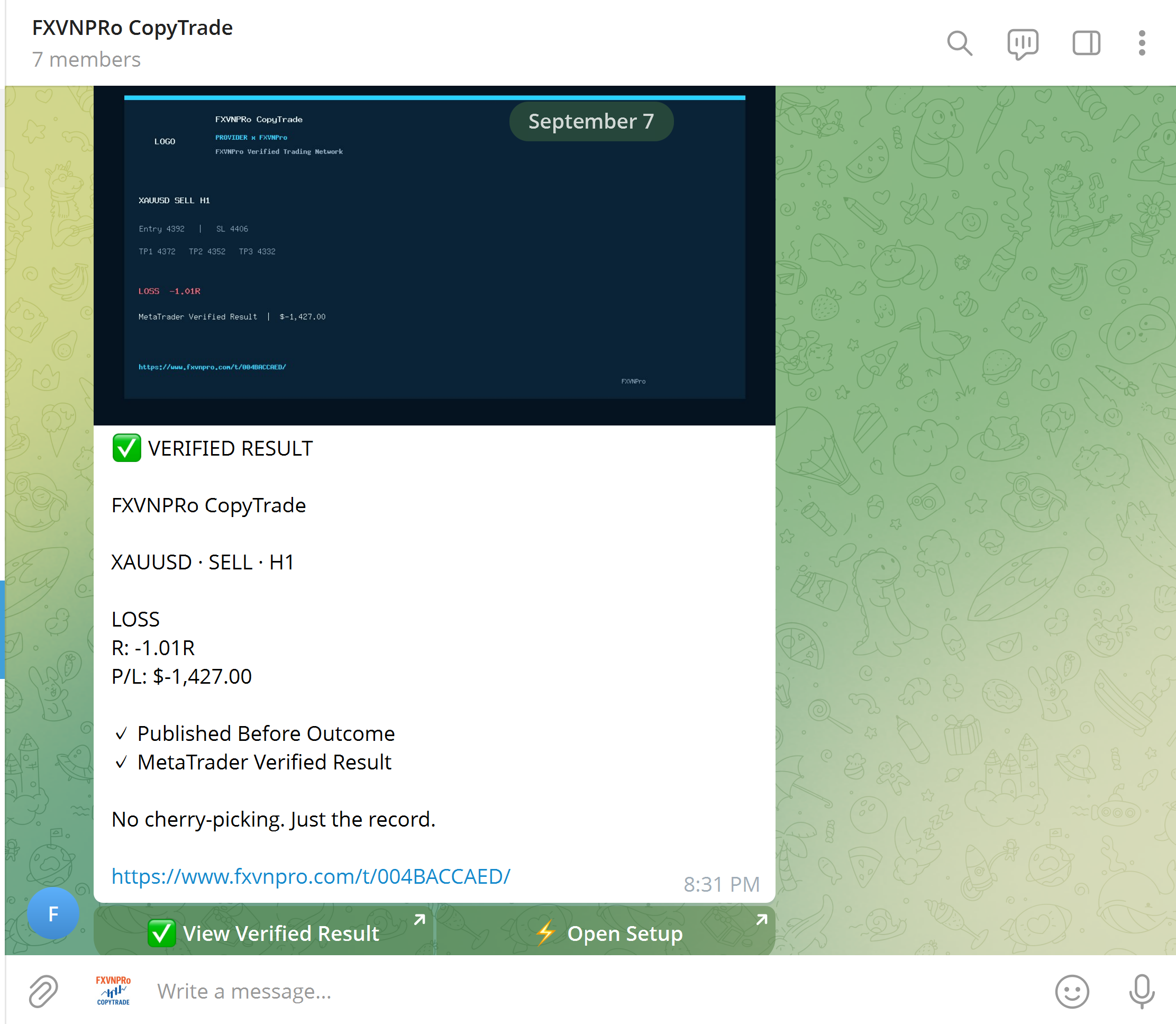 3 · VERIFIED
FXVNPro connects trade plans, Telegram trading communities and verified CopyTrade activity in one practical MT4/MT5 ecosystem.
Turn Entry, Stop Loss and Targets into a trade plan. Publish it before the outcome, then track and verify the result.
Turn Telegram signals into actionable MT4/MT5 setups. Signal Admins create the strategy while Members stay in control of risk.
Discover TRADERs, inspect verified trading history and performance, then decide who you want to follow across MT4 & MT5.
Build your strategy, distribute it to a community, or follow trading activity across MT4 & MT5.
Create Entry, Stop Loss and Targets before the outcome, then build a verified trading record.
Turn Telegram signals into an actionable workflow while followers keep control of their own risk.
Connect Chrome to MT4 or MT5 and open, modify or close trades from your browser.
Explore Masters and copy trading activity to your own MT4 or MT5 terminal with independent risk rules.